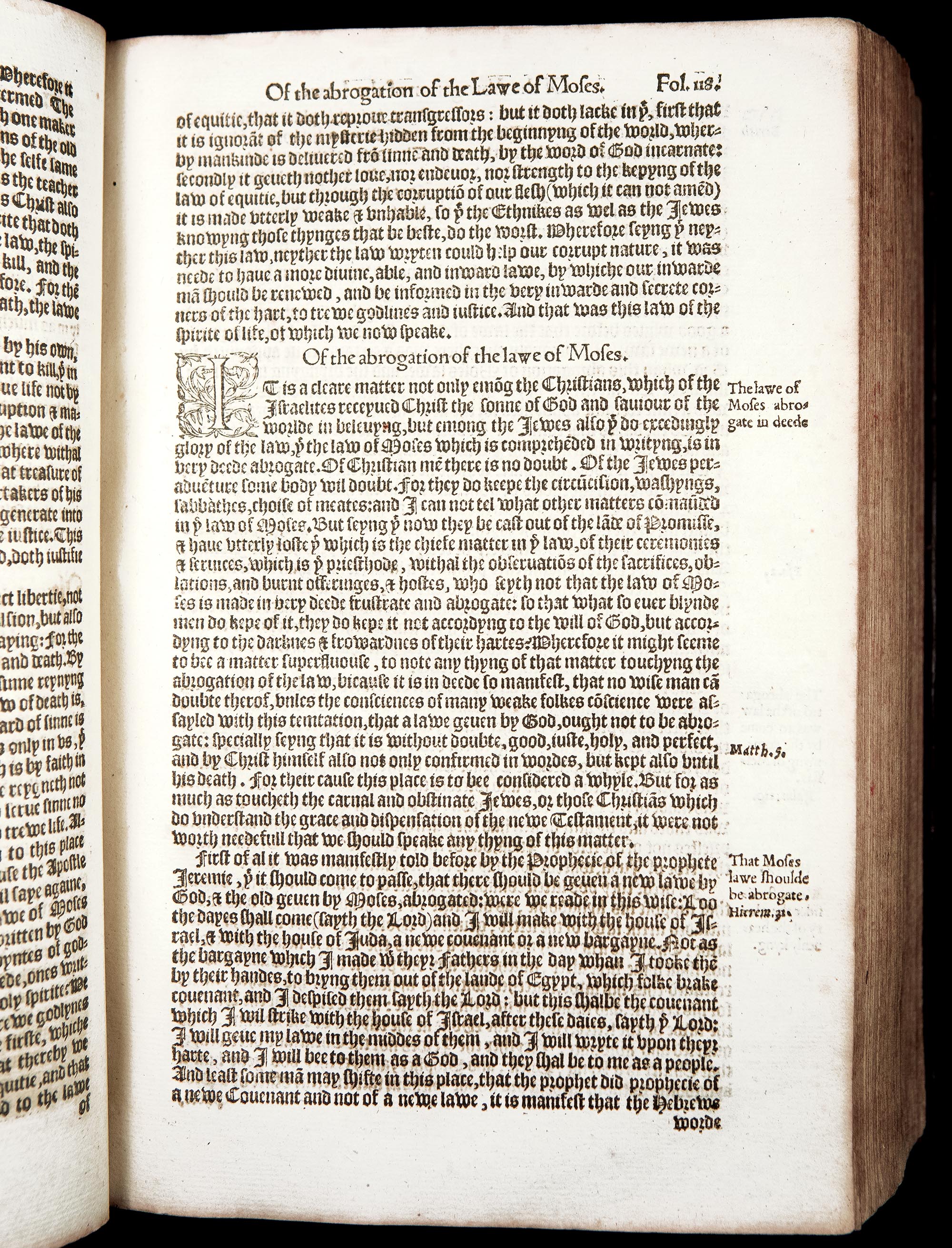
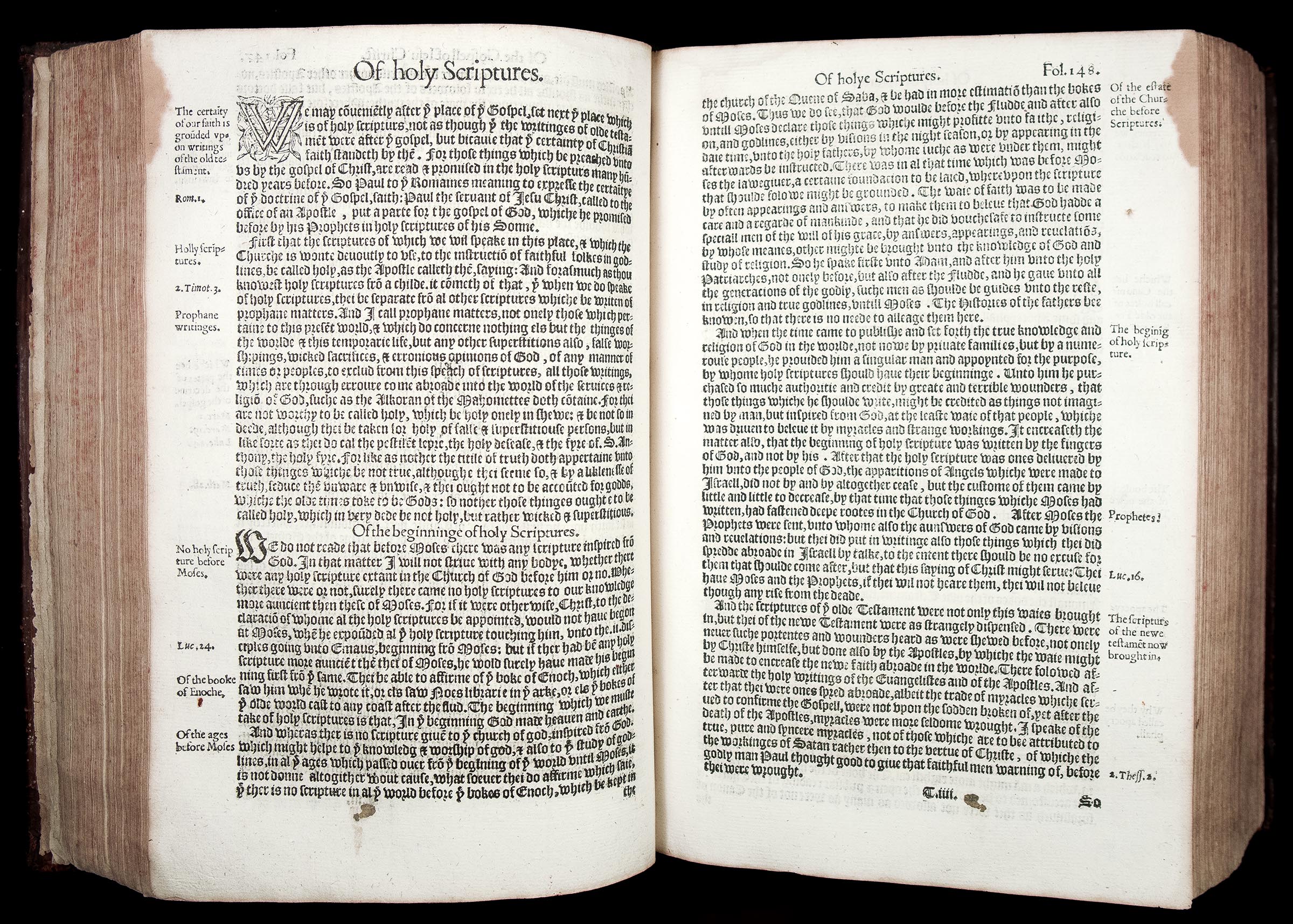
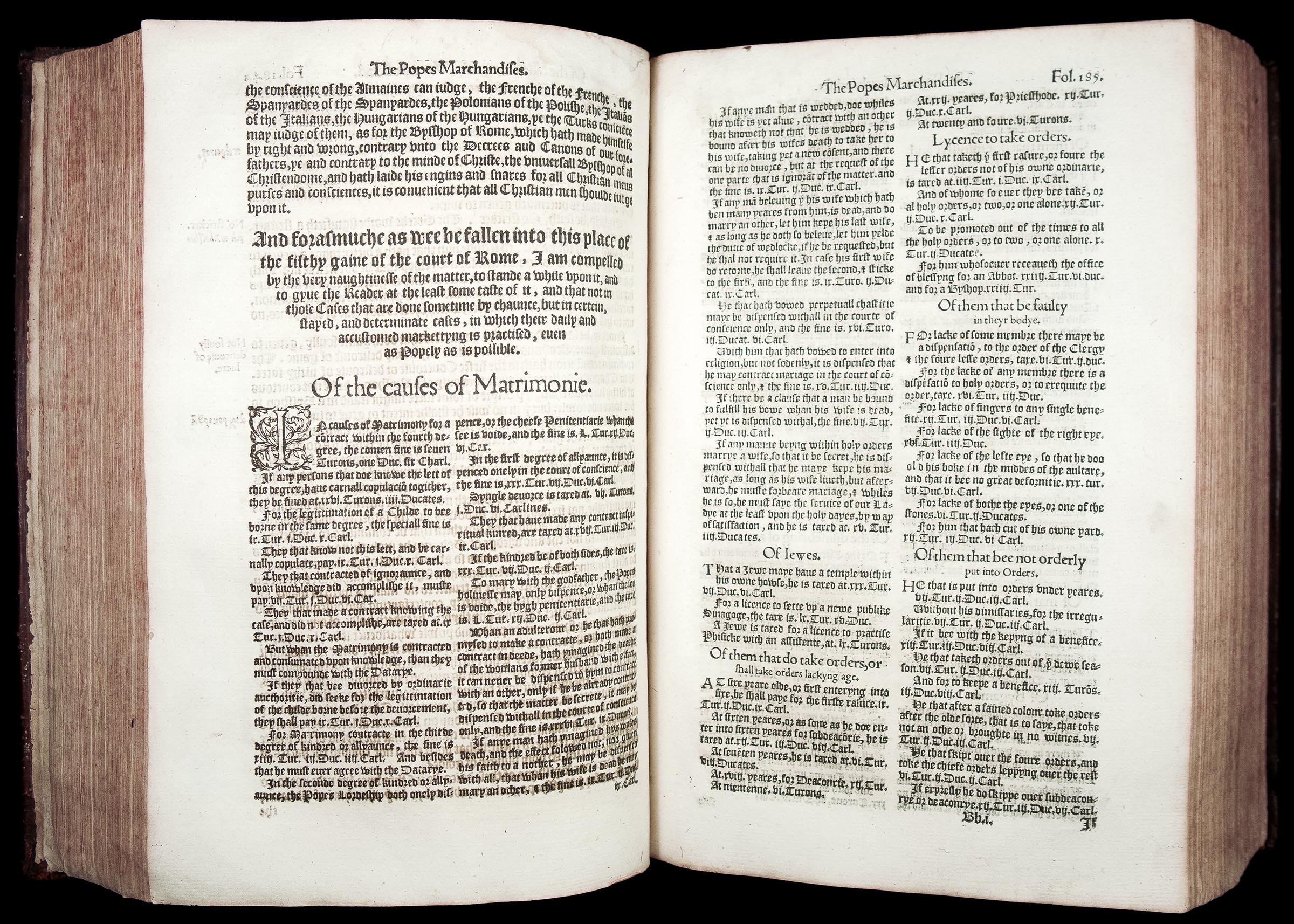
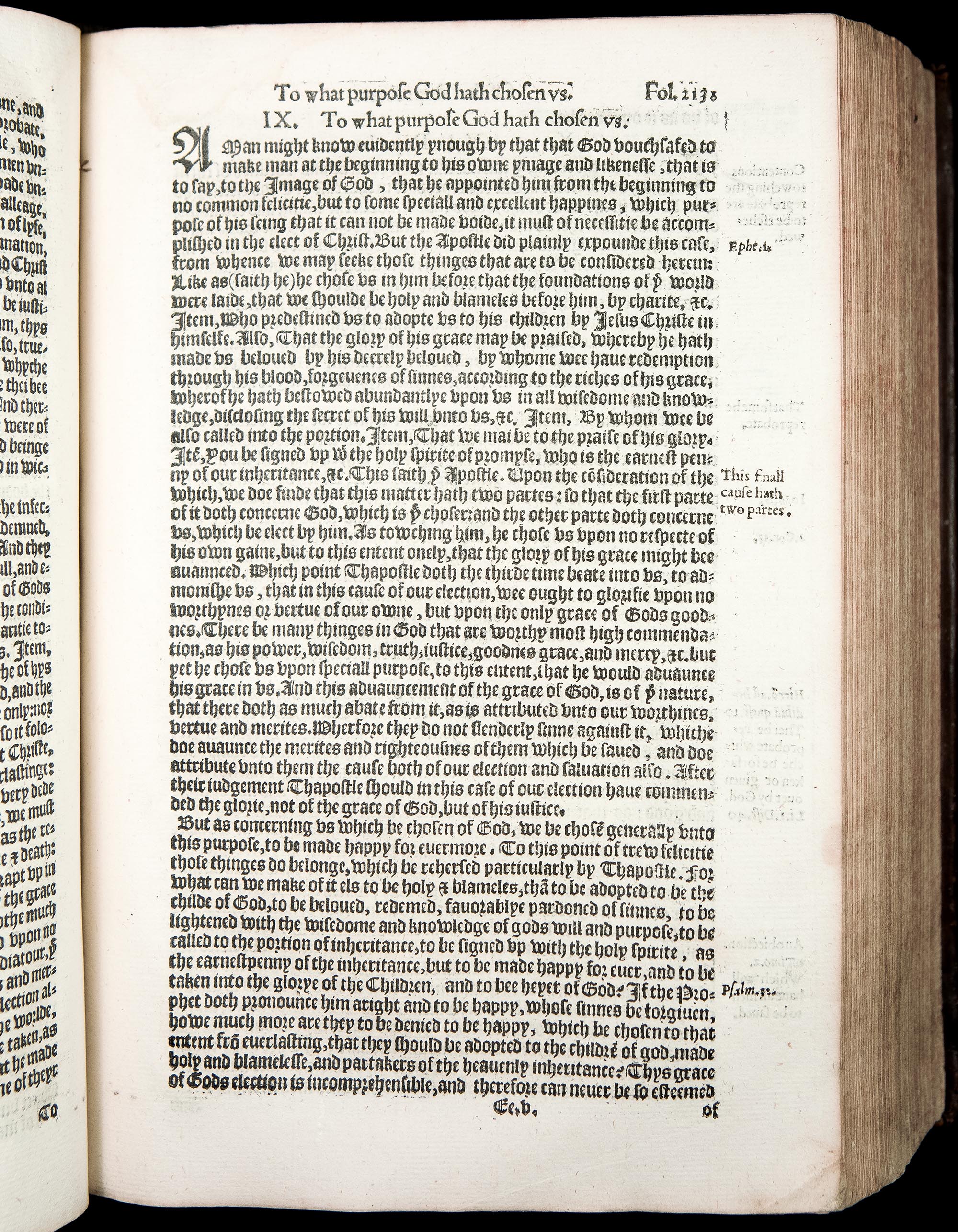
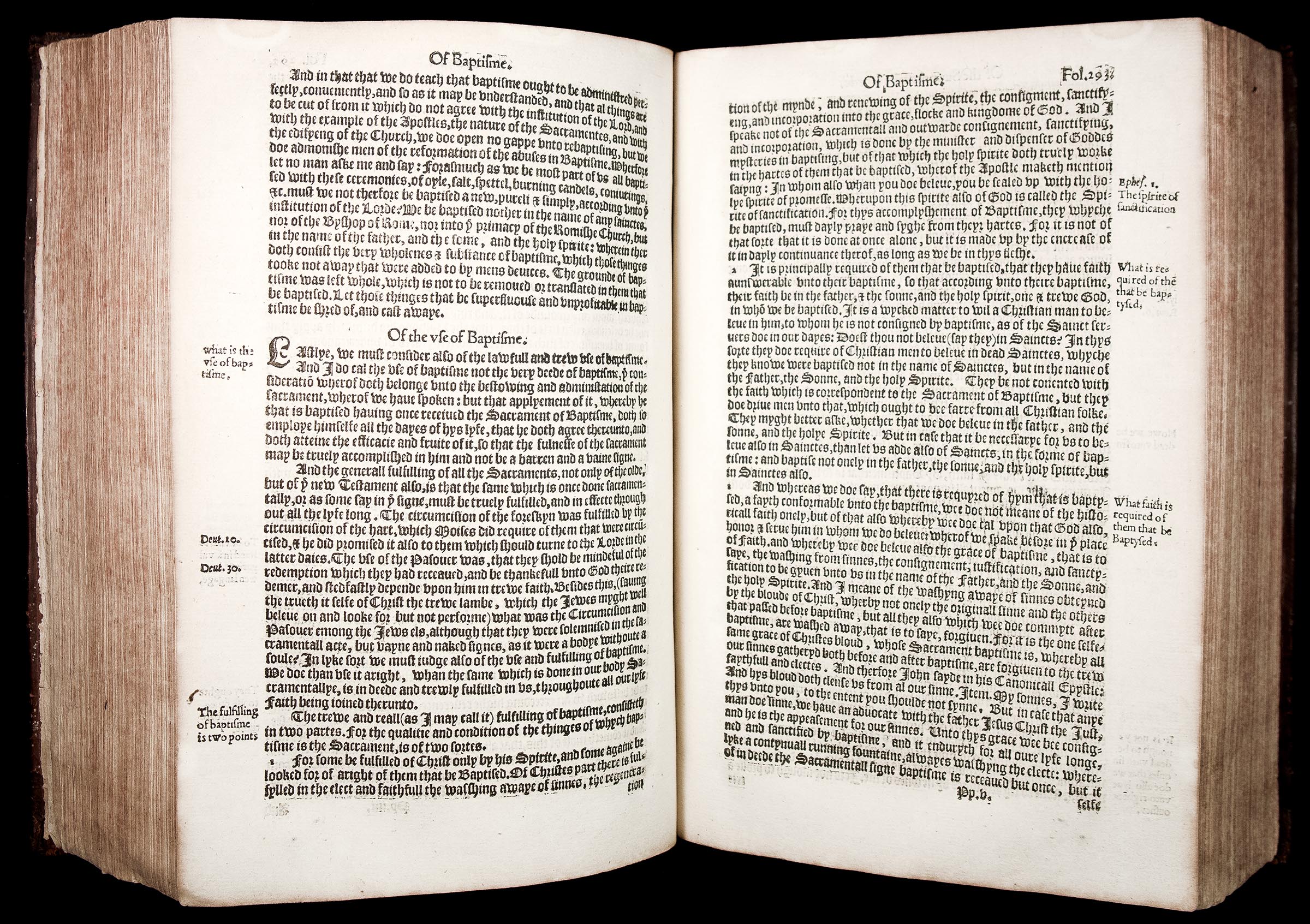
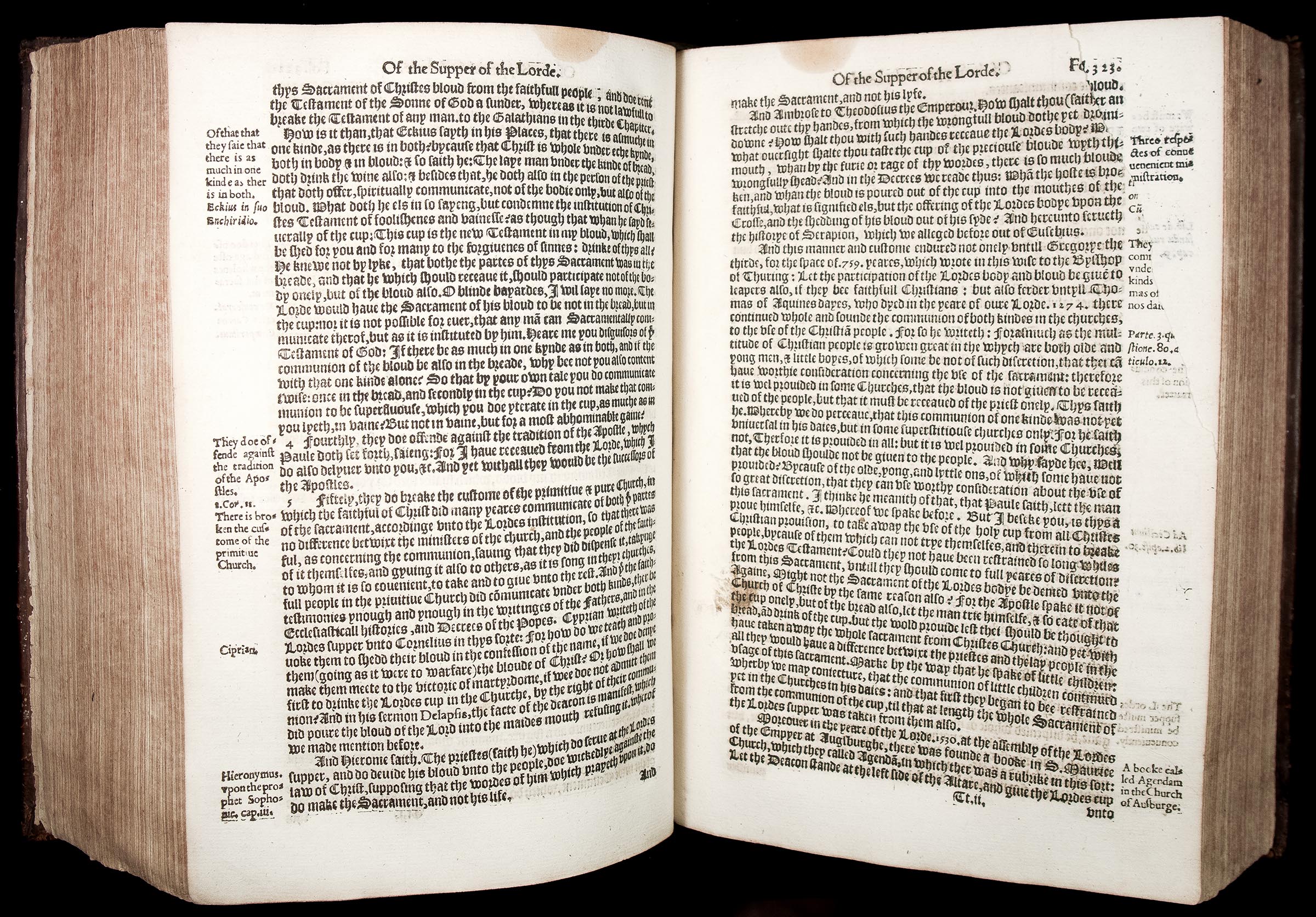
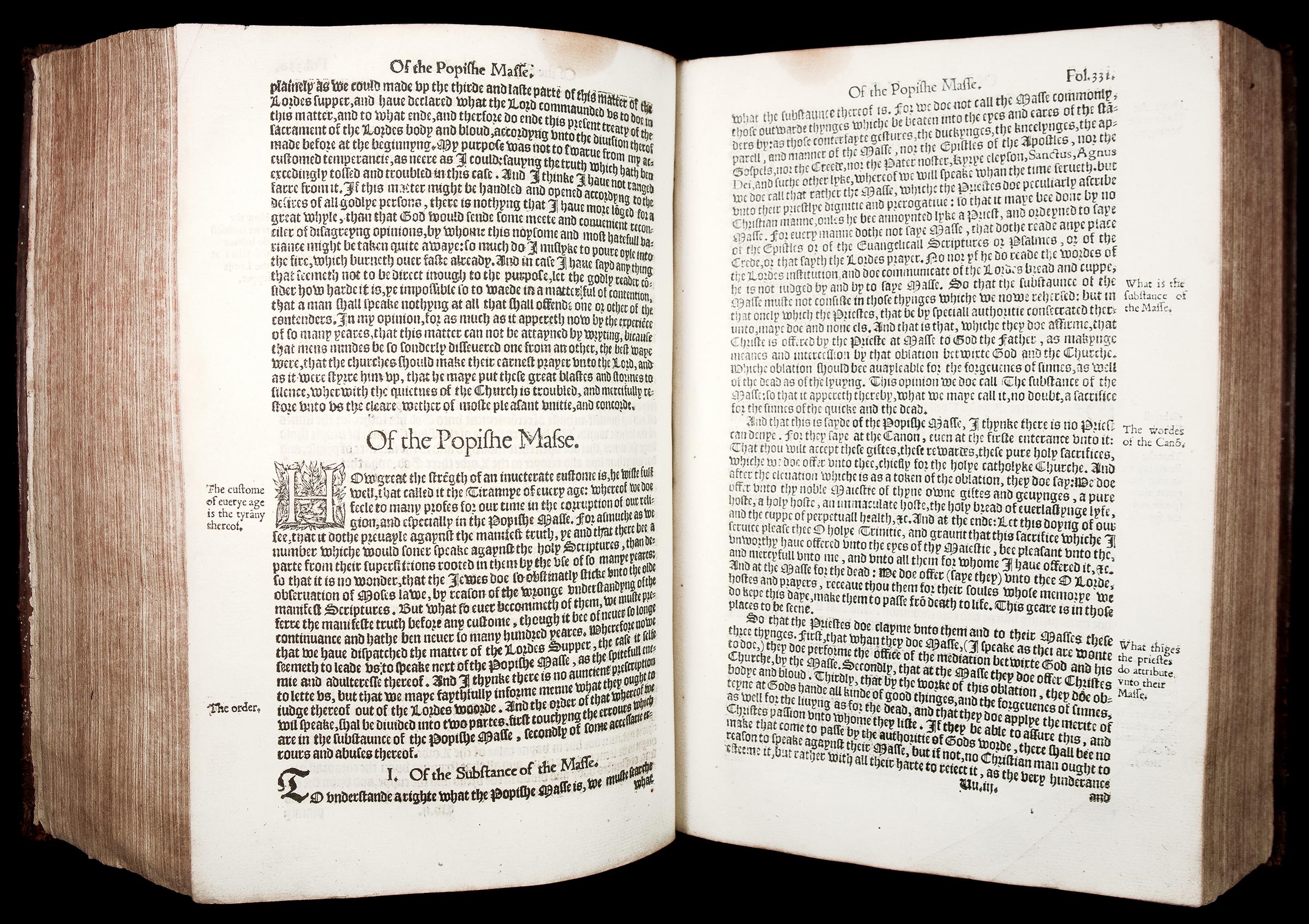
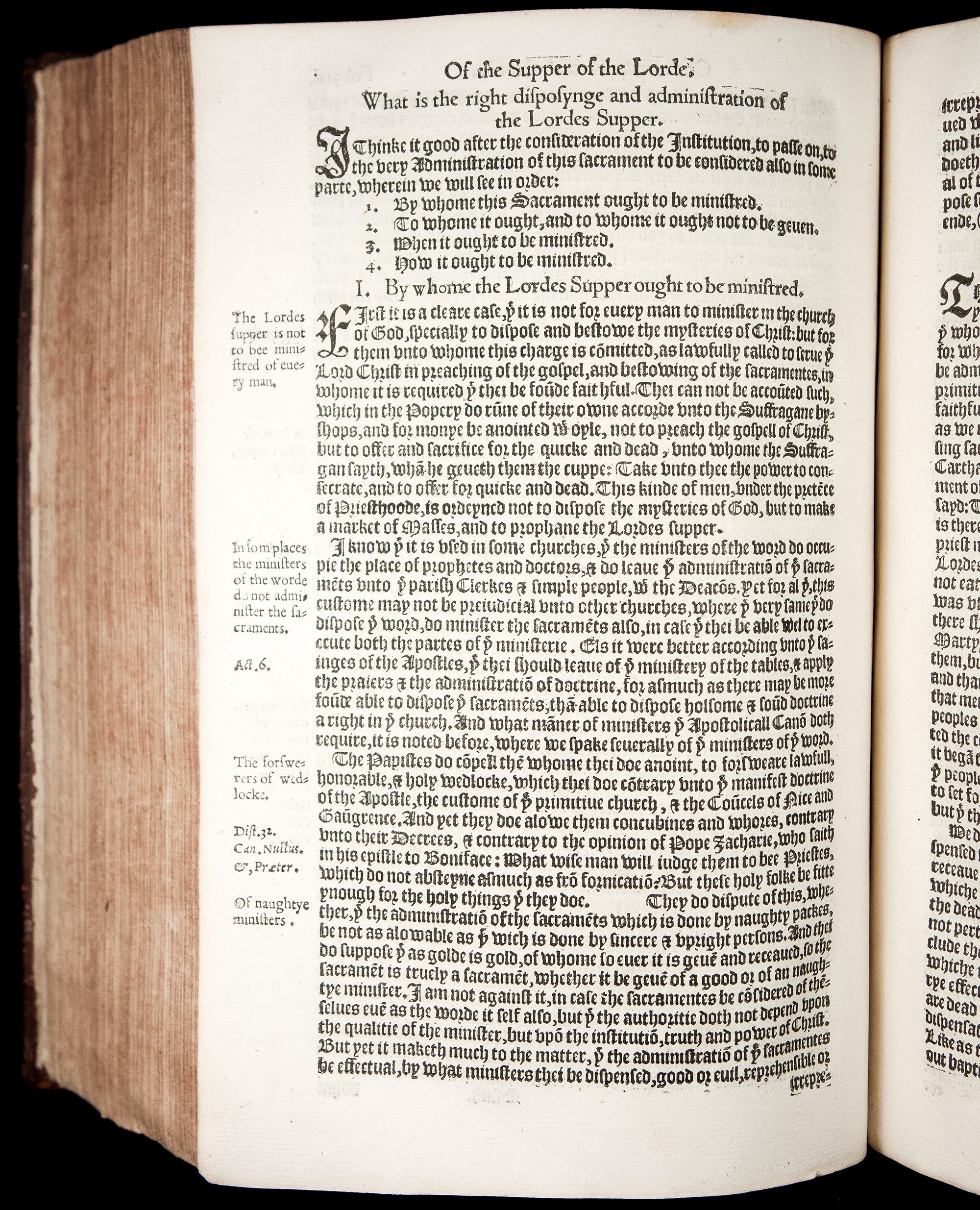
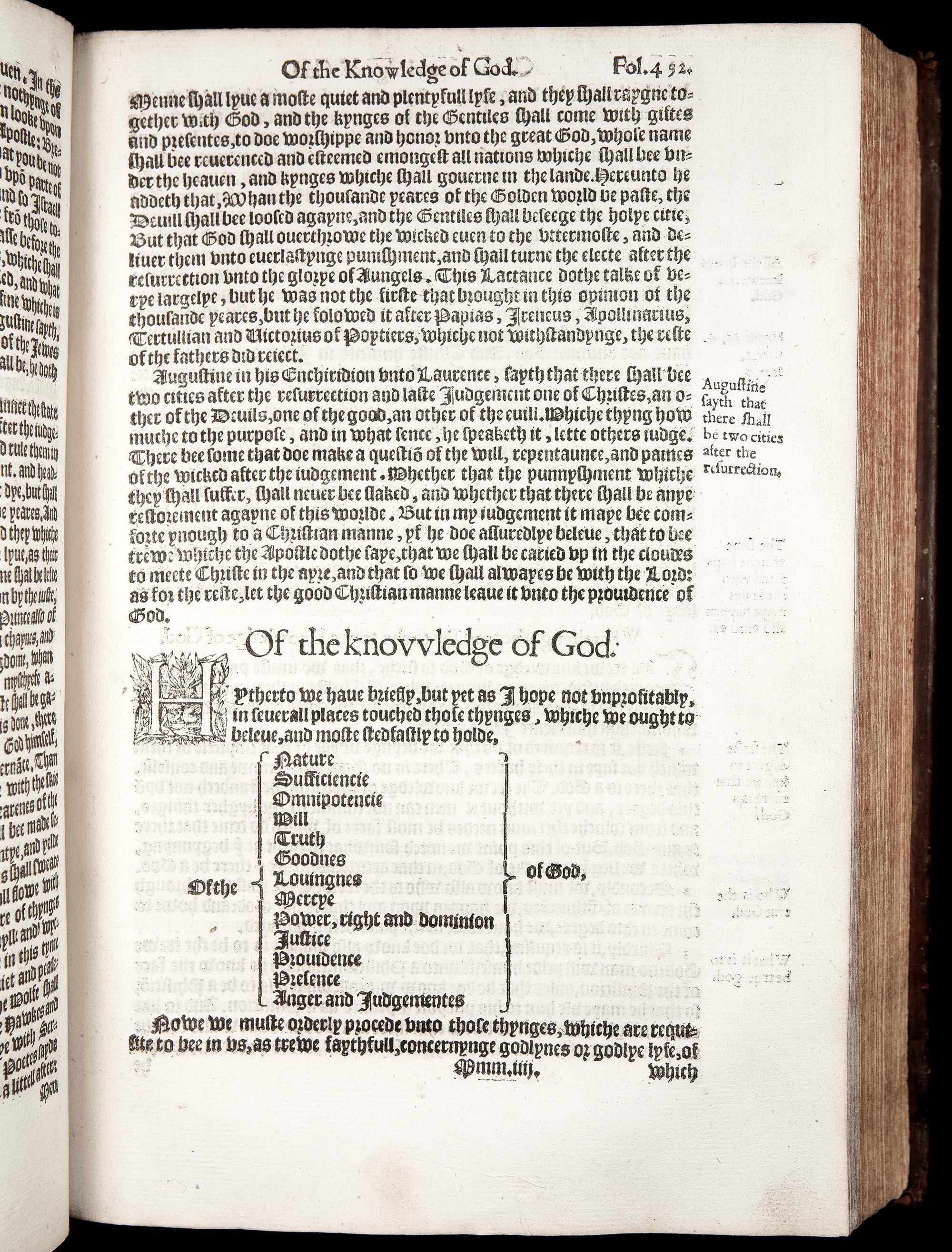
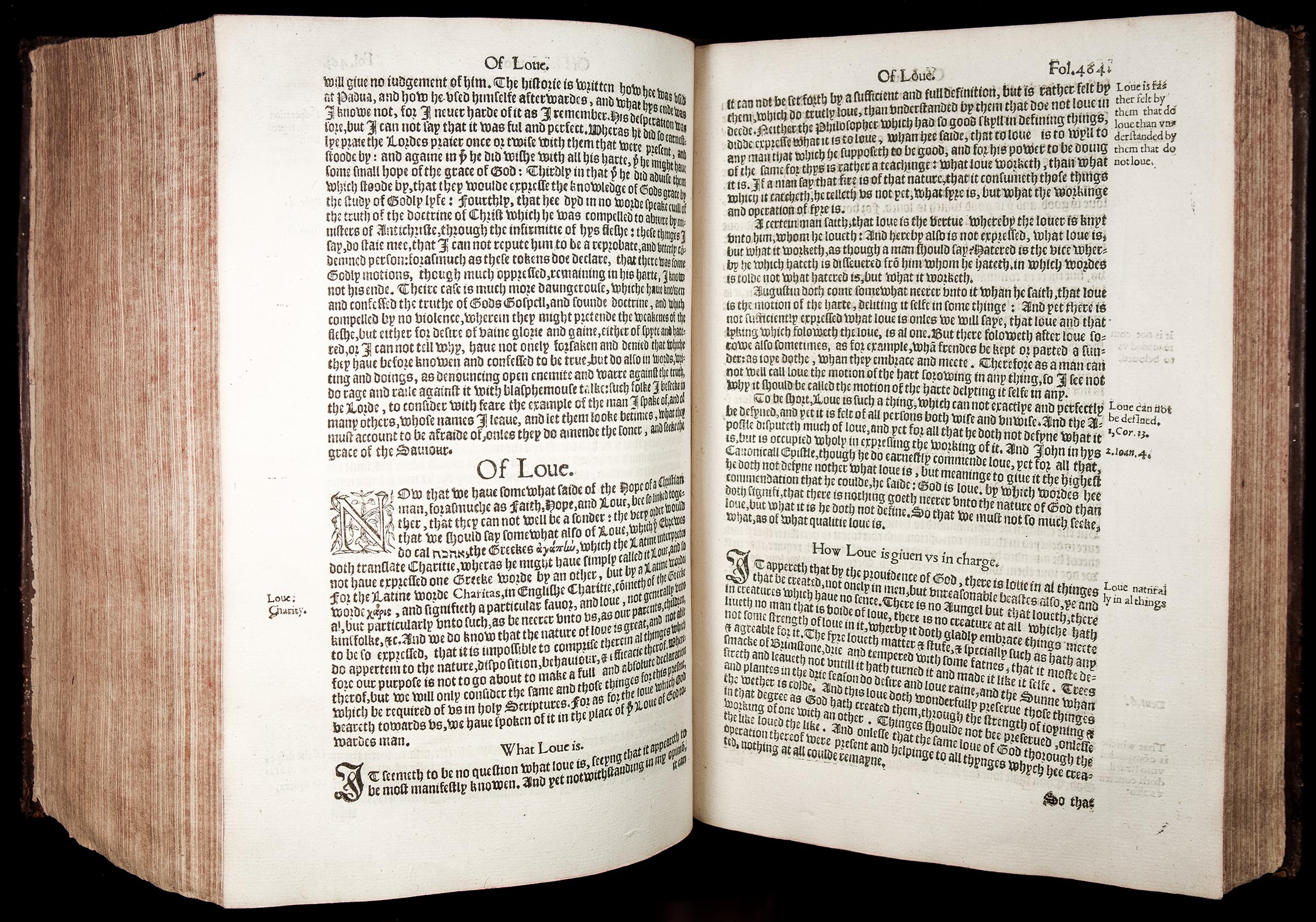
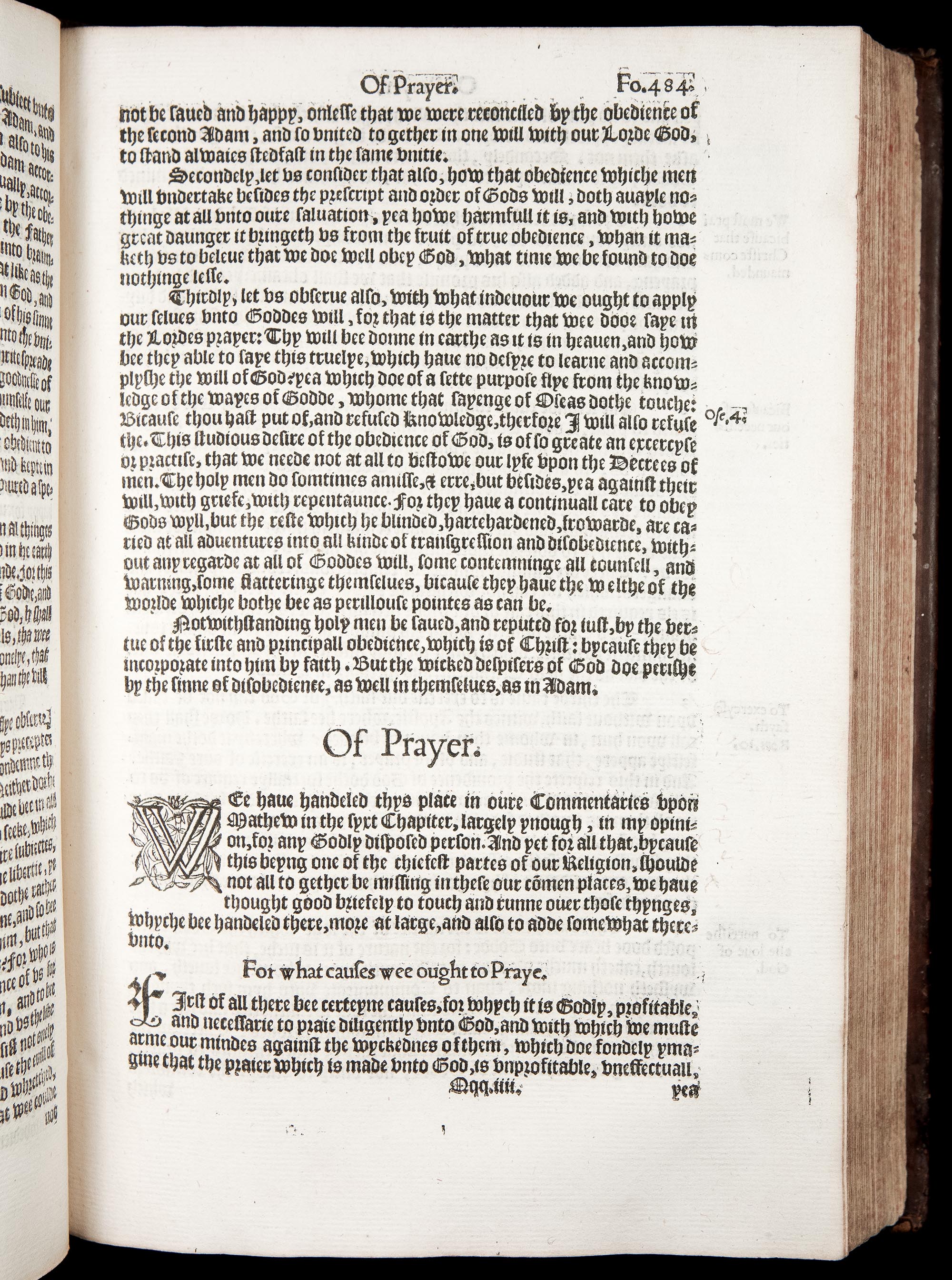
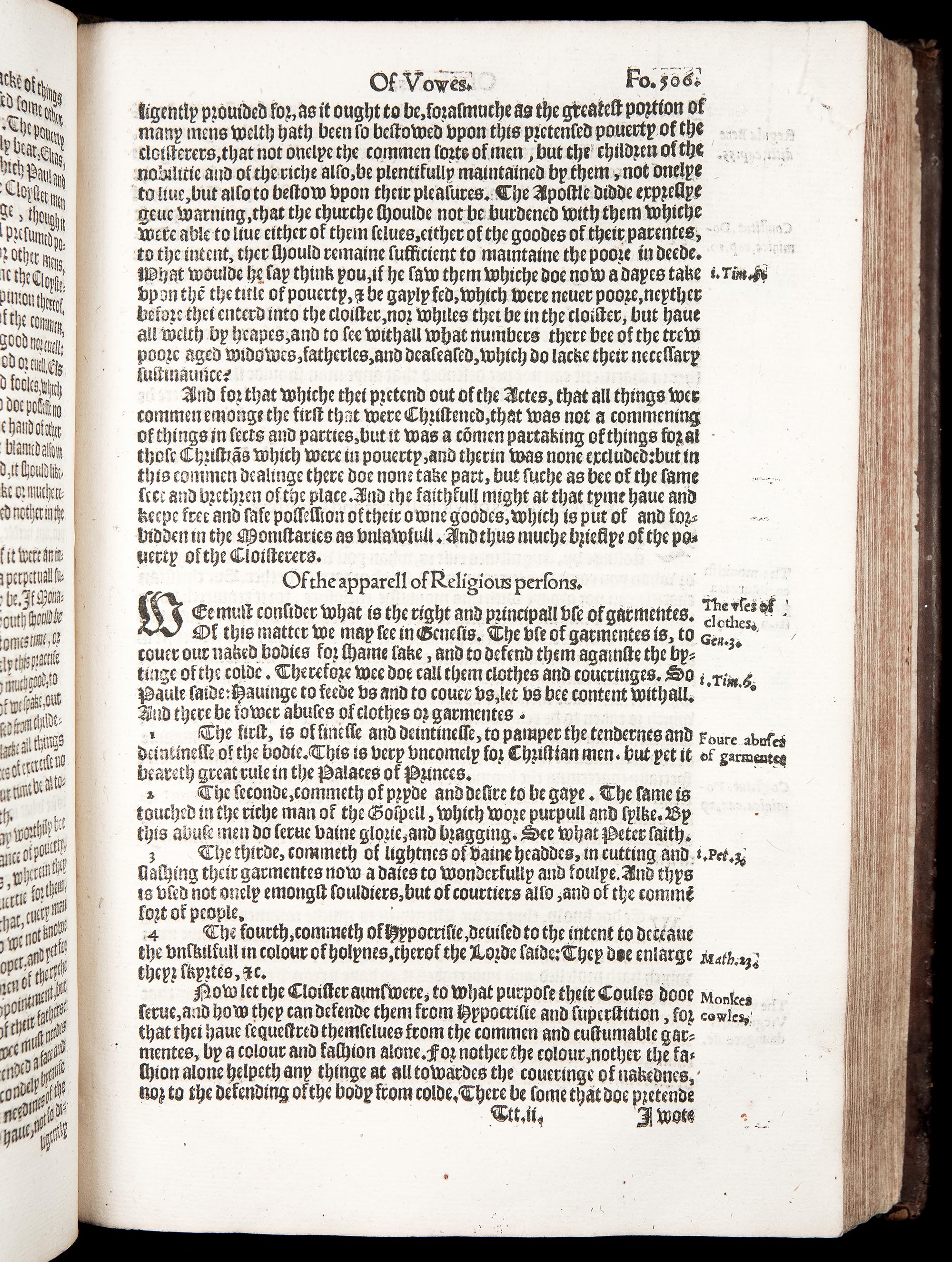
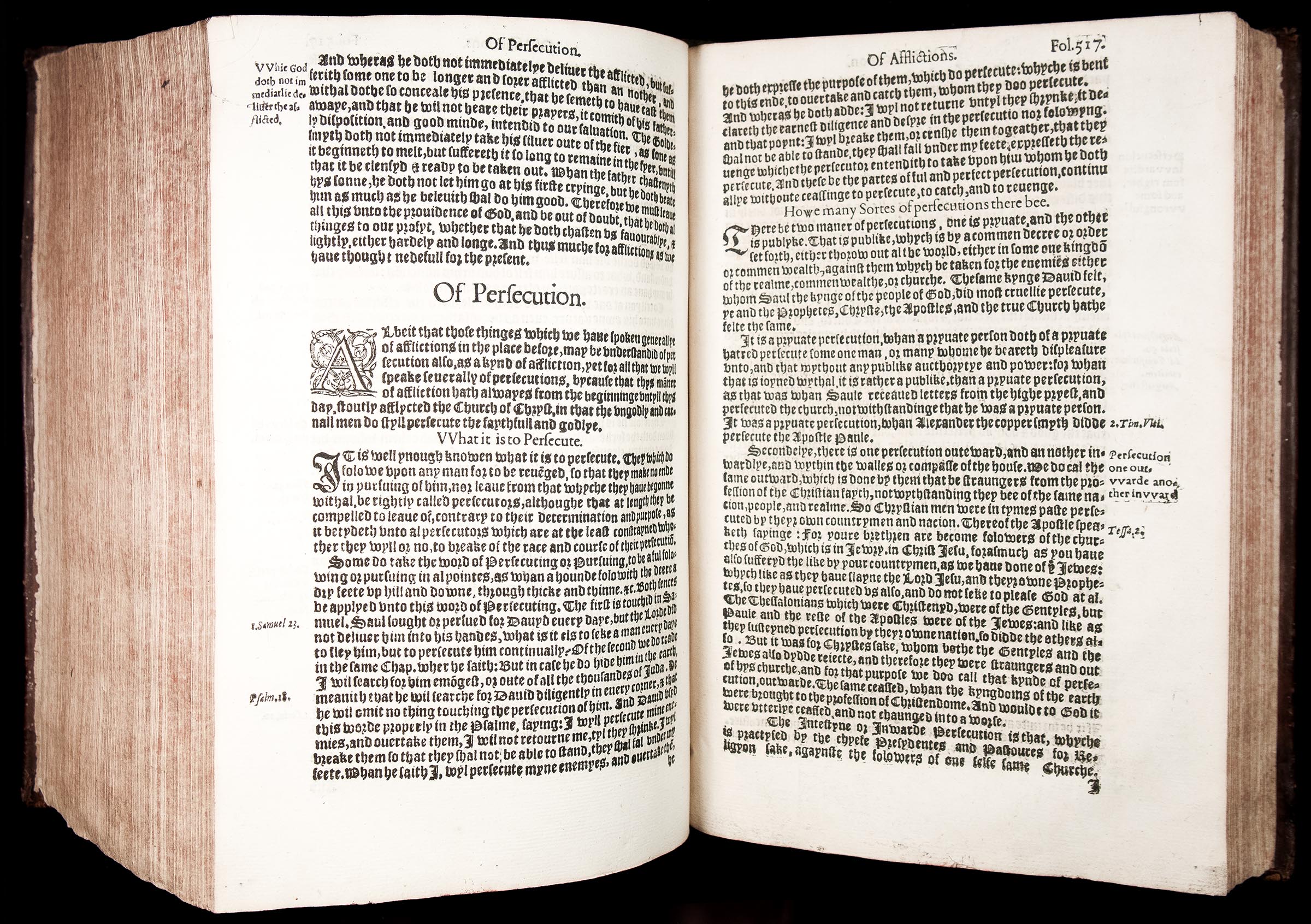
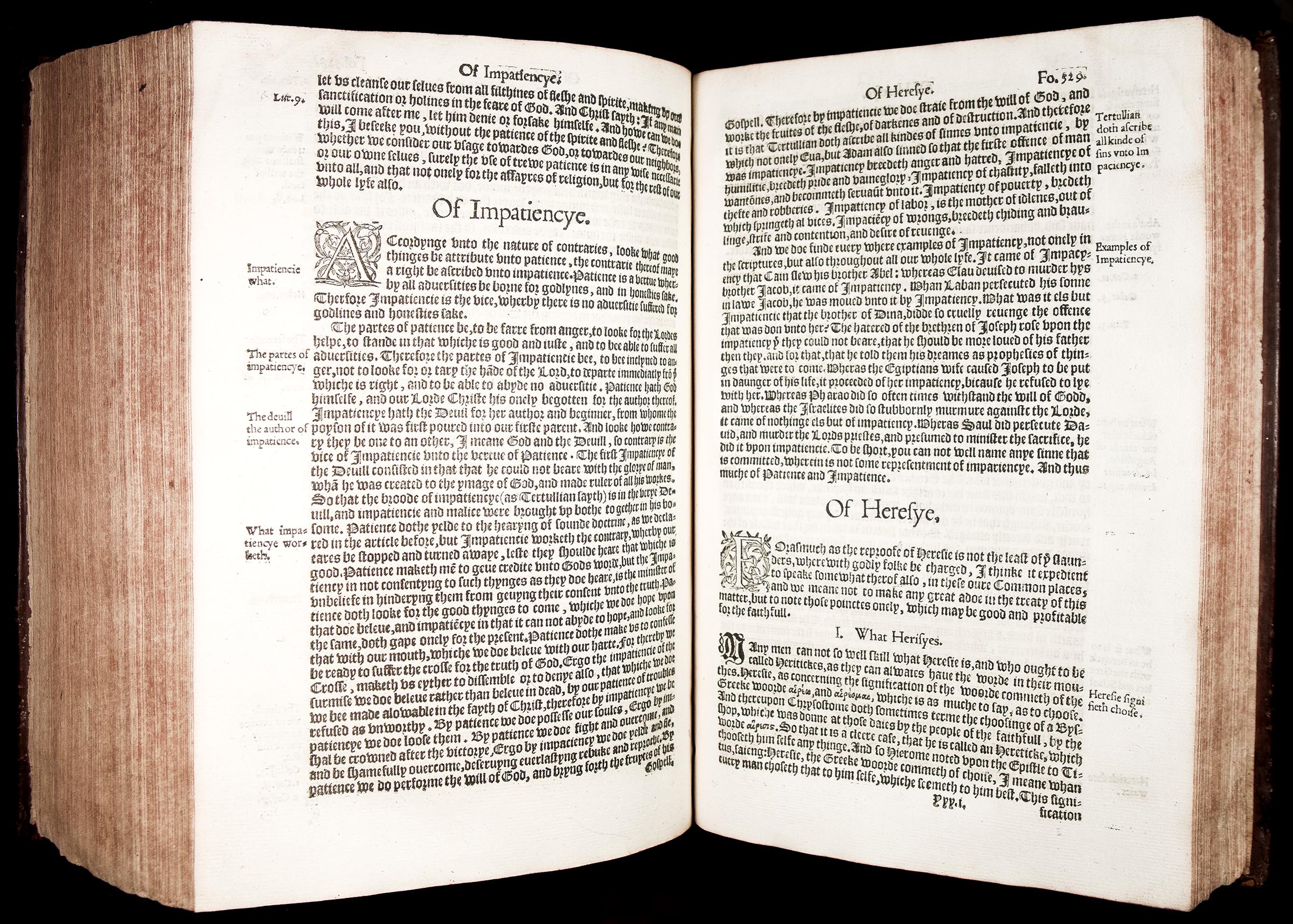
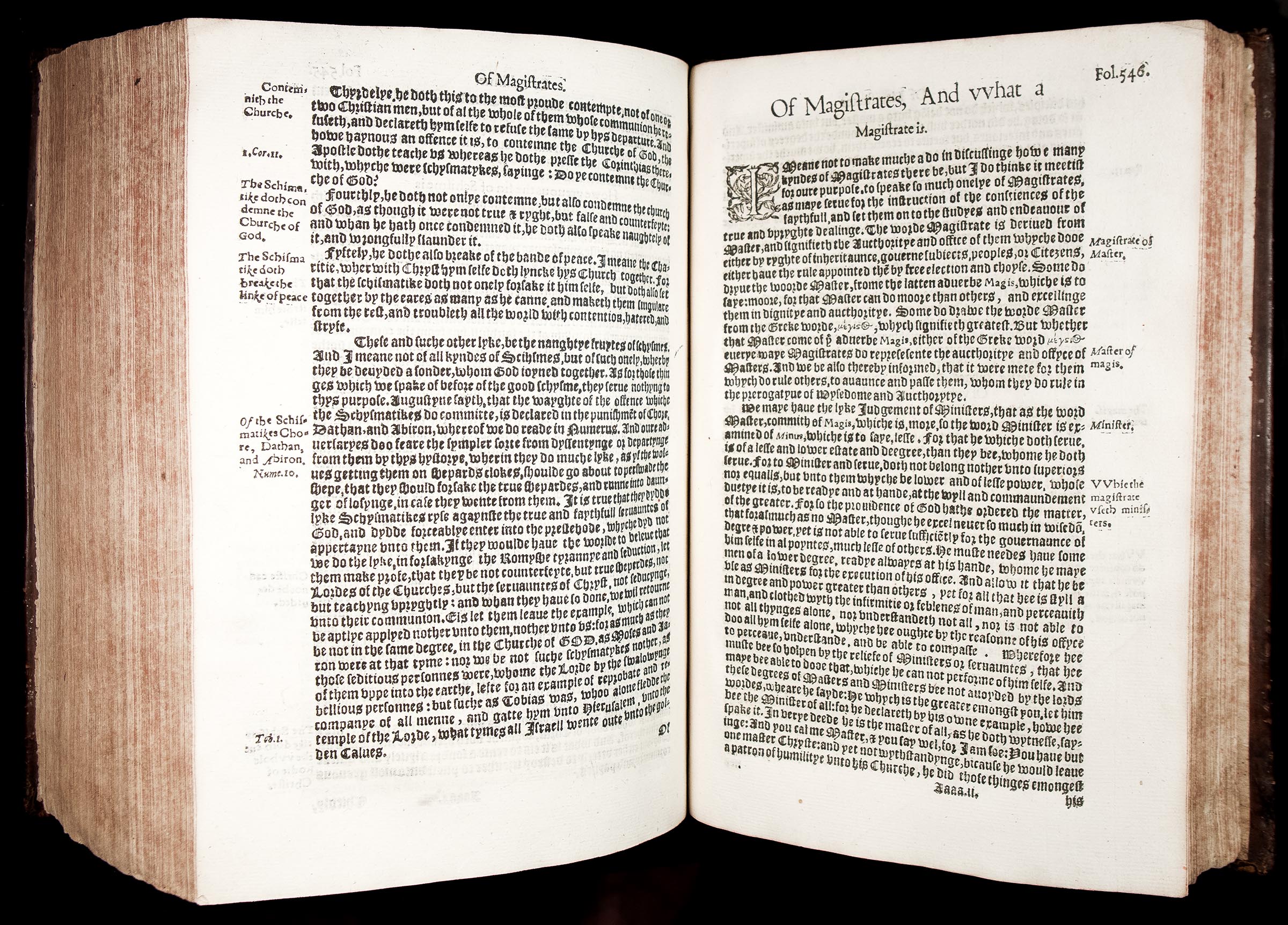
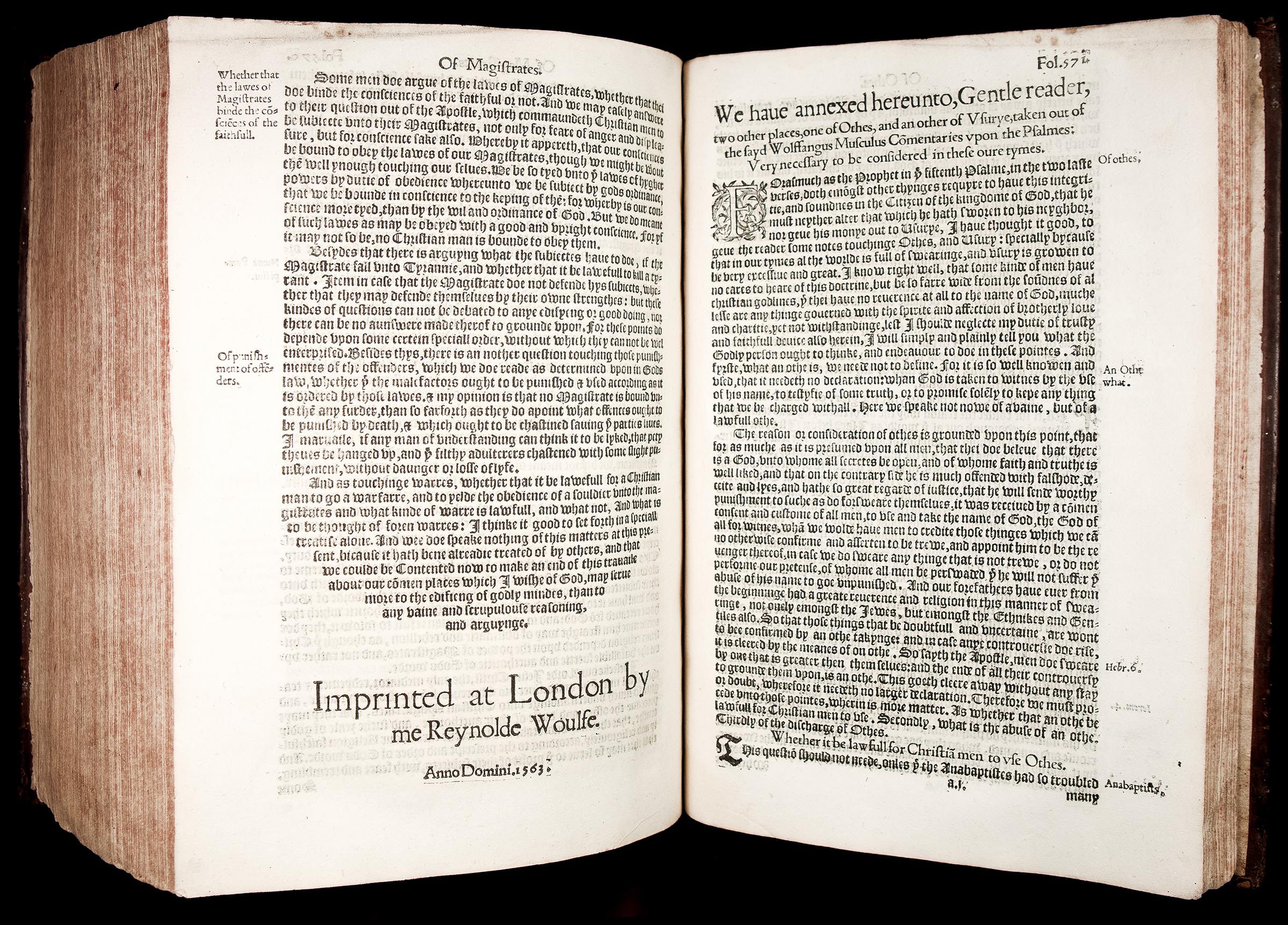
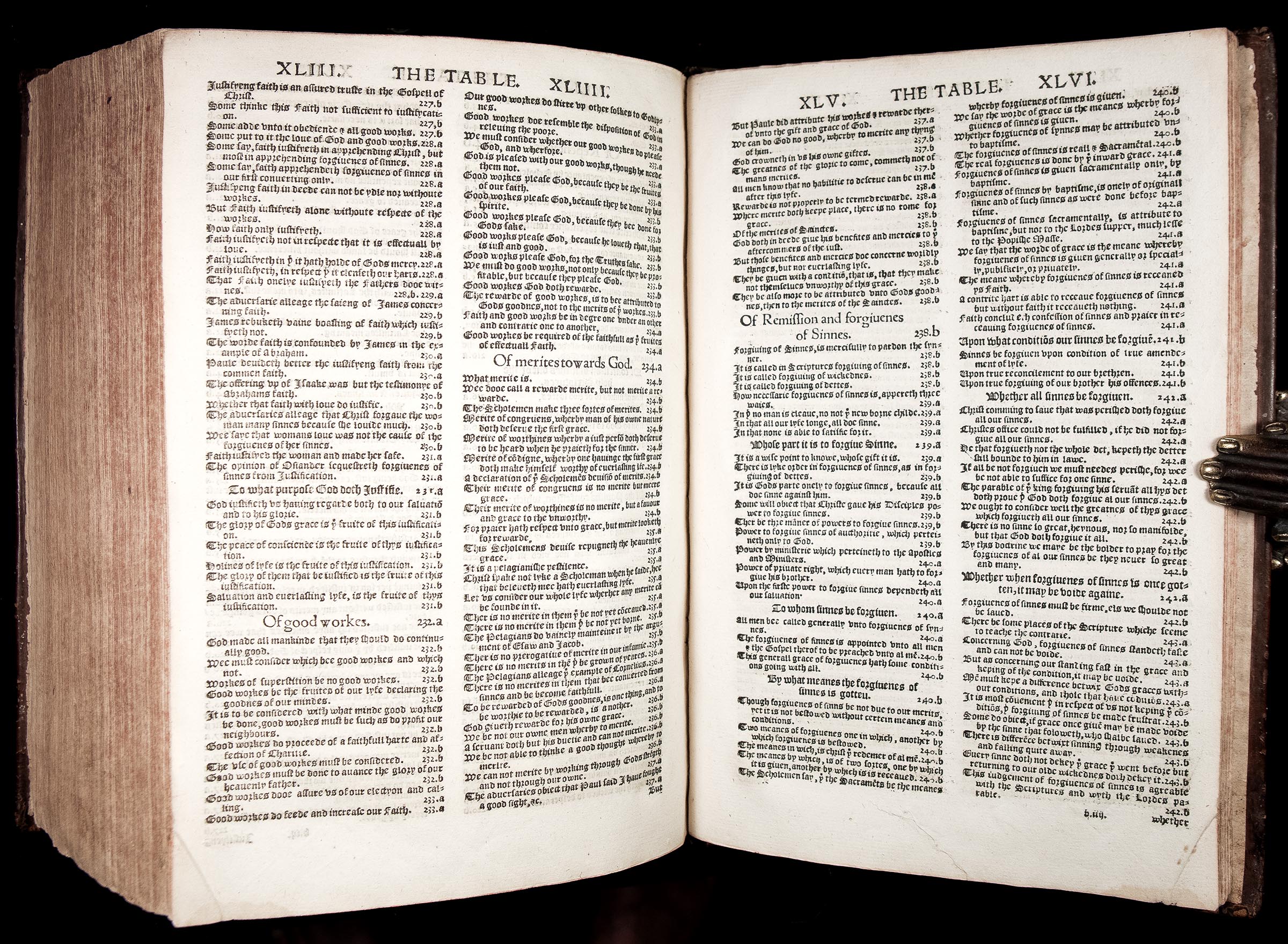
Printed in London by Reginald Wolfe, 1563.
Text in English (with some passages in Greek, Latin and Hebrew).
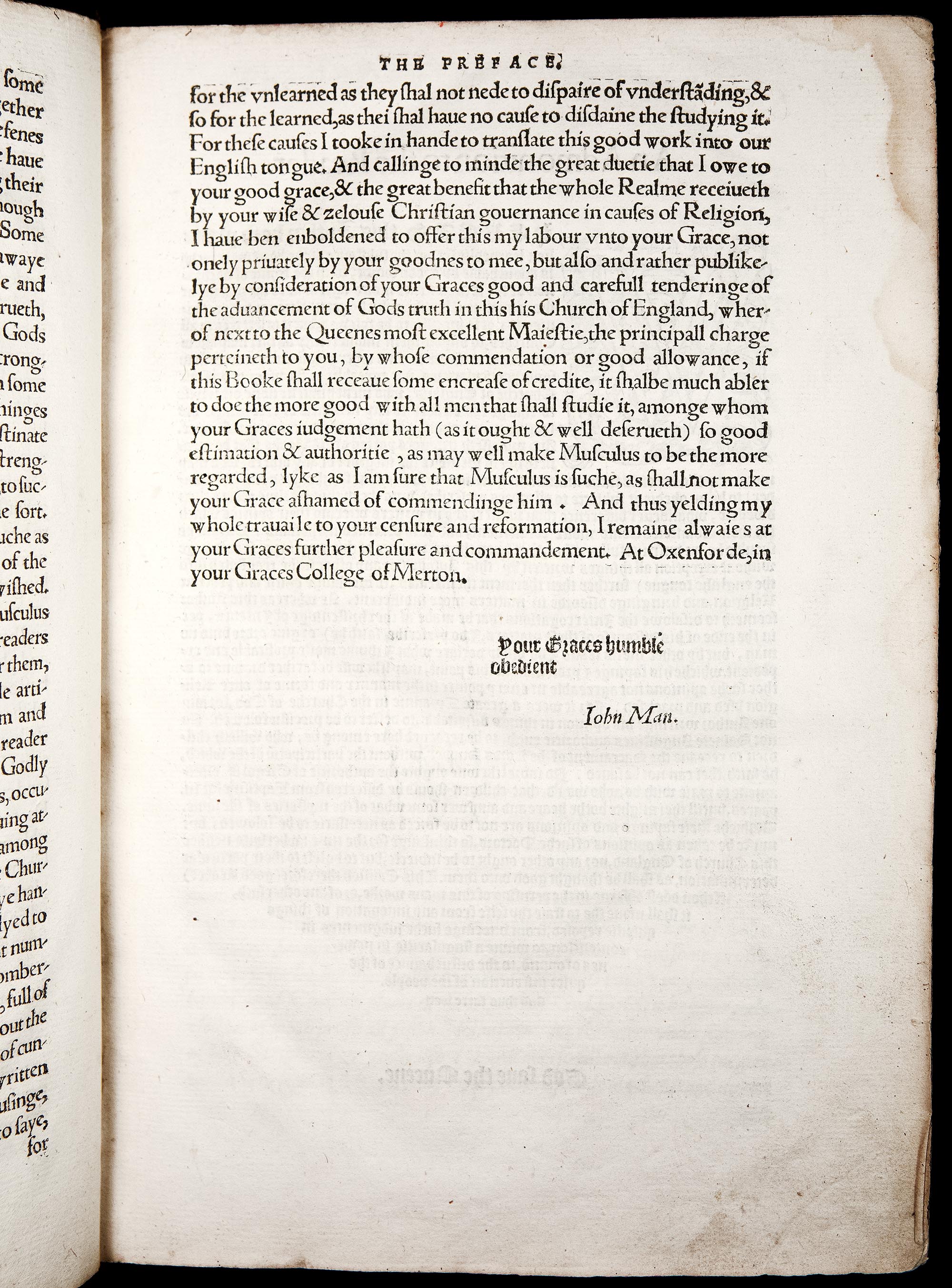
RARE FIRST ENGLISH EDITION of this monumental encyclopedia of Protestant theology! Translated from Latin by John Man (c. 1512–1569), warden of Merton College, Oxford, with his dedicatory epistle to Matthew Parker (1504–1575), the Archbishop of Canterbury, a key architect of the Elizabethan religious settlement, establishing the Church of England's middle way between Catholicism and Protestantism.
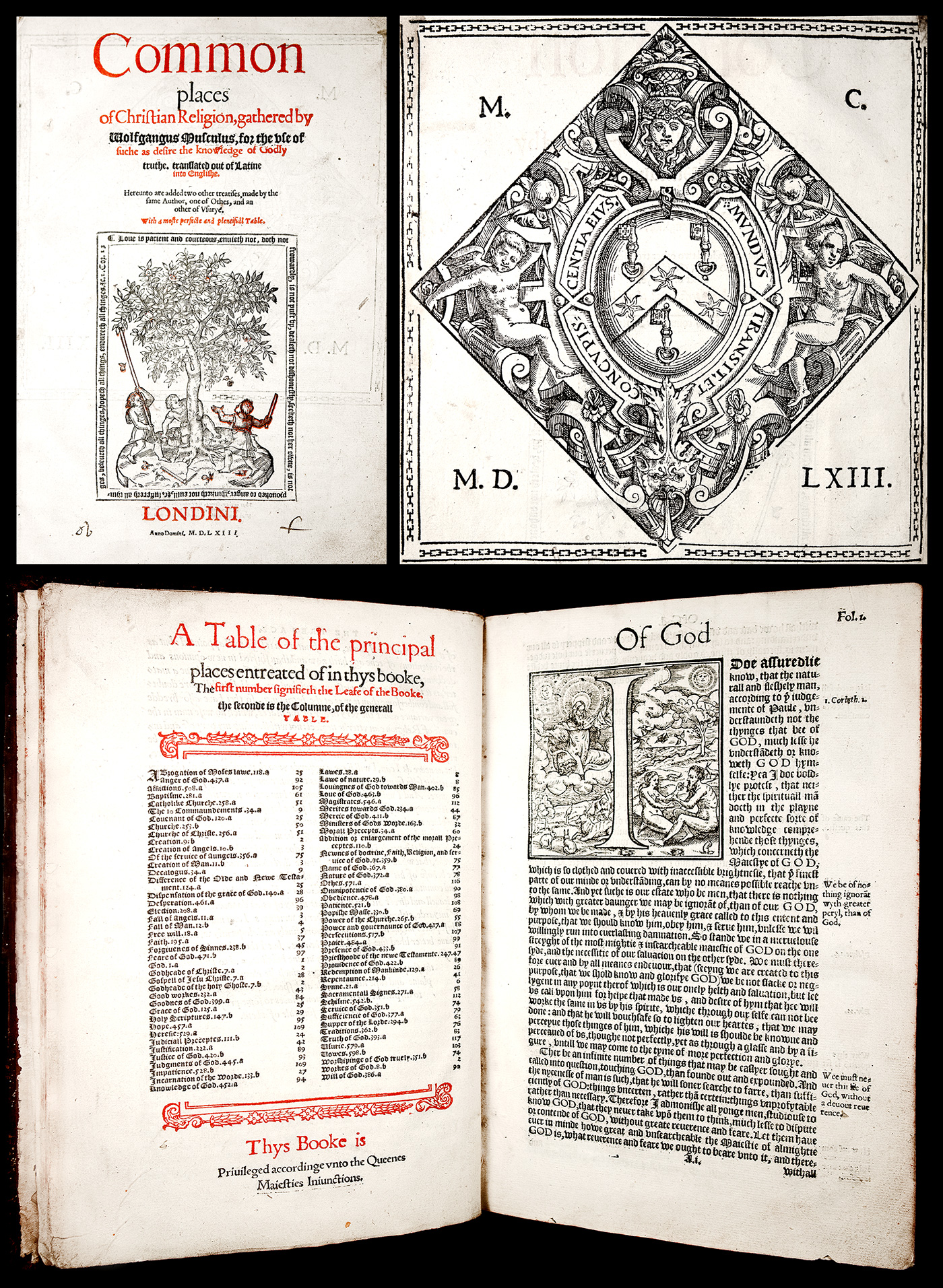
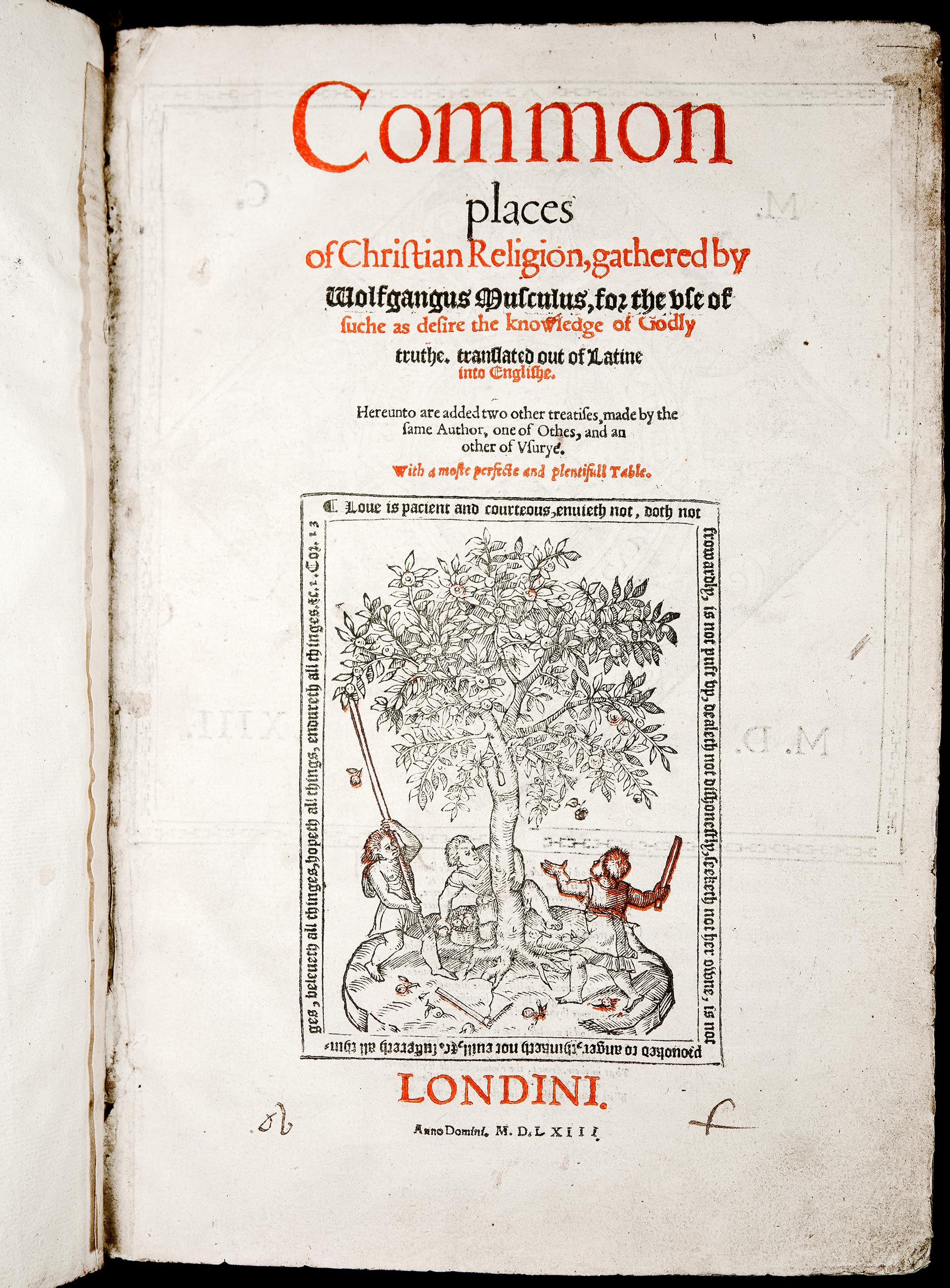
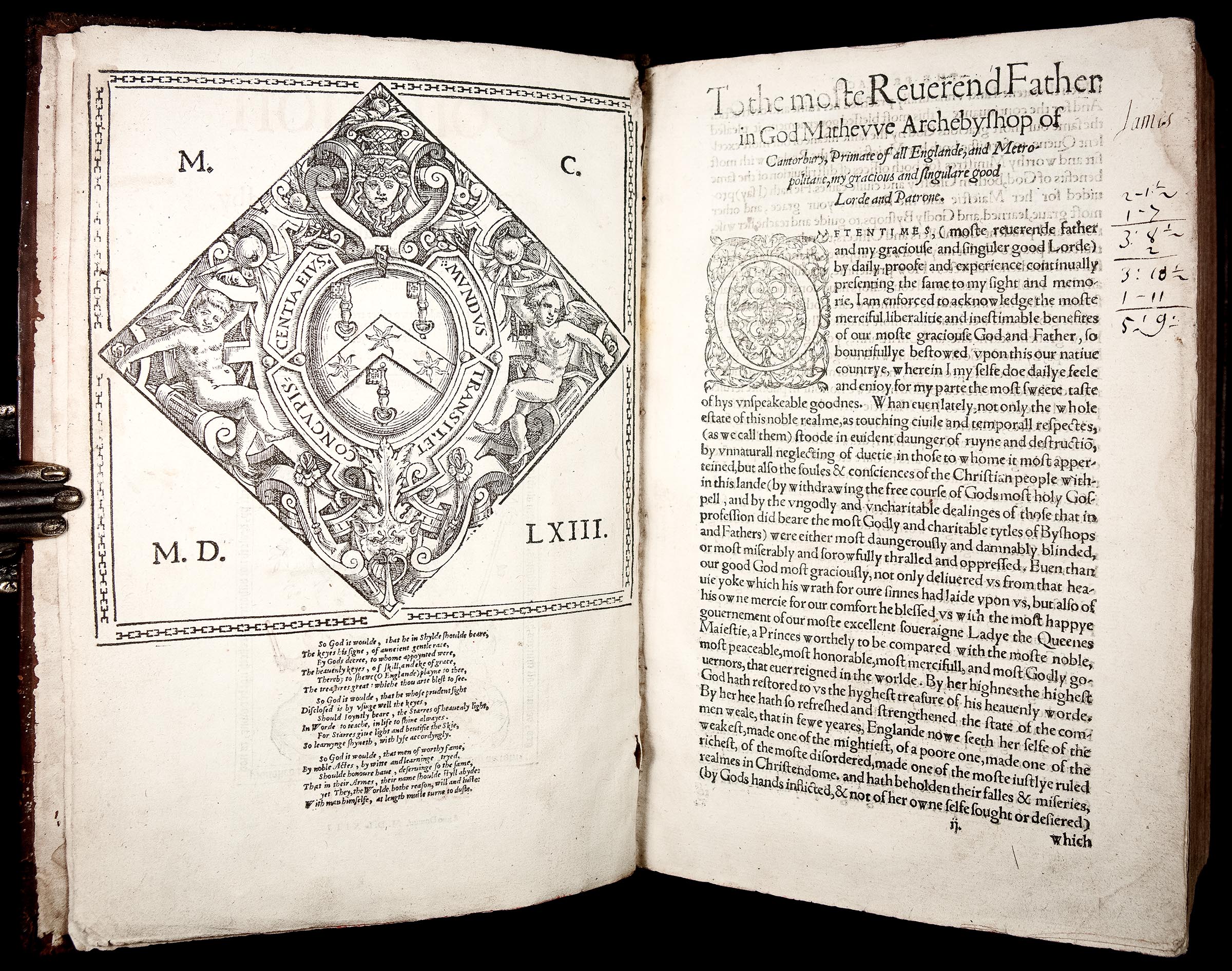
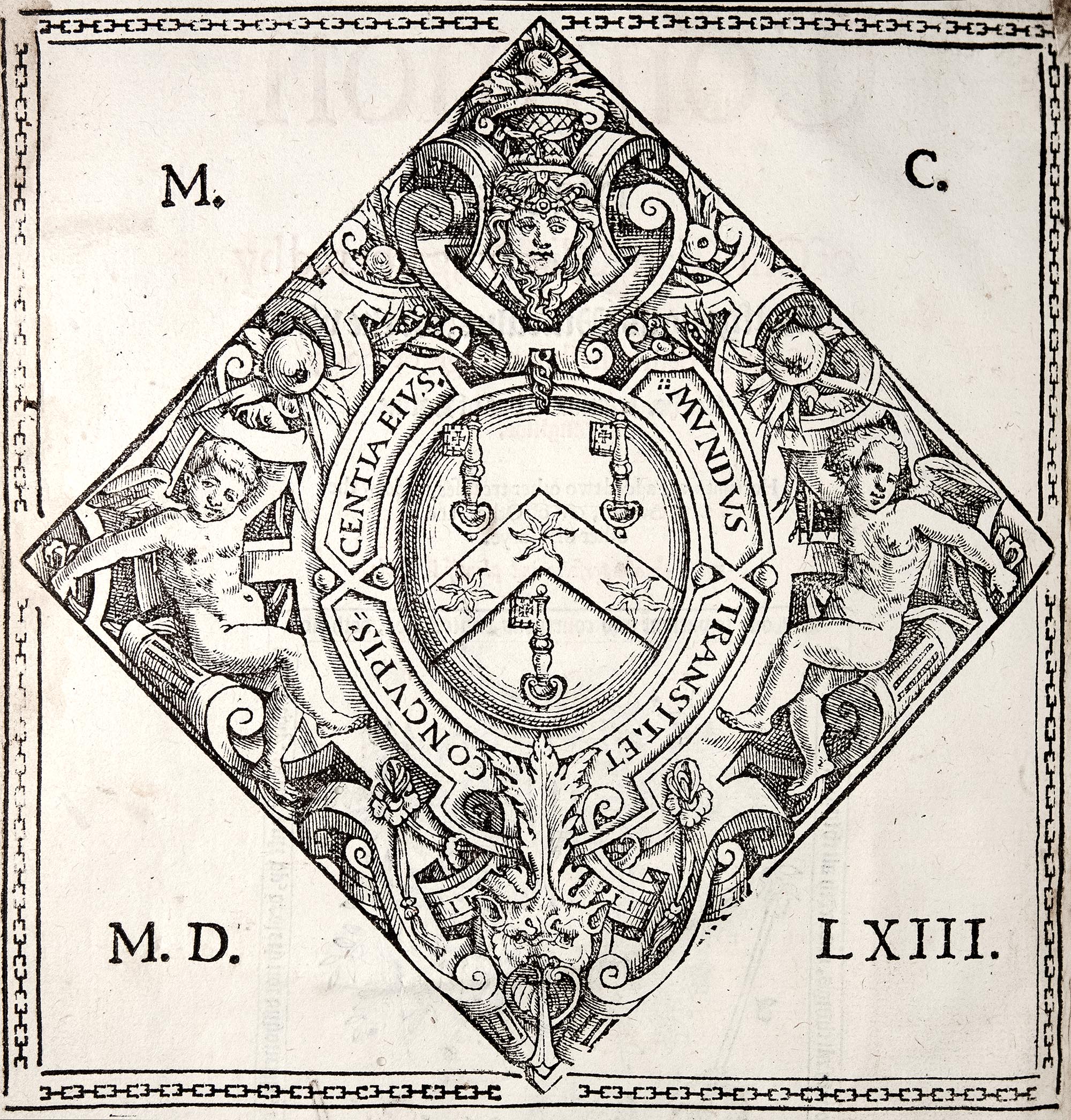
Embellished with dedicatee’s large woodcut coat of arms (verso of title); and with a fine woodcut printer’s device (McKerrow, 146) on the title-page depicting boys throwing sticks at a tree laden with fruit, printed in black and red, bordered with a legend quoting 1 Corinthians 13:4-7 (“Love is patient and courteous…”).
This massive work (comprising over 1200 folio pages, printed in 'black letter'!) is organized topically (following a structure similar to other "Loci Communes" ("Common Places") of the era, such as those by Philip Melanchthon):
- Theology Proper: It begins with foundational topics like the nature of God, the Trinity, and creation before moving toward redemption.
- Sacred Scripture: Musculus includes a detailed discussion on the authority and reading of the Bible, distinguishing between absolute divine authority and lower earthly authority.
- Practical Application: Unlike some purely theoretical works, Musculus's 'Common Places' emphasizes the application of faith to everyday life, reflecting his background in both monastic contemplative reading and active reform.
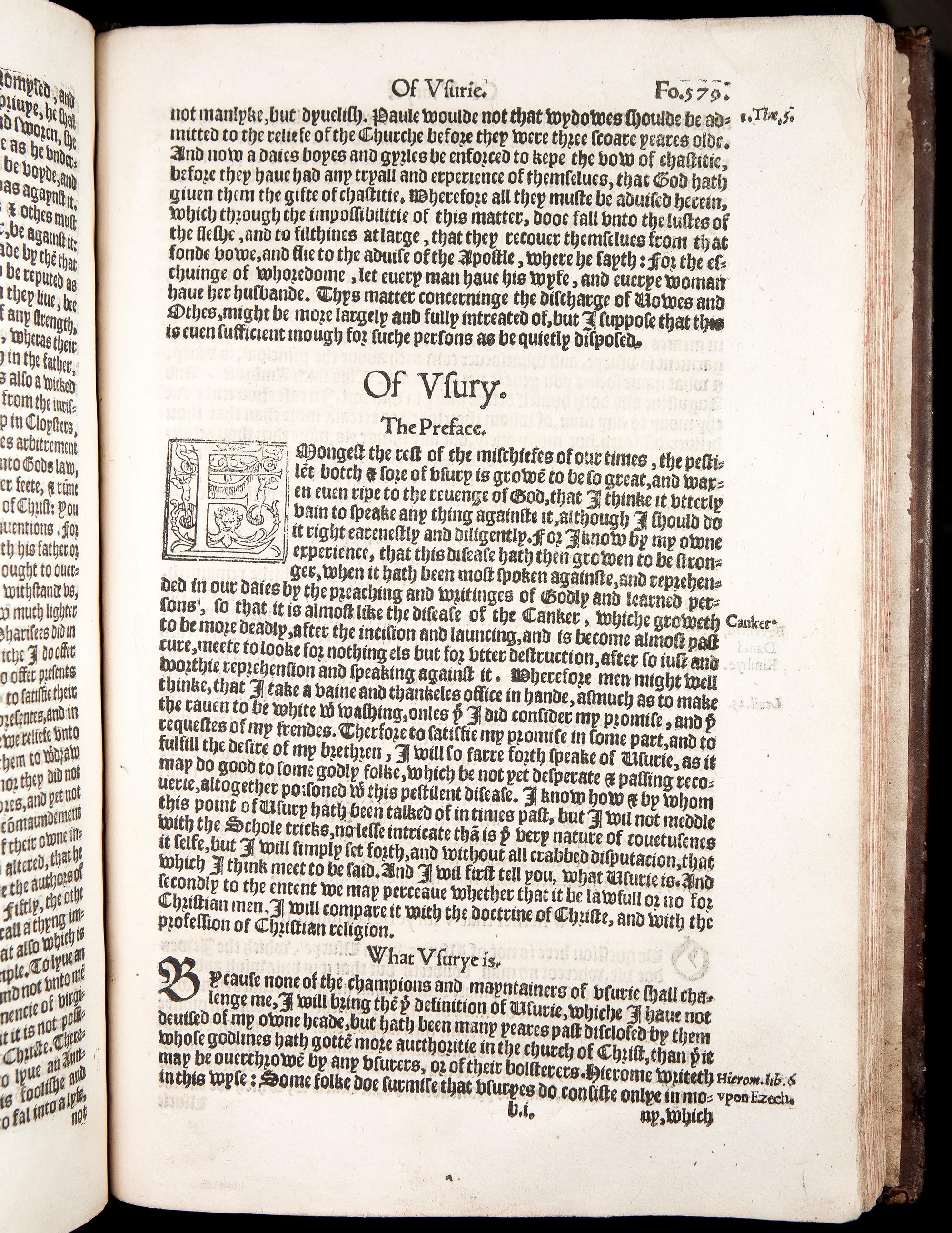
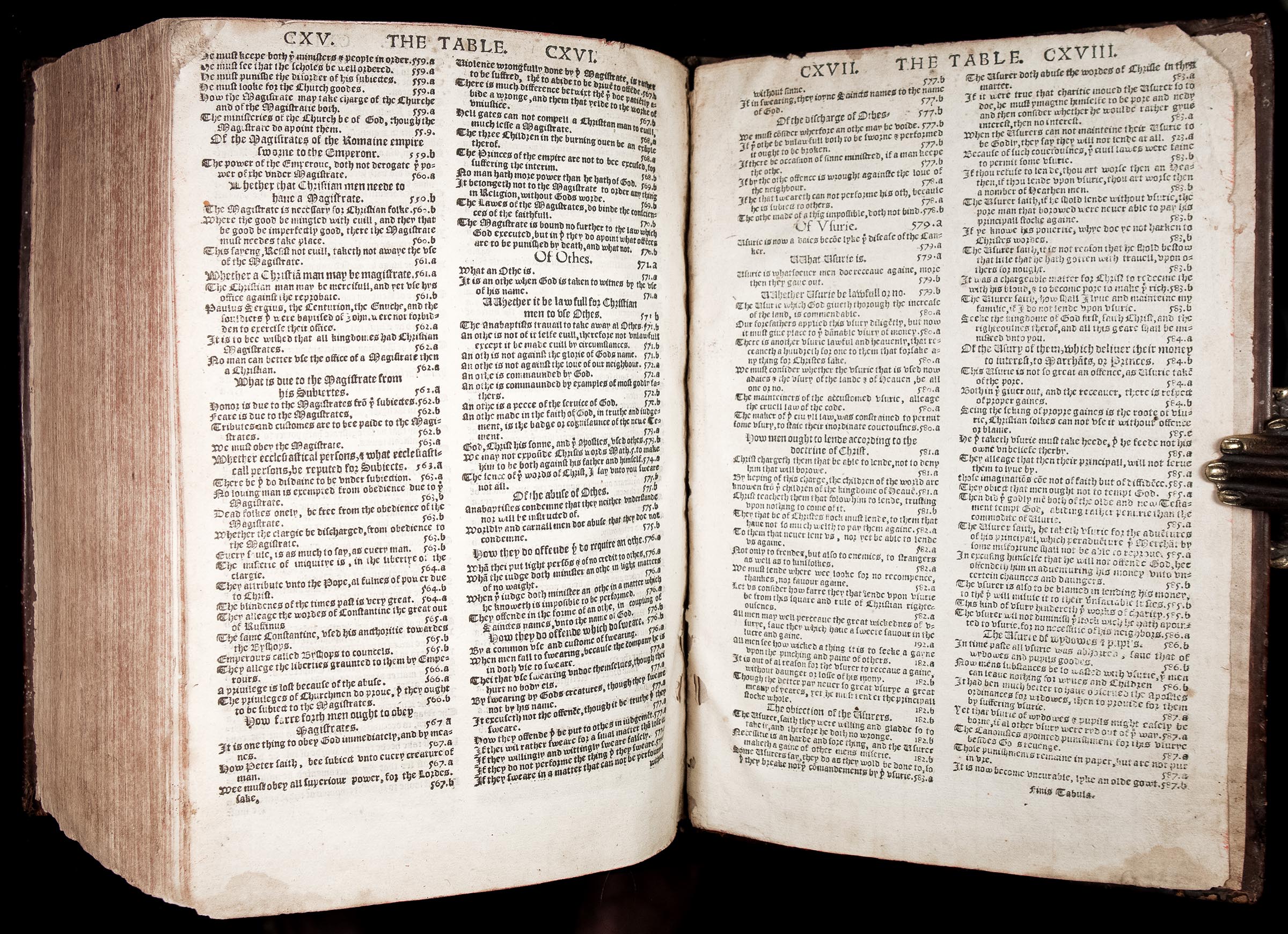
The English translator and editor, John Man, added at the end of the volume (as an appendix following the 1st colophon) two additional chapters: On Othes (i.e. Oaths); and On Usurie (i.e. Usury), which Man felt were “very necessary to be considered in these oure tymes”. These were not past of the original Latin text of Musculus’ Loci communes, but were excerpted from his renowned Commentary upon Psalms.
"Probably the most popular of all the Protestant books acquired [by Cambridge libraries] in the early part of Elizabeth's reign was Musculus' Common Places. His English editor was the Warden of Merton, John Man. […] His popularity is easy to understand. The Common Places must have been the ideal hand-book for the student and later for the preacher: comprehensive, clearly arranged, and homiletic in intent. It is an early and impressive example of the success which awaited works of practical divinity. Their use was not dependent on agreement as to every particular; in this case, for example, the editor included a preface excusing the author for disapproving of infant baptism." (Peter White, Predestination, Policy and Polemic, p. 85).
"First published in Latin in Basle in [1560], this series of essays on topics ranging from God's works to schism and the role of magistrates was heavily supported by scriptural references, was translated into English, and published in folio in 1563 [this edition!] and quarto in 1578. The translator, John Man, thought it ideal for what he deemed the unlearned as well as the learned, but at nearly 1,200 pages of folio it was not a cheap or easy option, and, to judge from the many references to it in English treatises and sermons, copies fell into the hands of the well-educated and well-provided members of the clergy, rather than beginners." (Ian Green, Print and Protestantism in Early Modern England, p. 139).
"Musculus's […] systematic writing, comprised of his collection of common doctrinal topics or Loci communes, [was] first published in 1560. The Loci communes, or 'Common Places,' were written to be a summary of doctrine arising out of the more detailed and developed biblical commentaries. The first major theological Loci communes were written by Philipp Melanchthon, [...] and the genre quickly became a standard for early modern theologians. Based on discussions arising from typical biblical texts, doctrinal excurses or lengthy theological discussions would be organized into a separate publication, which often served as a basic theological textbook. Musculus's Loci communes comprised 69 separate topics […], [and] are noteworthy in part because they contain what is perhaps the first Reformed treatment of the doctrine of the Covenant as a separate and distinct topic." (Mark A. Lamport (Ed.), Encyclopedia of Martin Luther and the Reformation, p. 537-8).
"As a theologian, Musculus left a lasting imprint in his Loci communes sacrae theologiae (Commonplaces of Sacred Theology), a massive work of systematic theology first published [in Latin] in 1560, revised the next year, and soon translated into English and French. He wrote it over the course of a decade while honing his abilities as a biblical exegete. The authorities in Bern, where he then taught, commissioned the text to serve as a scholastic manual of theology, a handbook for students.
"Musculus purposefully adopted a pastoral and biblical-theological approach to this academic task. With pick and shovel, Musculus had attended carefully to pericopes concerning the Noahic and Abrahamic covenants in his commentary on Genesis, and now he shaped that exegetical yield into doctrine in his Loci communes. What makes his Loci communes unique is that it was, among other things, the first Reformed system in which the 'covenant' received its own distinct chapter. […] Musculus carve[d] out a clear place for covenant as a particular, well-cultivated topic or doctrine within his system. He also used the doctrine as a kind of method for navigating the relations between various topics: Abraham, Moses, and Christ; the Old and New Testament; justice and grace; election and reprobation. Musculus conceived of two kinds of covenant, or what he called more precisely the 'twofold covenant of God,' made up of 'general' and 'special' aspects. He described the general covenant as that which God "fixed with the entire fabric of the world, and all those who inhabit it, so beasts as well as men, also with day and night, winter and summer, cold and heat, planting and harvest, etc." Musculus connected this general covenant with creation and with God's preservation of the world after the flood. Because it involved the regular order of nature, it could be called 'earthly and temporal.' Next, Musculus explained the special covenant: While the general covenant of creation 'does not continue beyond the state of this world which at last shall be destroyed,' the special covenant is 'everlasting.' For, he argued, God has 'condescended to ratify it with the elect and believers.' This covenant is special because it concerns 'all the elect and believing in Christ … the true seed of Abraham and children of the promise.' […]
"Musculus moved from creation to redemption, from perpetual planting and harvest to the promise of the Seed. Under Musculus, the twofold doctrine of the covenant began to sprout, even if his general covenant was not identical with the more fully developed doctrine of the covenant of works. Strikingly, though, Musculus also started to describe, if not fully expound, the law-gospel distinction within a covenantal framework as one of the topics that followed his presentation of covenant: 'The law warns, urges, and curses; the gospel preaches grace and remission of sins to those who believe.' In this regard, he sits among a range of formative theologians who provided essential mineral elements to the Reformed tradition, including Calvin, Heinrich Bullinger, Zacharias Ursinus, Caspar Olevianus, Andreas Hyperius, and Robert Rollock." (Zachary Purvis, Packed Dirt, Churchgoing, Pericope, Covenant: Tales of Wolfgang Musculus, Modern Reformation, Vol. 32, No. 5/'The Already' issue).
"Wolfgang Musculus is an oft-overlooked German Reformer who taught at Bern in Switzerland. His Loci Communes, in contrast to Calvin's Institutes, contain a full doctrine of the attributes of God and were studied widely. He is also the only Reformer we know of on record who made the children of believers participants in the Lord's Supper, which makes him an interesting case study on the covenant and the sacraments." (Ryan McGraw, Reformed Scholasticism: Recovering the Tools of Reformed…, p. 44).
Wolfgang Musculus, born Müslin or Mauslein (1497 – 1563) was a prominent Lotharingian humanist philologist, Reformed theologian and hymn-writer, born in the village of Duss (Moselle), then a German-speaking area. In 1527, he left the Benedictine monastery at Lixheim, to serve as deacon of the Cathédrale Notre-Dame-de-Strasbourg while studying under Bucer and Capito. He left for Augsburg in 1531. While there, he participated in the Wittenberg accords (1536) and Worms discussions (1540), though he eventually left in response to the anti-Protestant Augsburg Interim (1548). Musculus declined an invitation from the Archbishop of Canterbury to join Bucer in England after the Interim, instead heading for the Swiss territories.
From 1549 he served as professor of theology at Bern, where he remained an important Reformed leader until his death. While at Bern, he wrote several biblical commentaries and his major systematic treatise on theology Loci communes sacrae theologiae (offered here in its first English edition). Starting with a commentary on Gospel of Matthew published in 1544, Musculus proceeded to compose commentaries on 16 different biblical books, of which his Commentary on the Psalms is particularly important. The order of his exegetical works closely followed a model proposed by his friend and fellow reformer Martin Bucer. His exegetical approach is characterized by a comprehensive and copious style, and his commentaries were renowned in the Reformed tradition for centuries.
Musculus also had a considerable musical talent and is famous for his hymns. J. S. Bach used Musculus' 1530 hymn, a paraphrase of Psalm 23, as the text for his chorale cantata "Der Herr ist mein getreuer Hirt" (BWV 112).
The translator and editor of this 1st English edition was John Man (c. 1512–1569), an English clergyman, diplomat, and academic who served as the Warden of Merton College, Oxford, starting in 1562. Appointed by Queen Elizabeth I, he held this position until his death, while also serving as Queen's ambassador to Spain in 1565. Man is noted for his role as a Protestant leader in academia during the Elizabethan era.
ESTC S115472; Pollard & Redgrave STC, 18308; Herbert, Typographical Antiquities 608; McKerrow, Printers’ & Publishers’ Devices in England and Scotland, 146 (for R. Wolfe’s device, citing this particular edition).
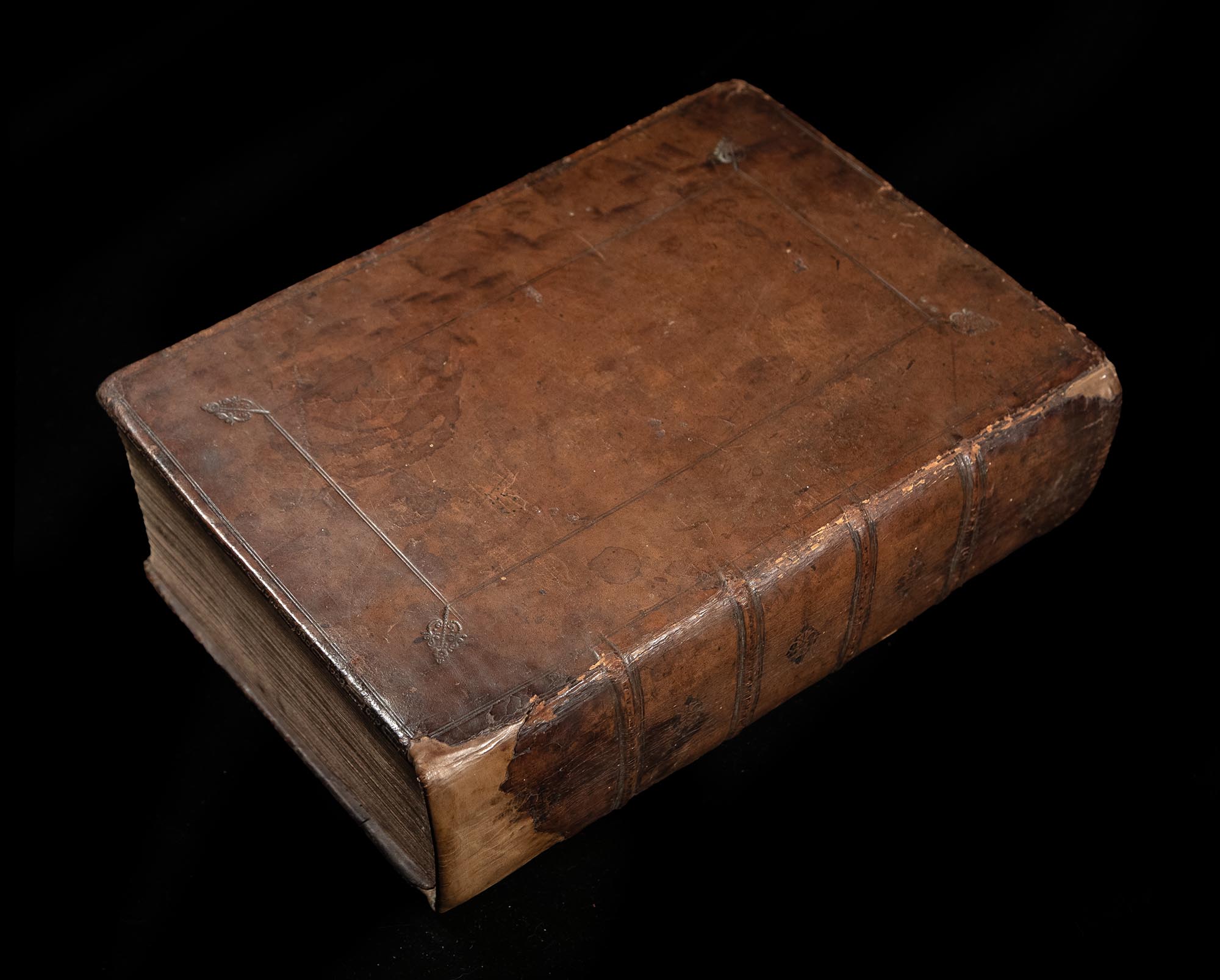
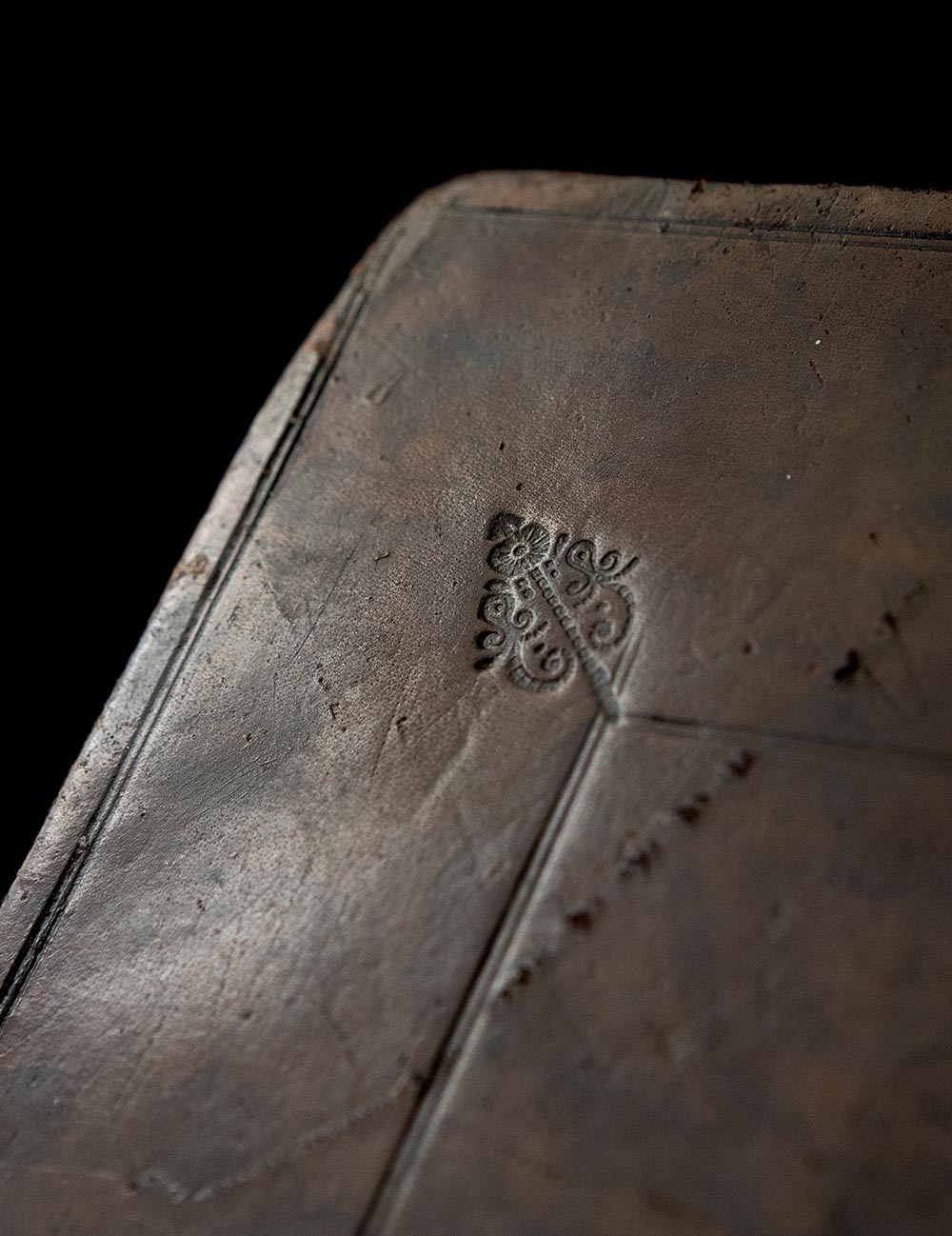
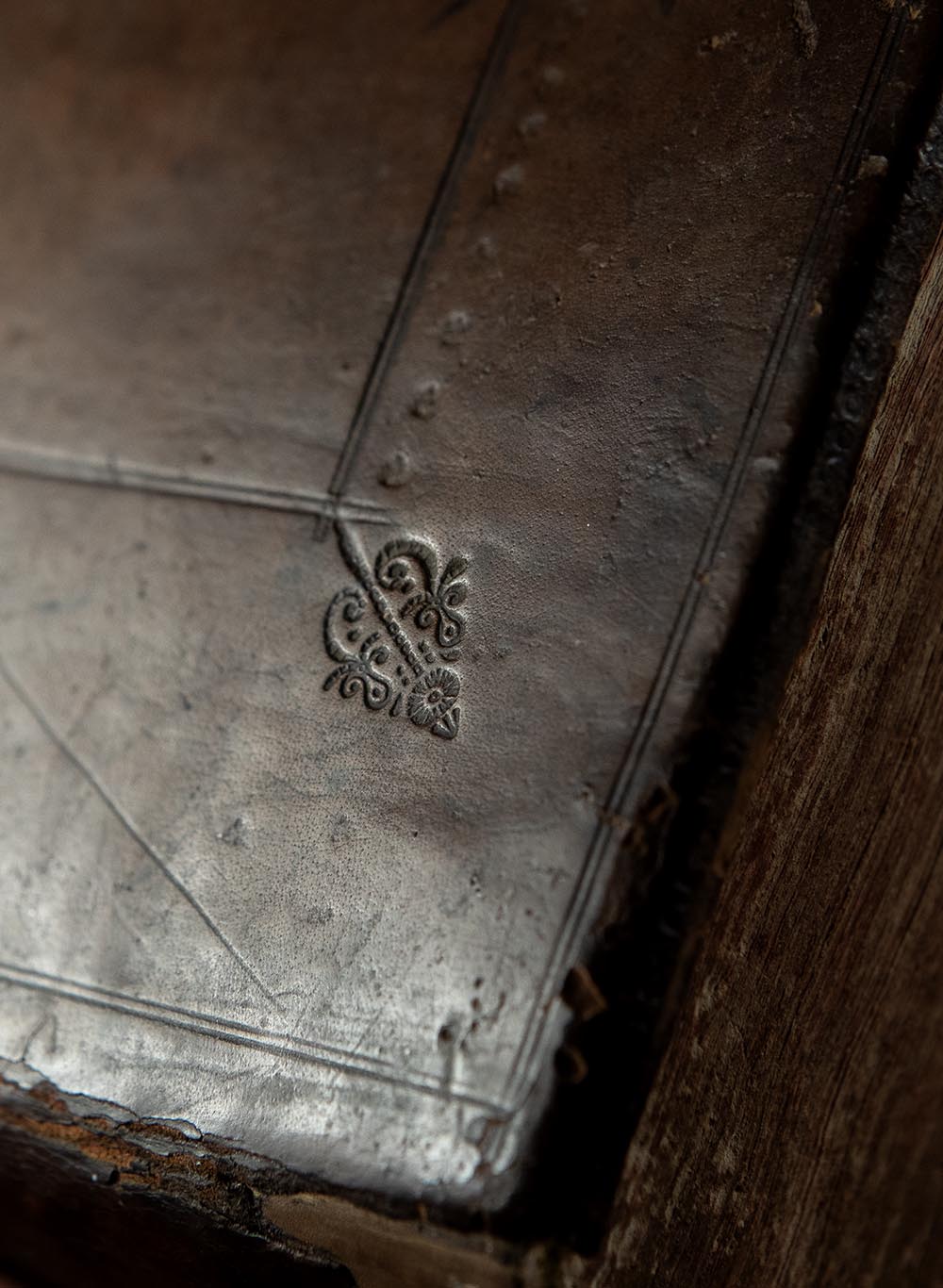
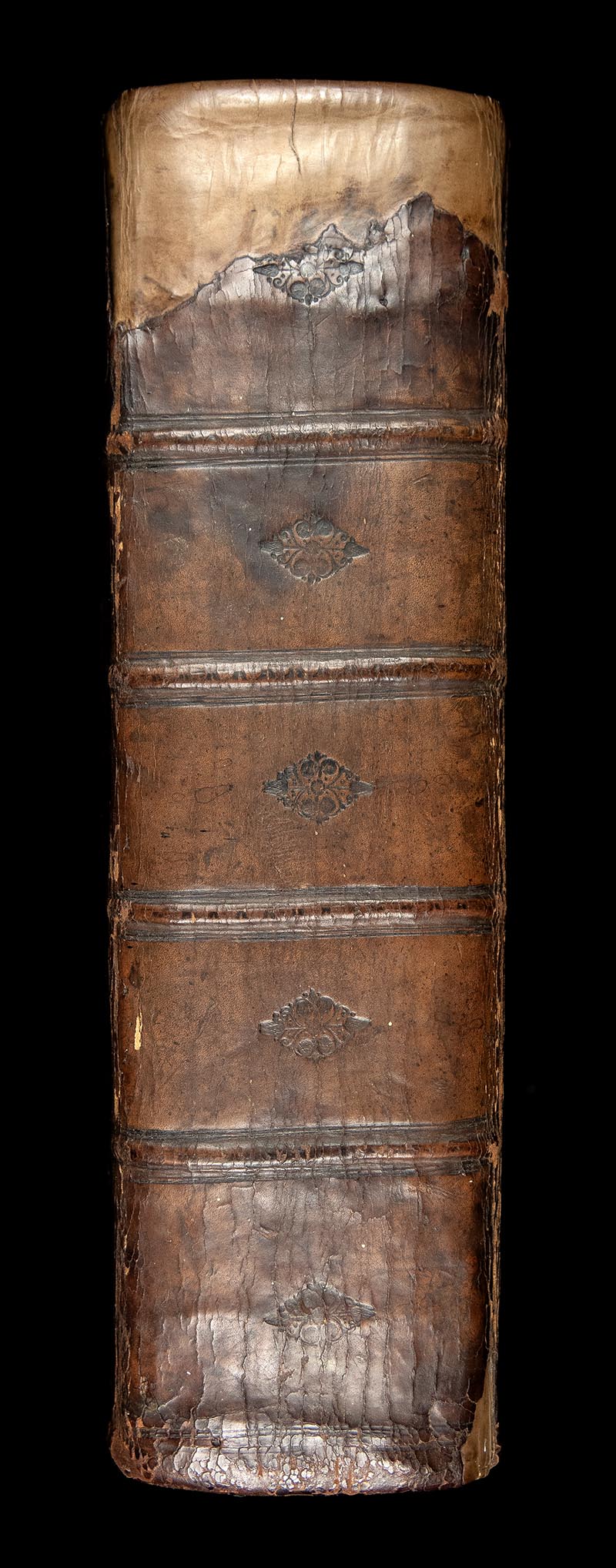
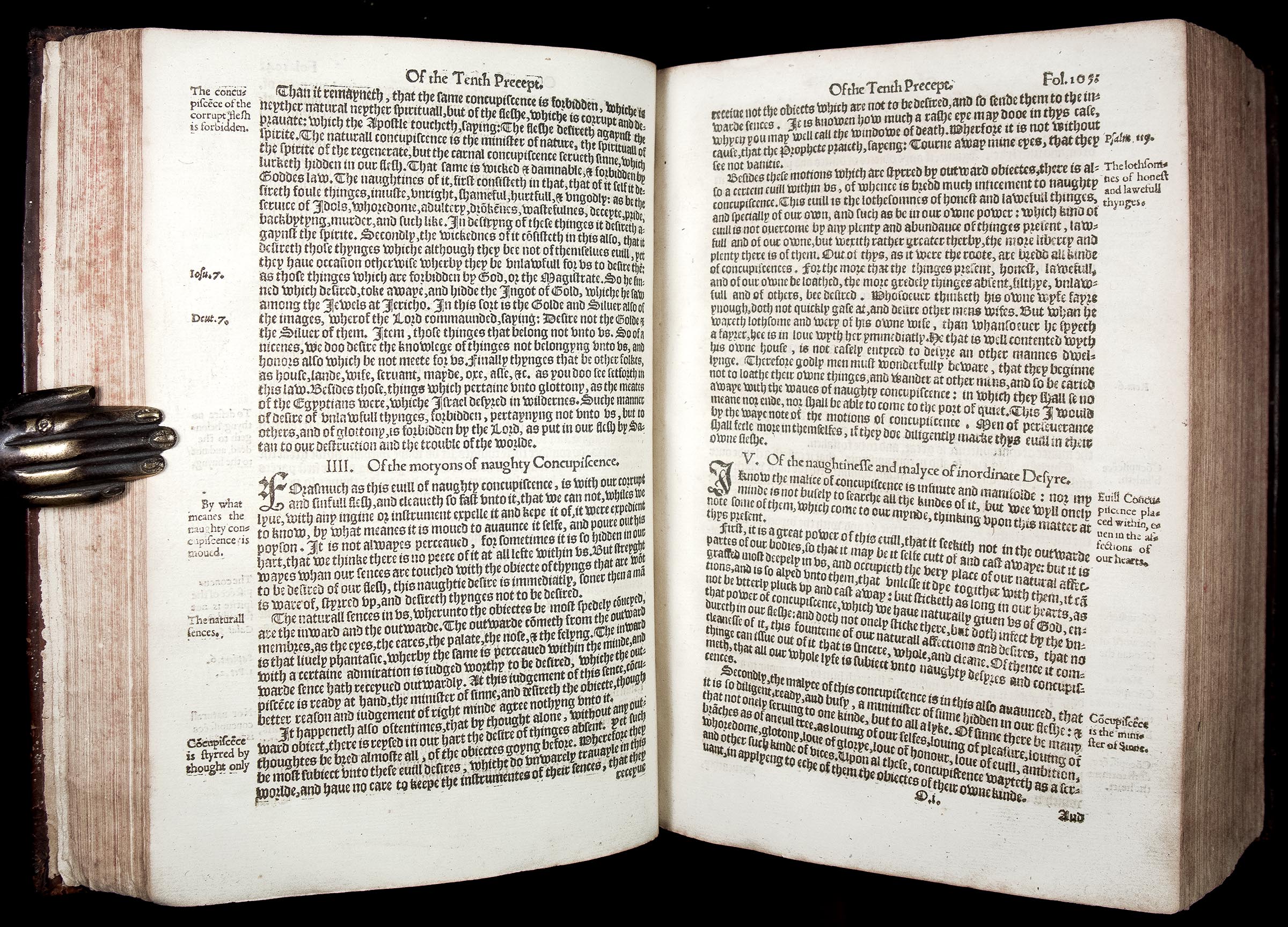
Thick Folio, textblock measures 28.5 cm x 19 cm. Bound in original 16th-century dark-brown calf, with covers paneled in blind, spine blind-tooled in compartments. Stubs of vellum spine-liner protruding between pastedown and free endpaper both at front and rear.
Foliation: [6], 587, [1 blank], [32] leaves (forming 1252 pages in total).
Signatures π6 A-Y8 Aa-Zz8 Aaa-Zzz8 Aaaa-Cccc8 Dddd2 a8 b10, 2a-c8 d6.
COMPLETE, including the integral blank b10.
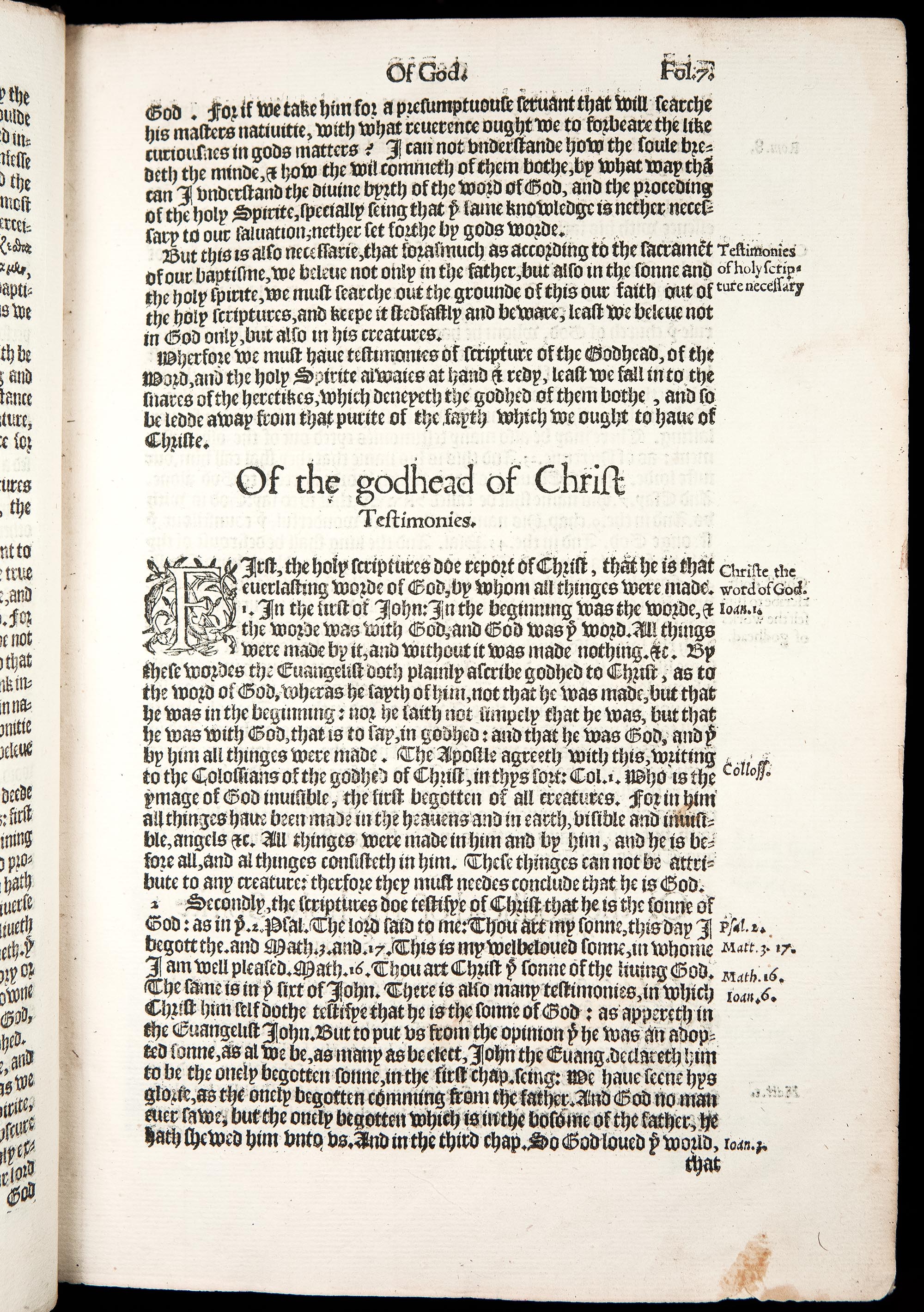
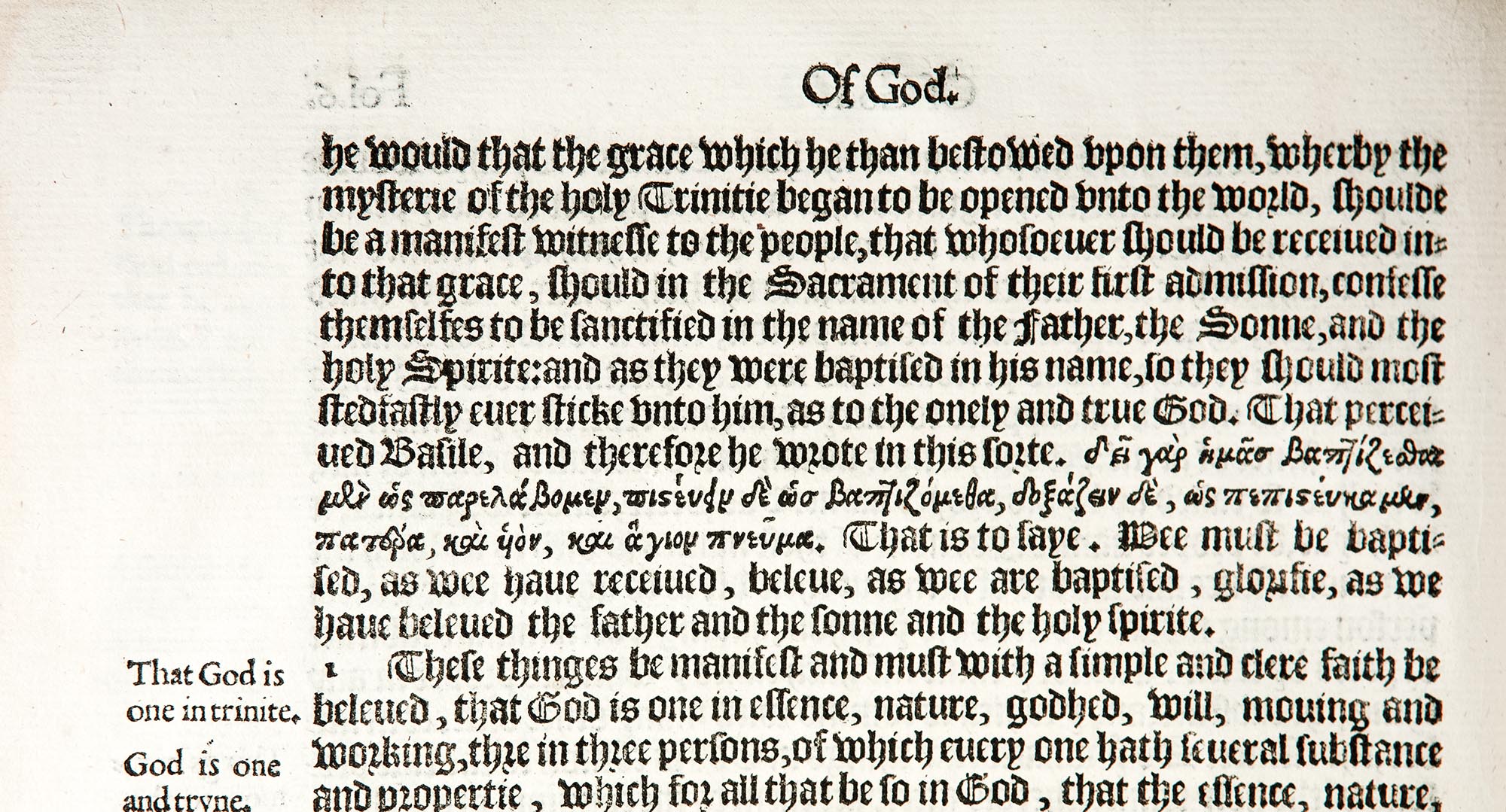
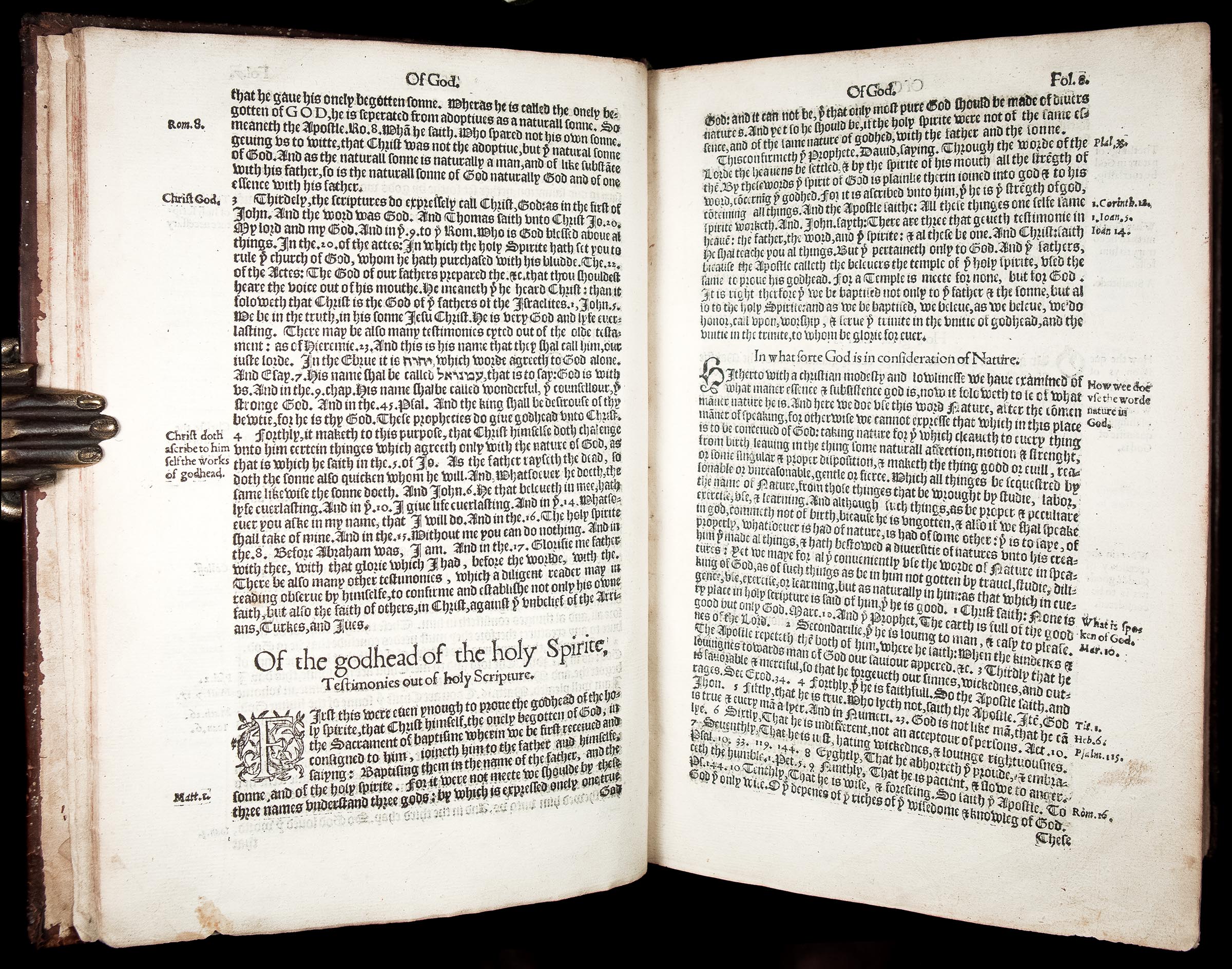
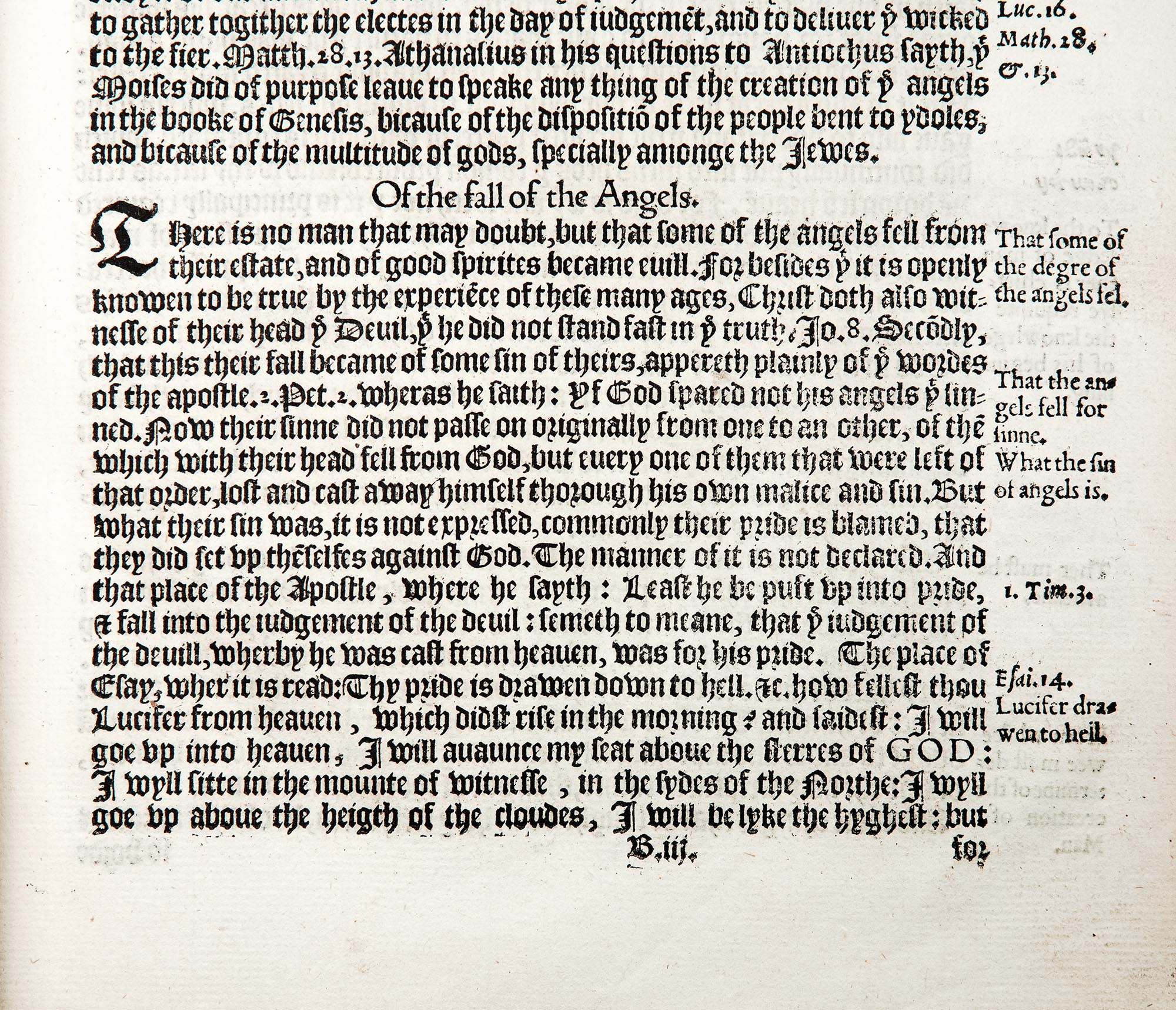
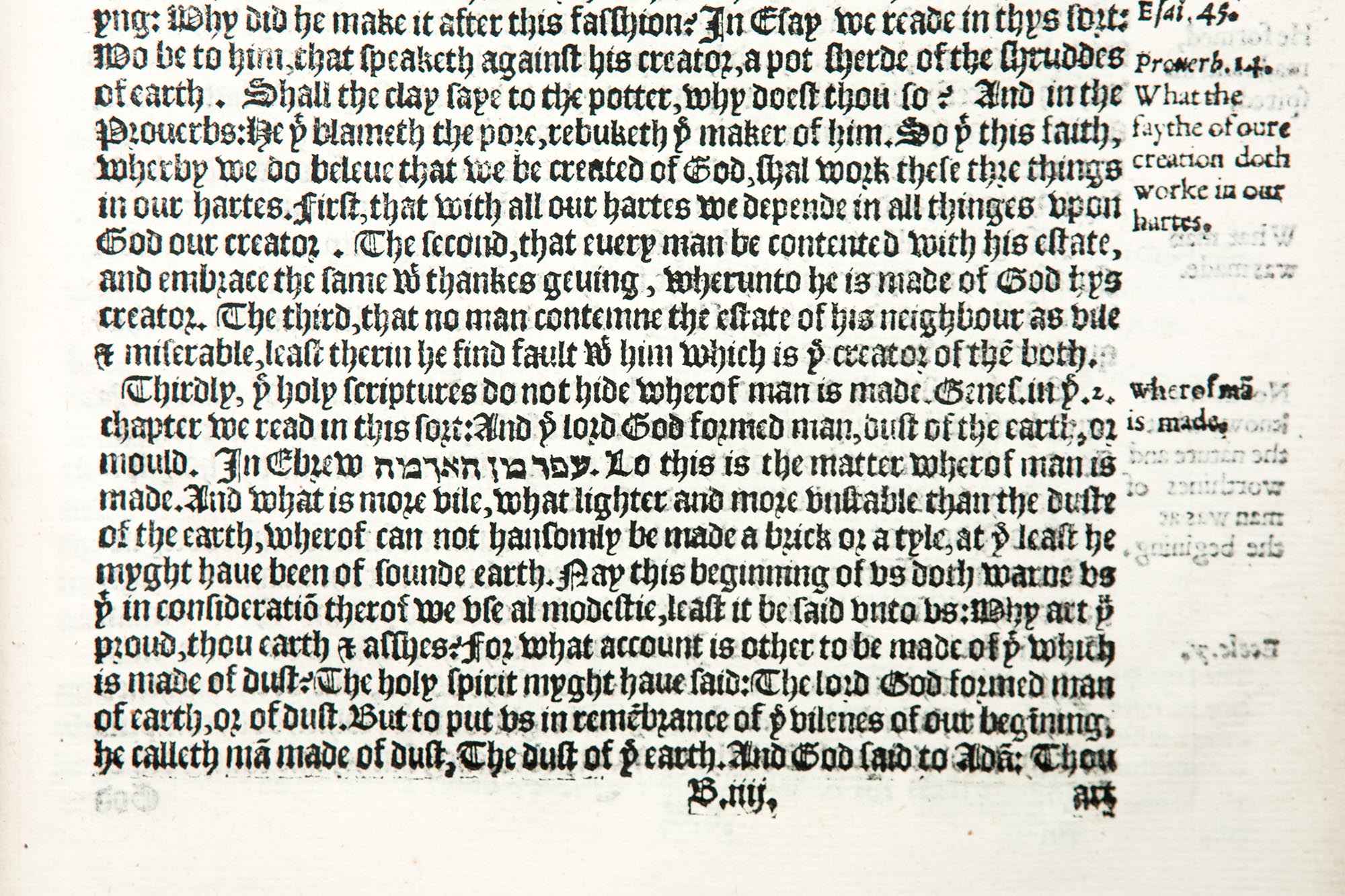
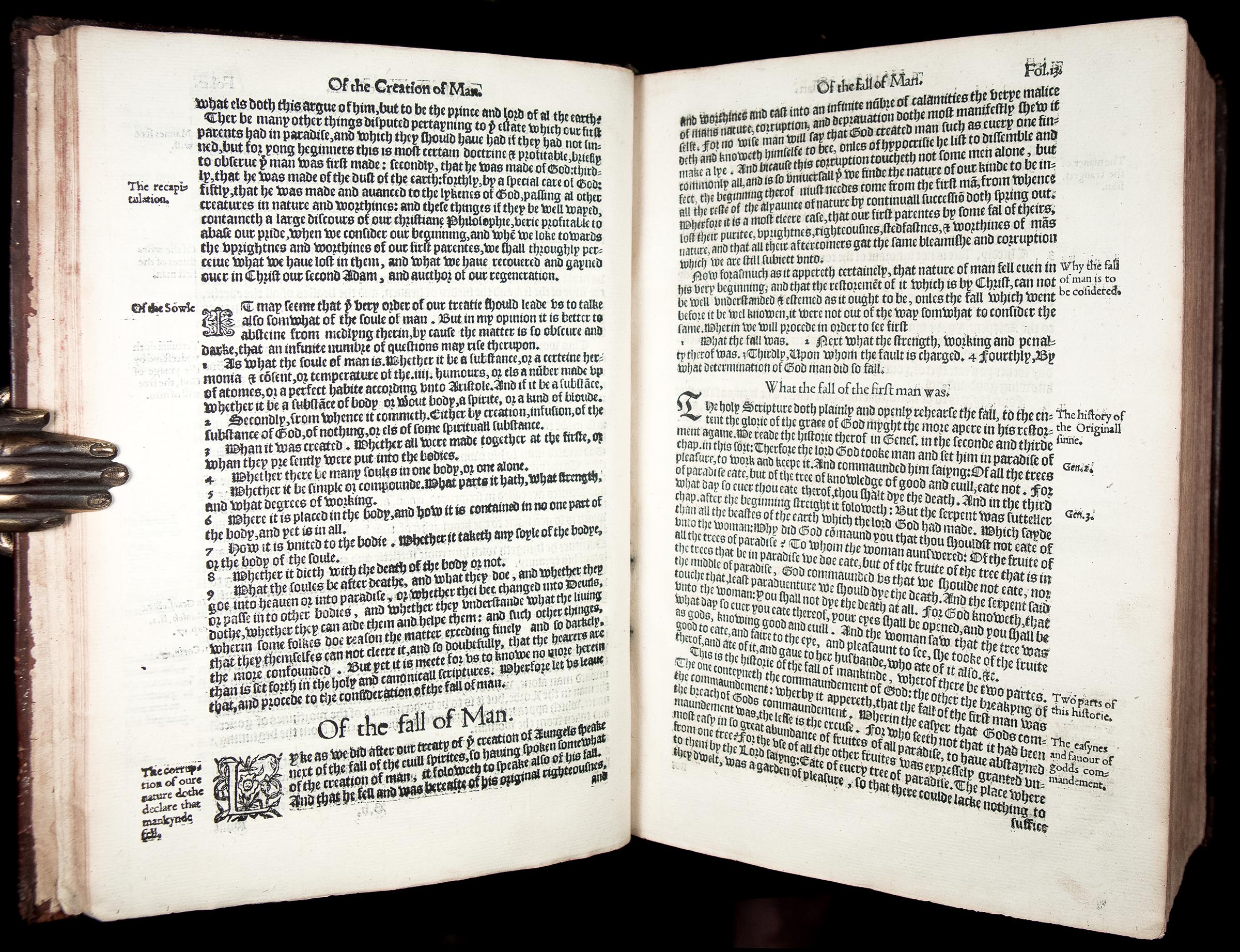
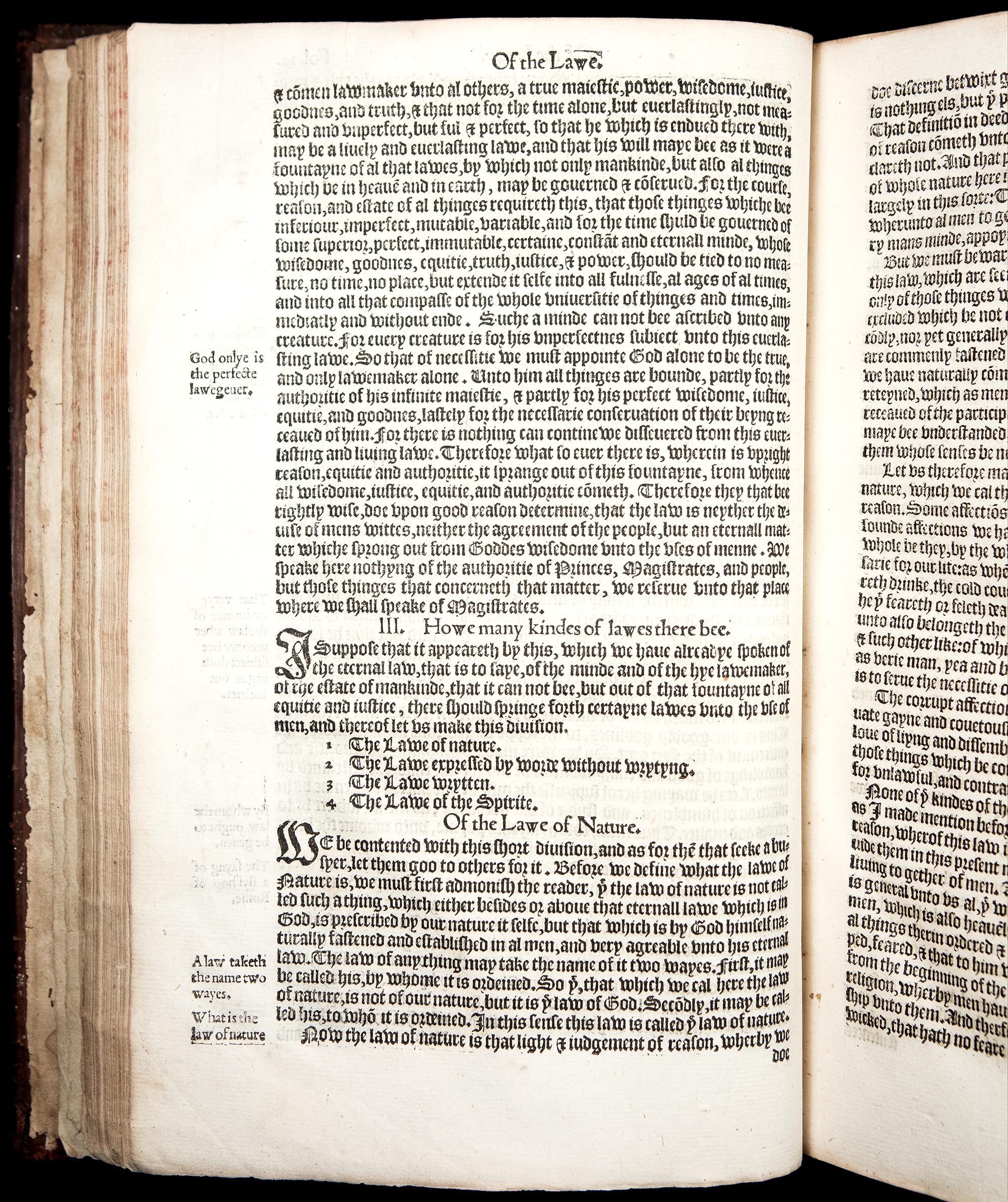
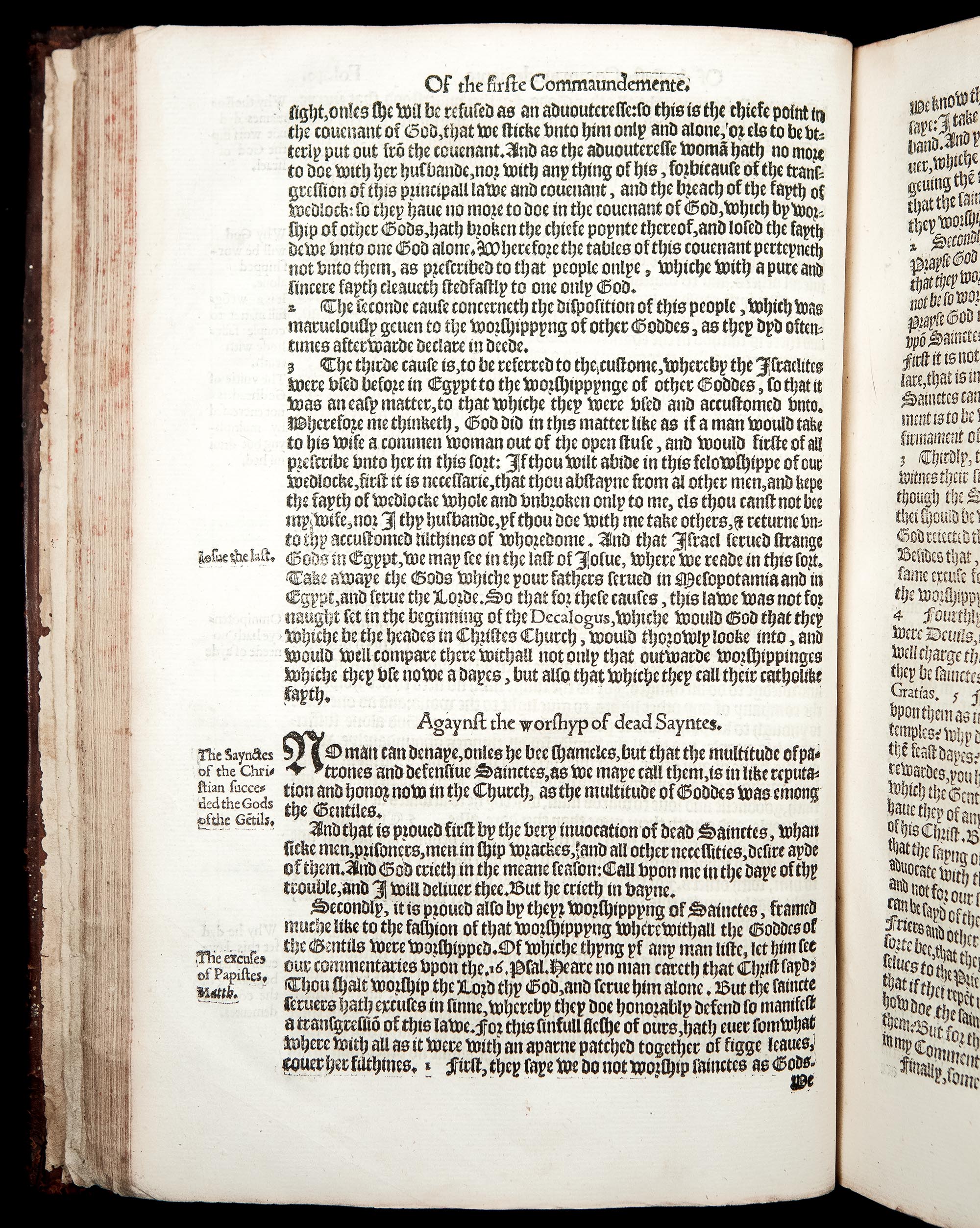
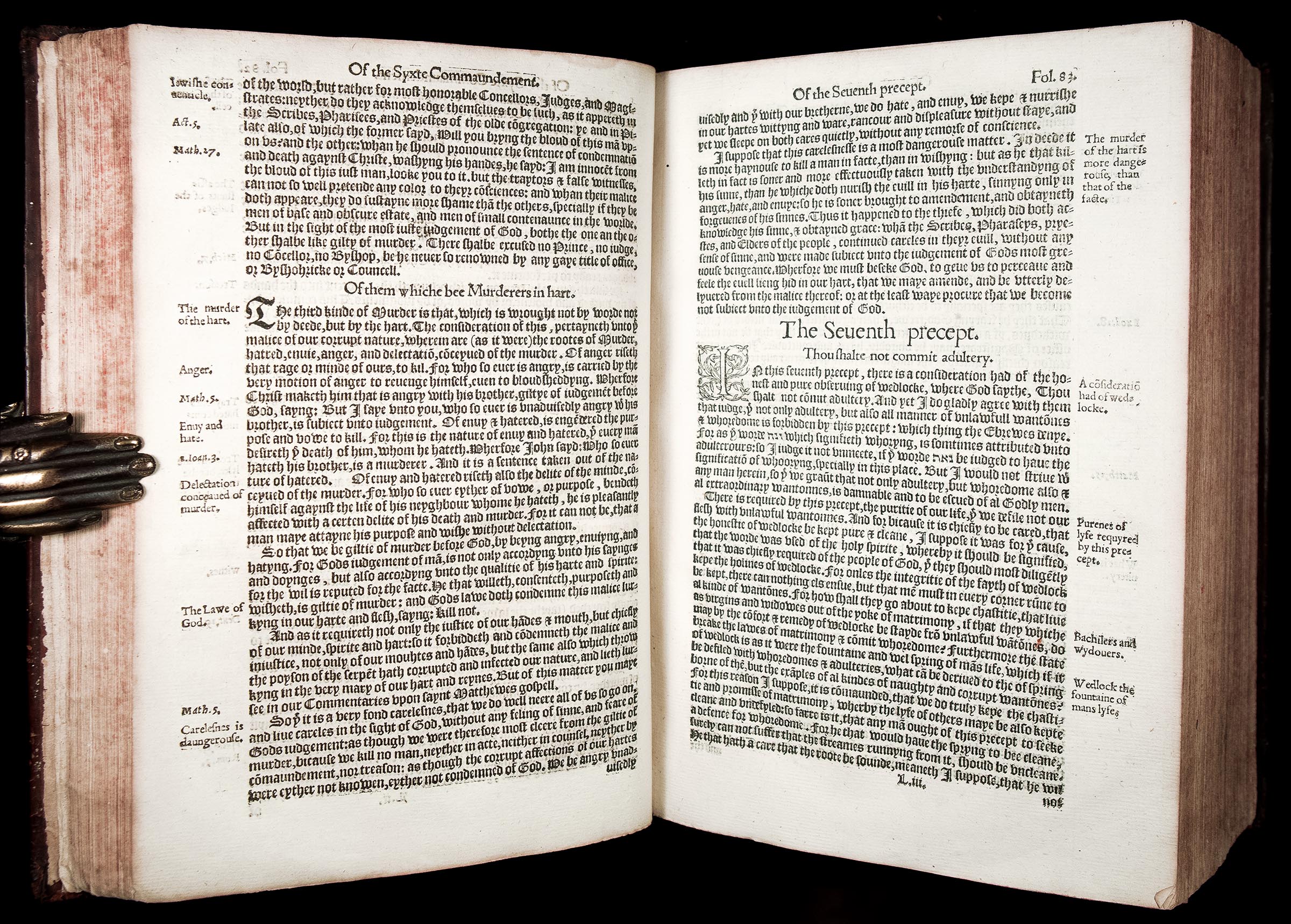
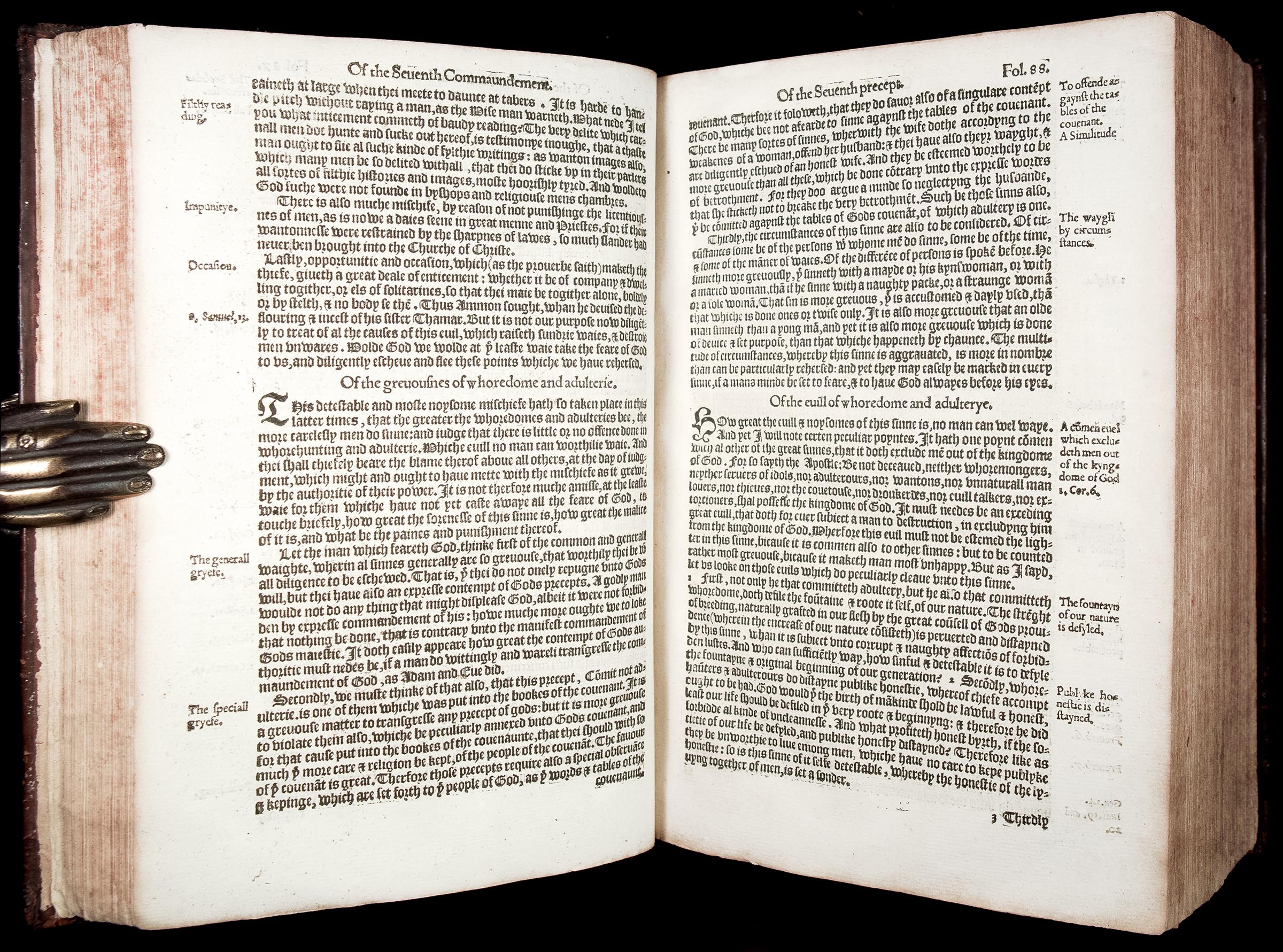
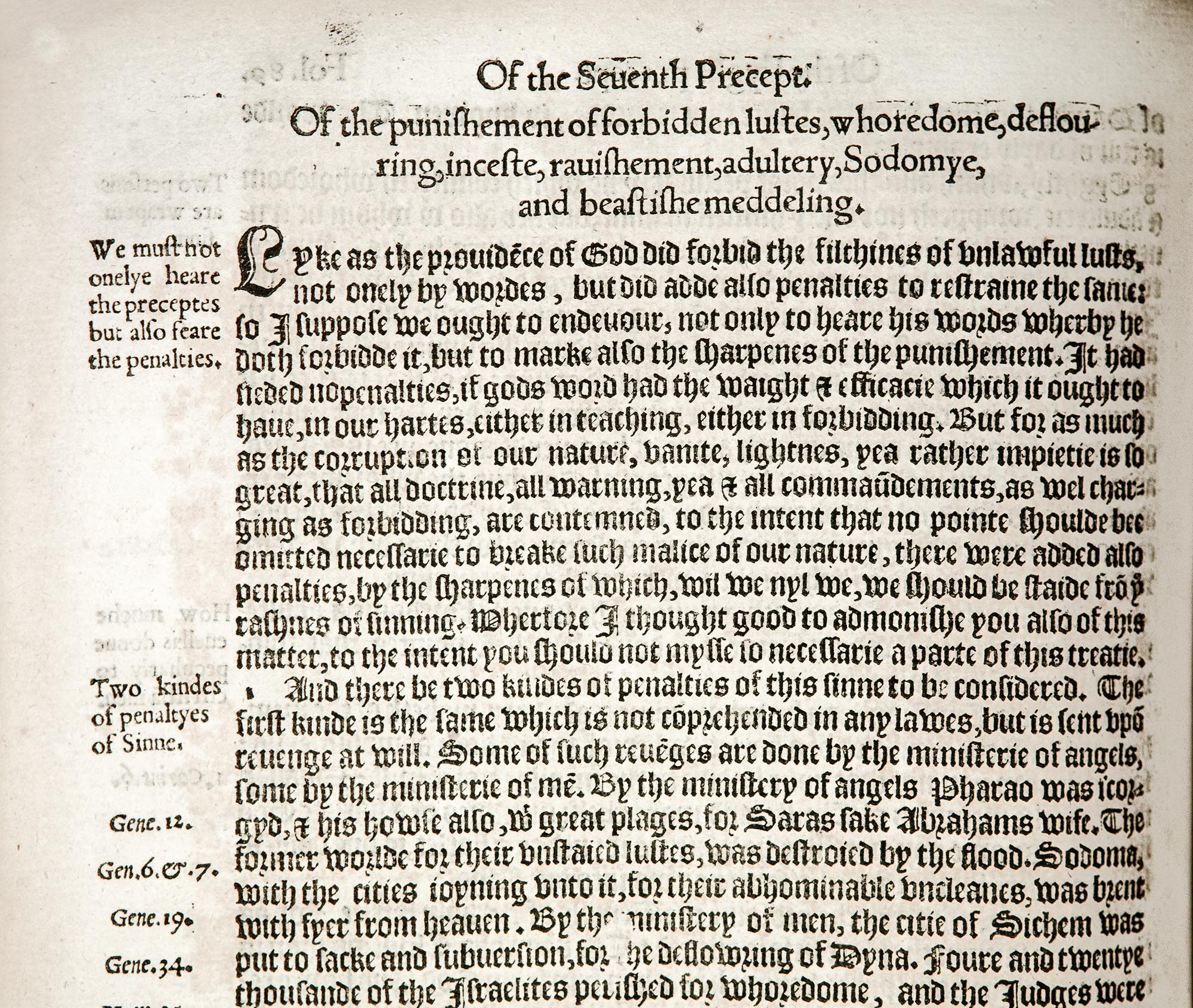
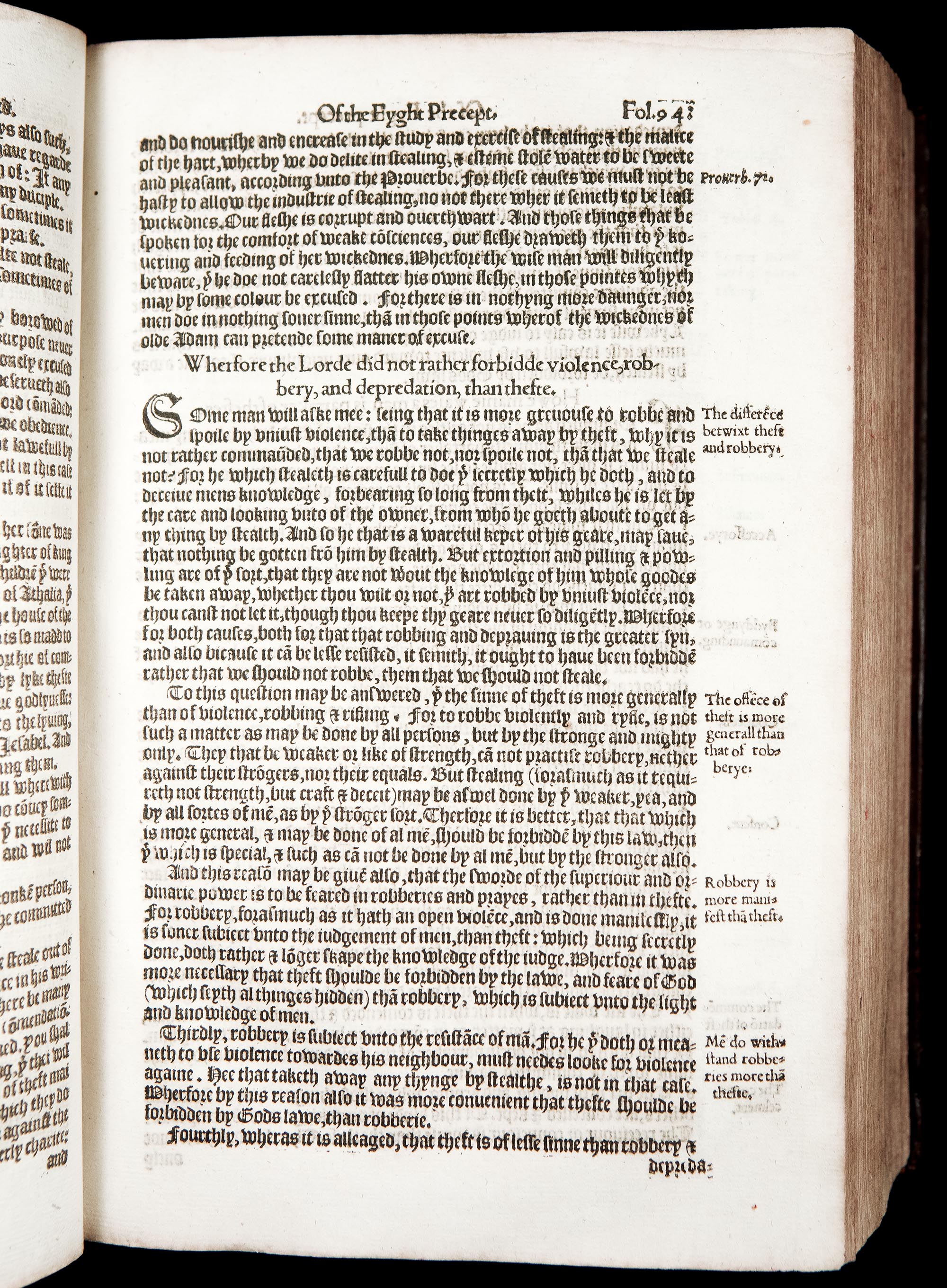
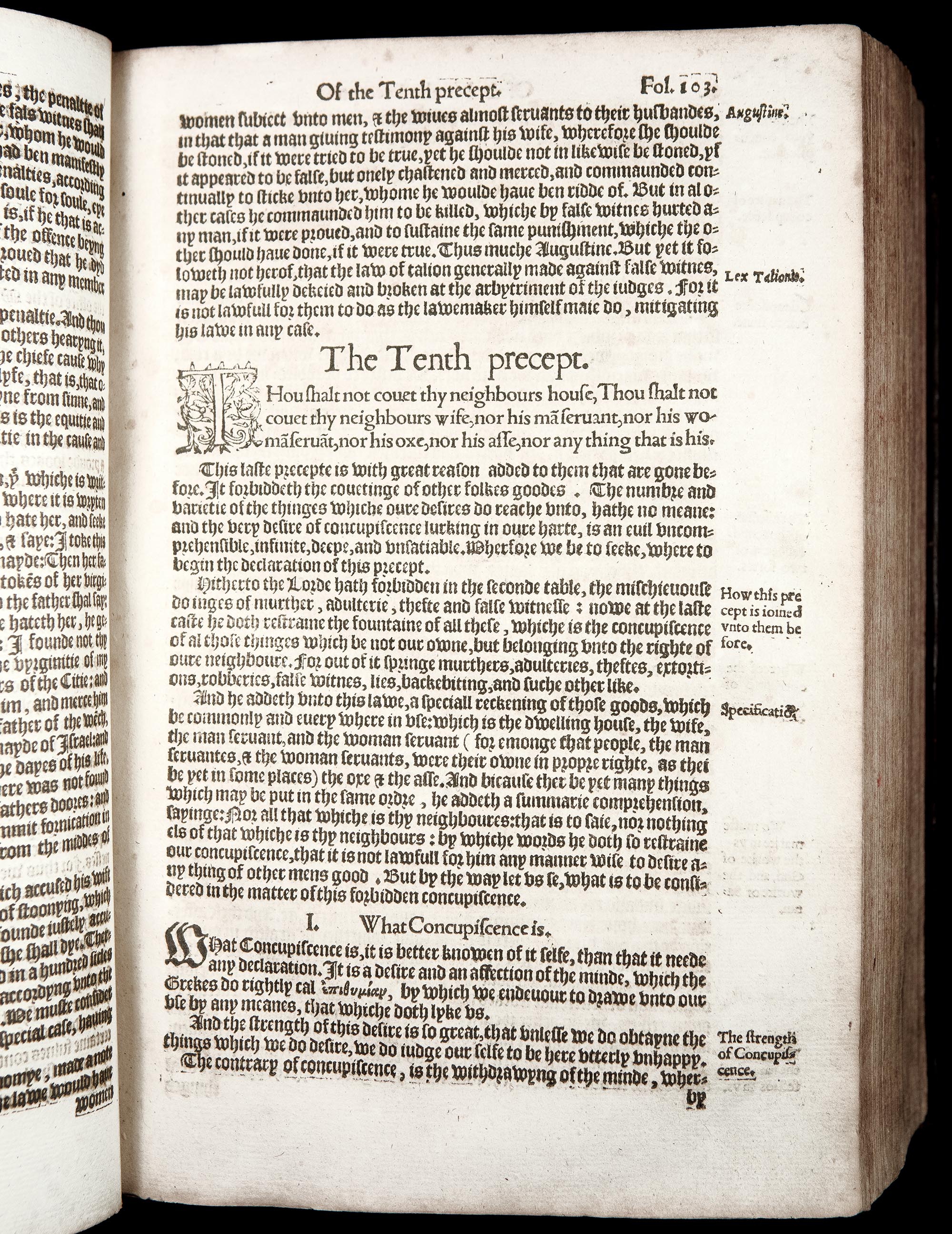
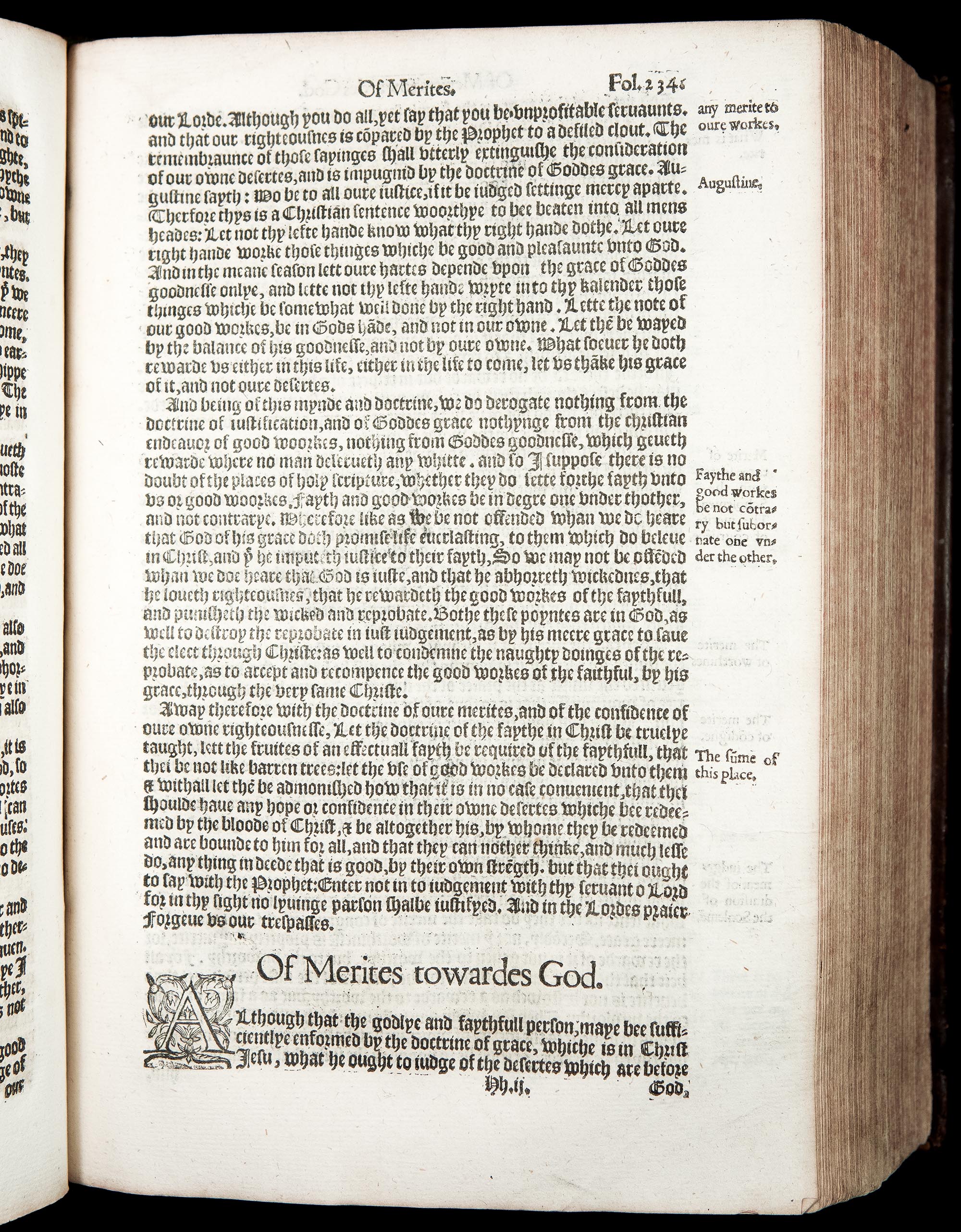
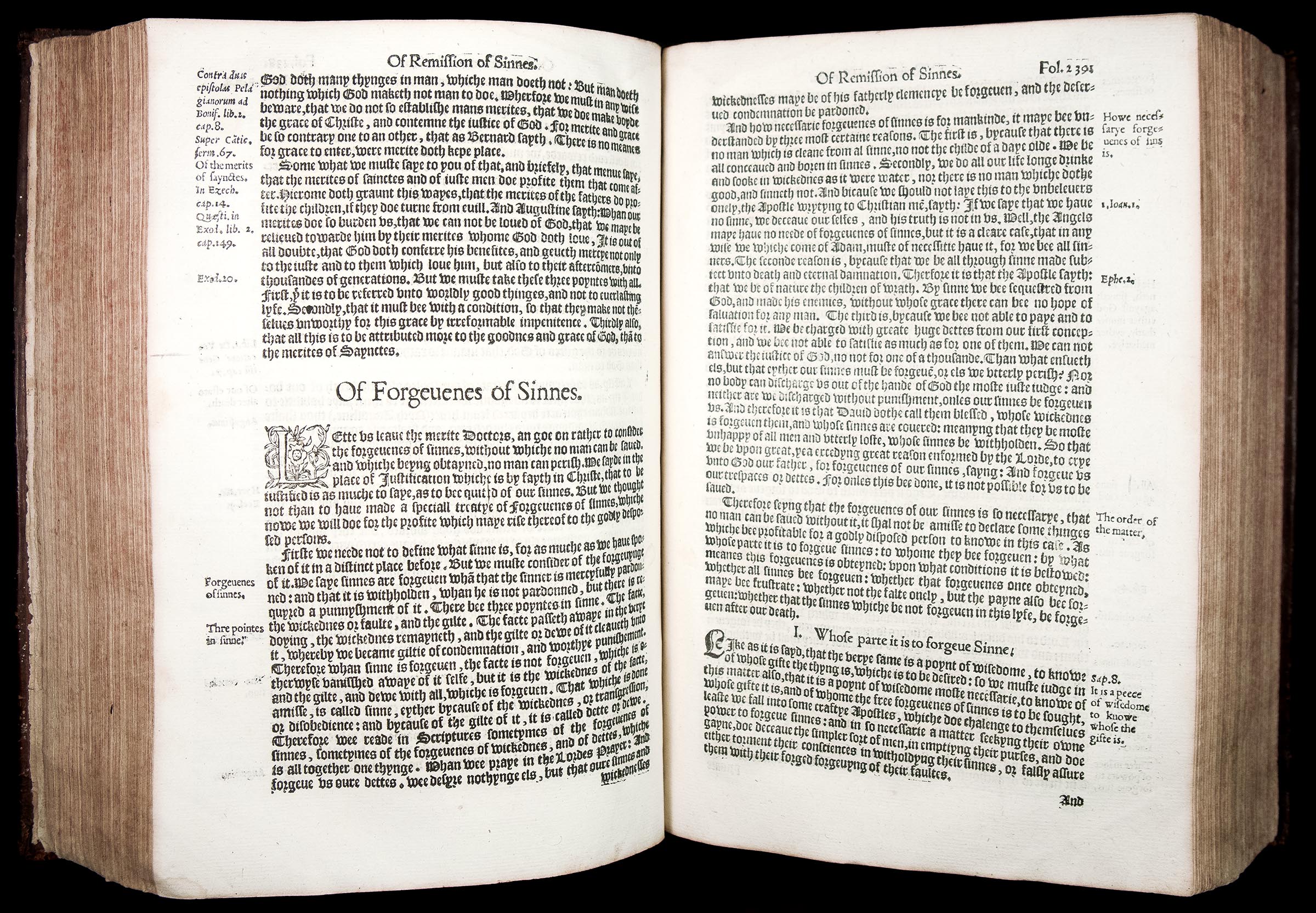
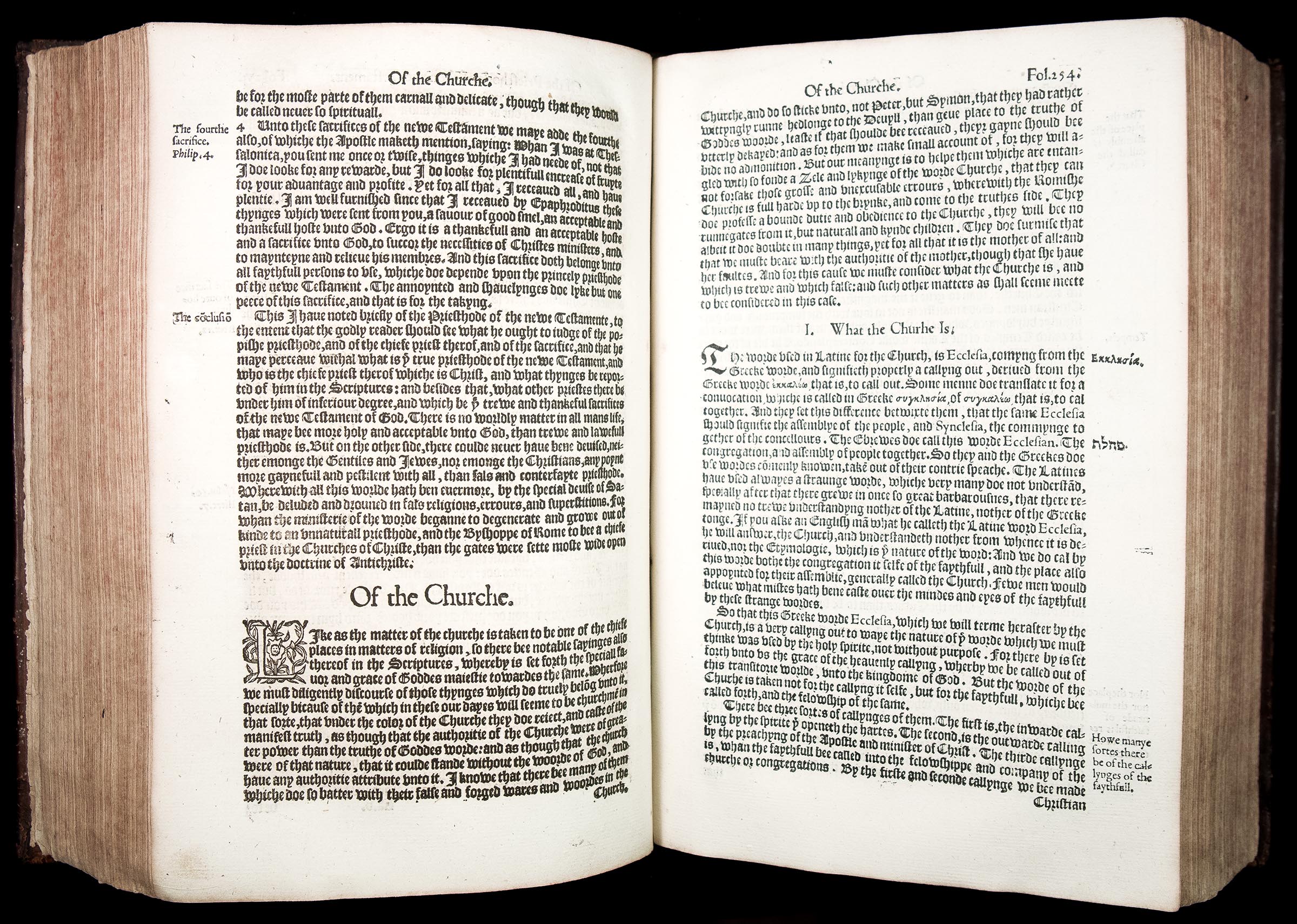
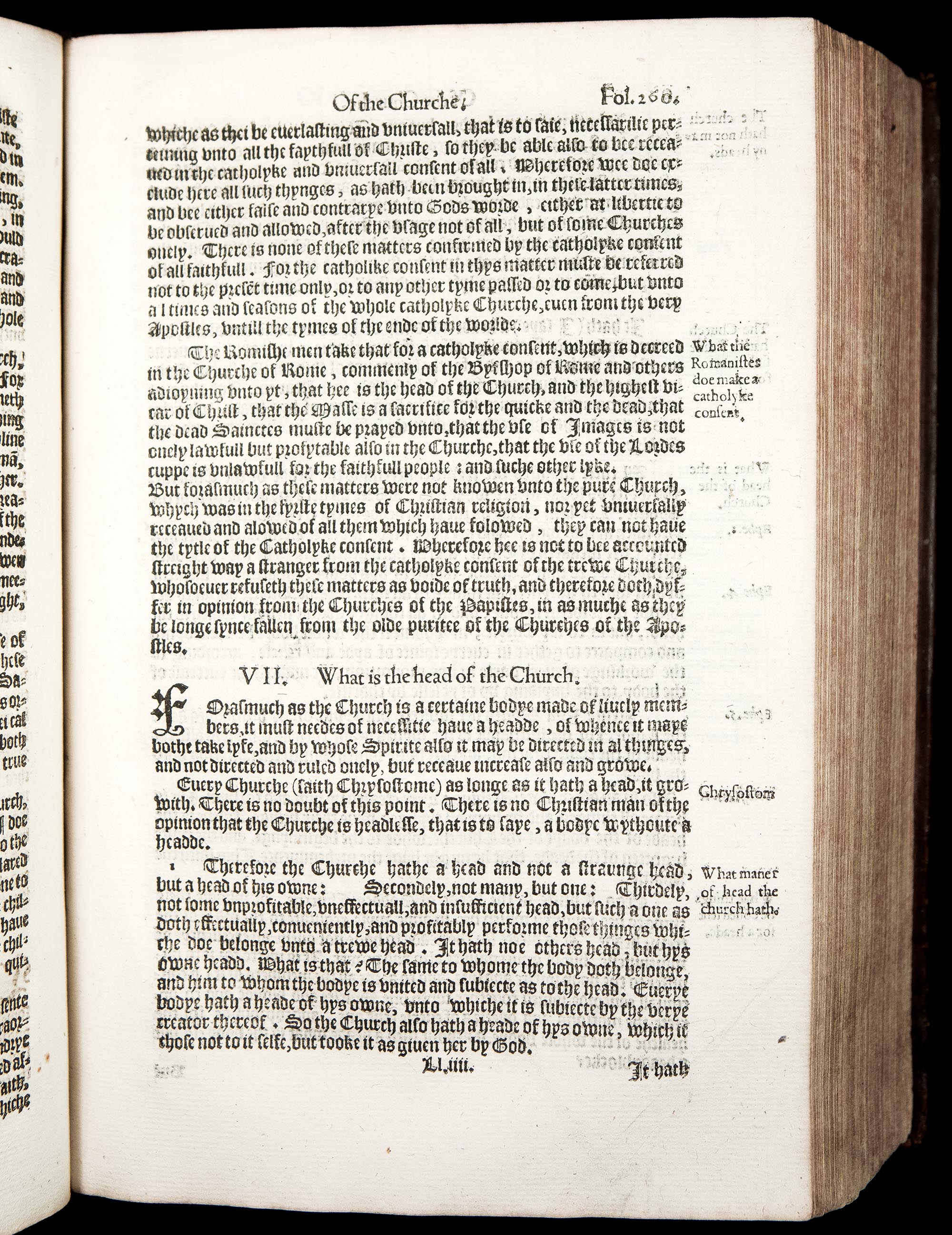
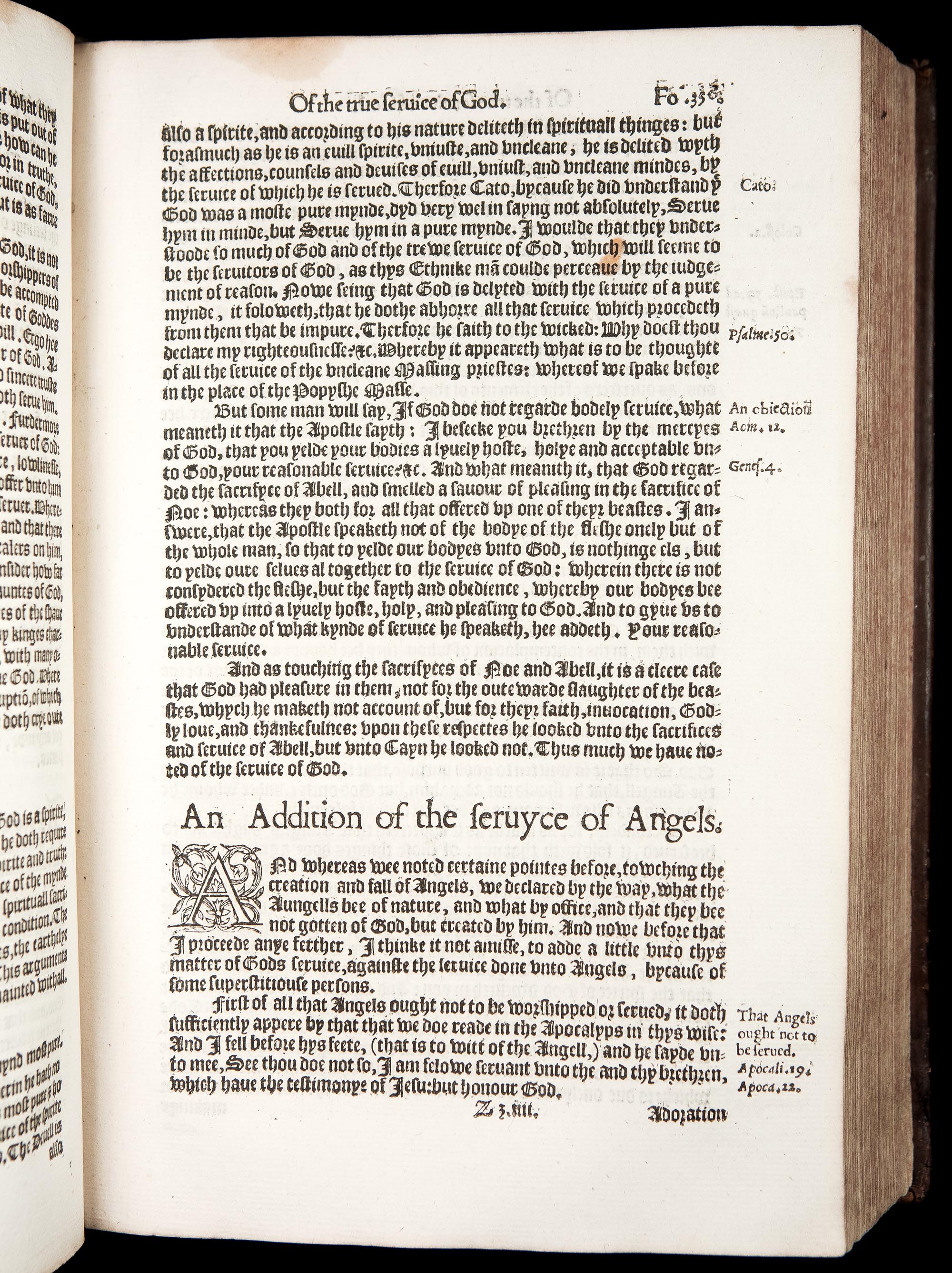
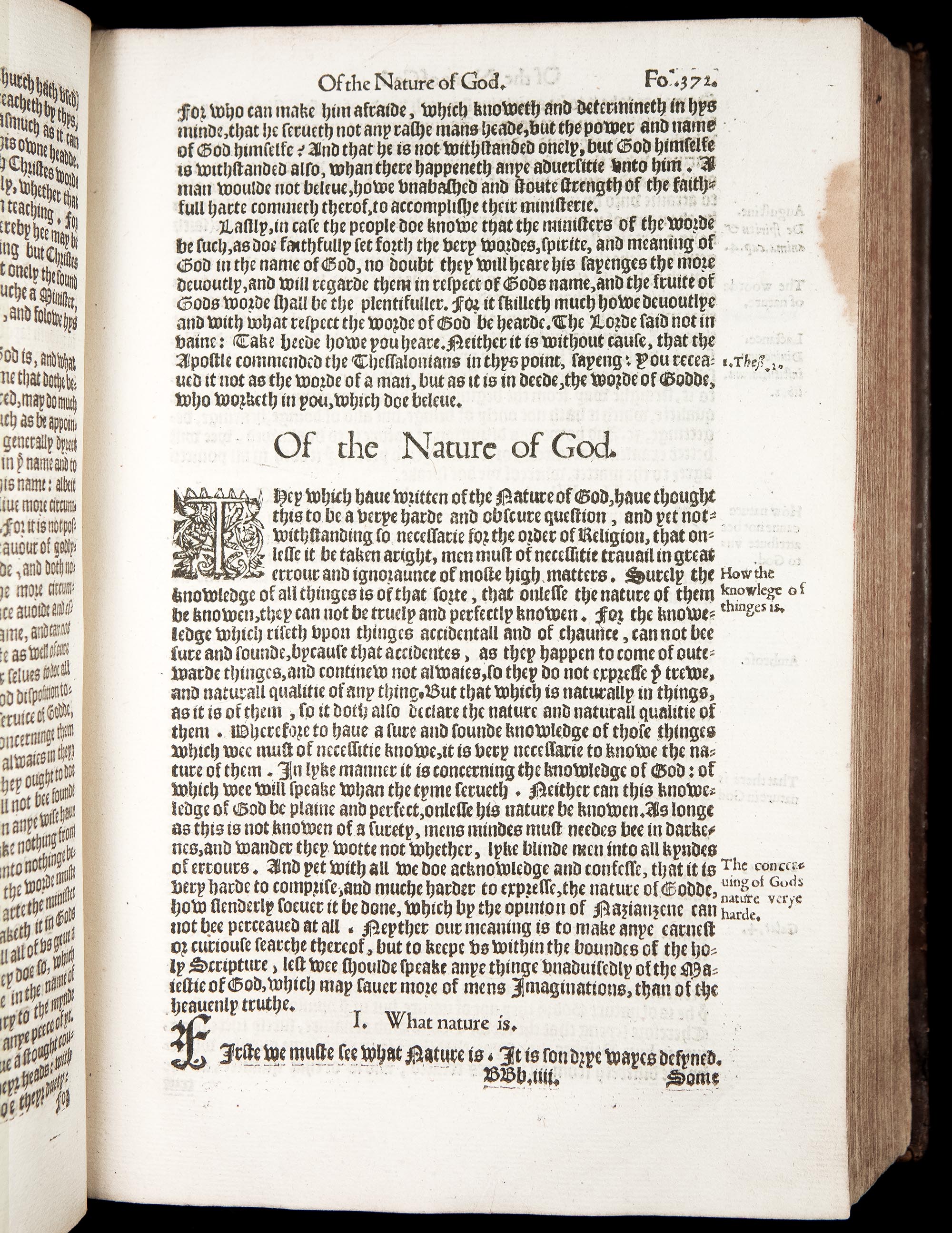
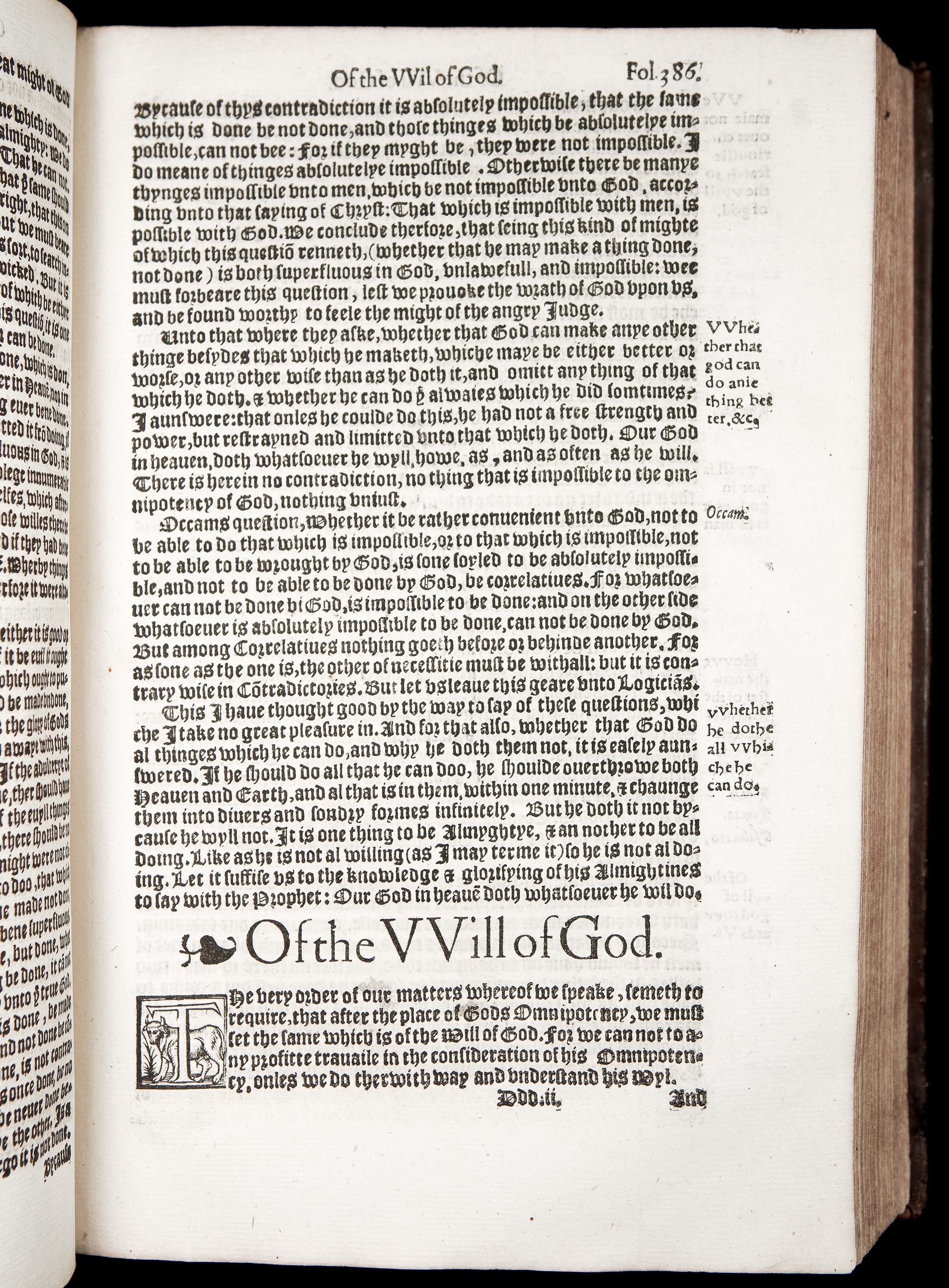
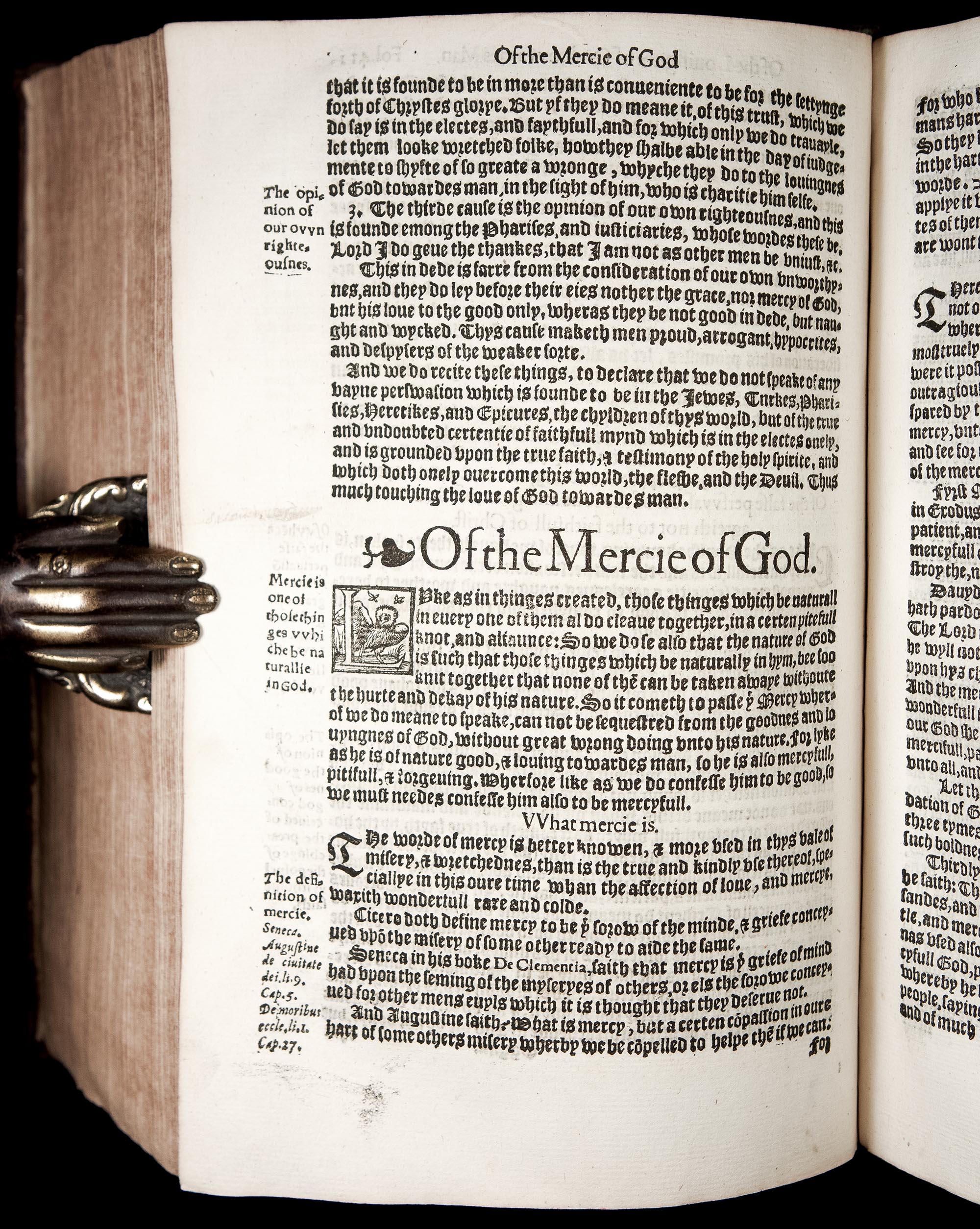
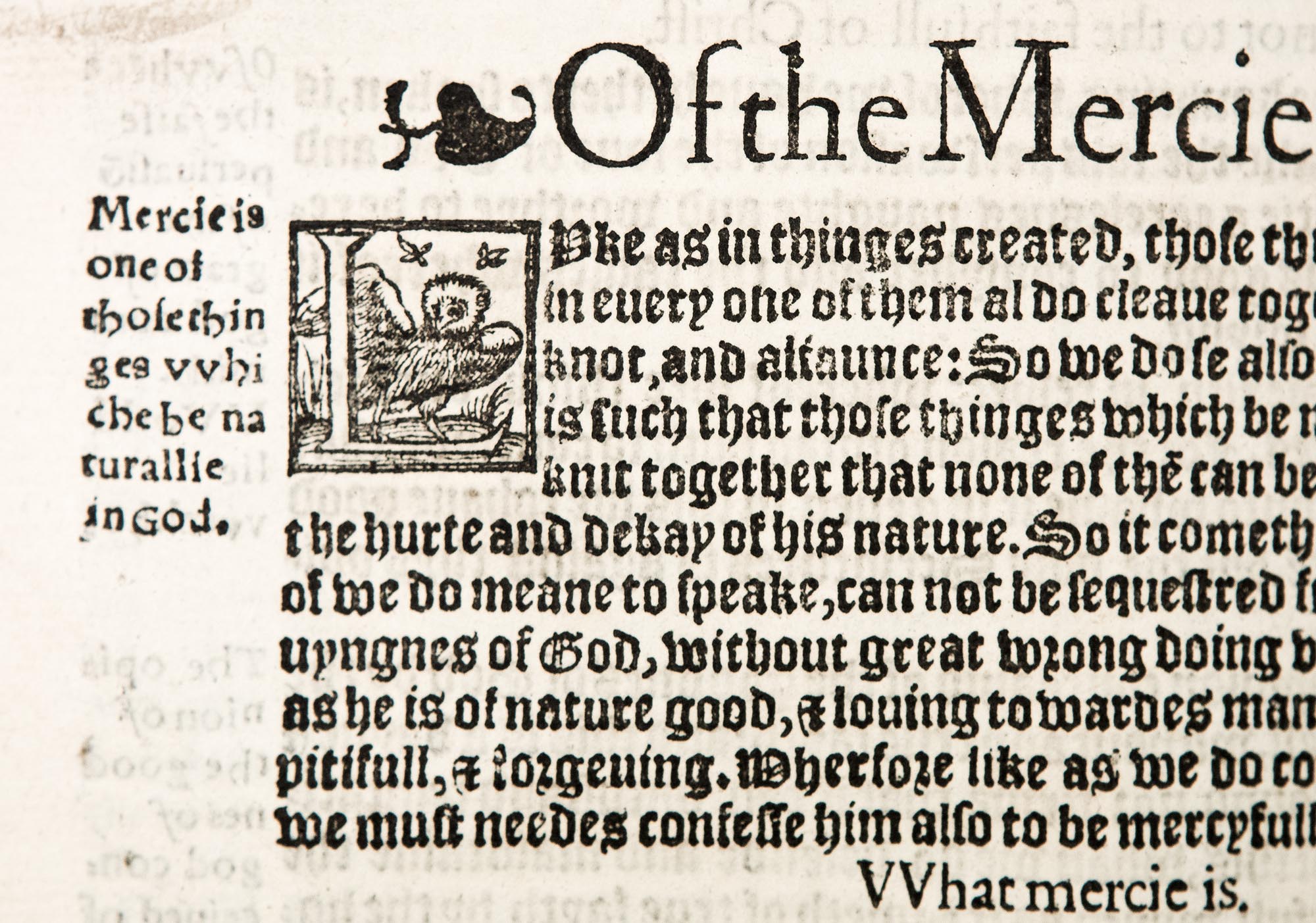
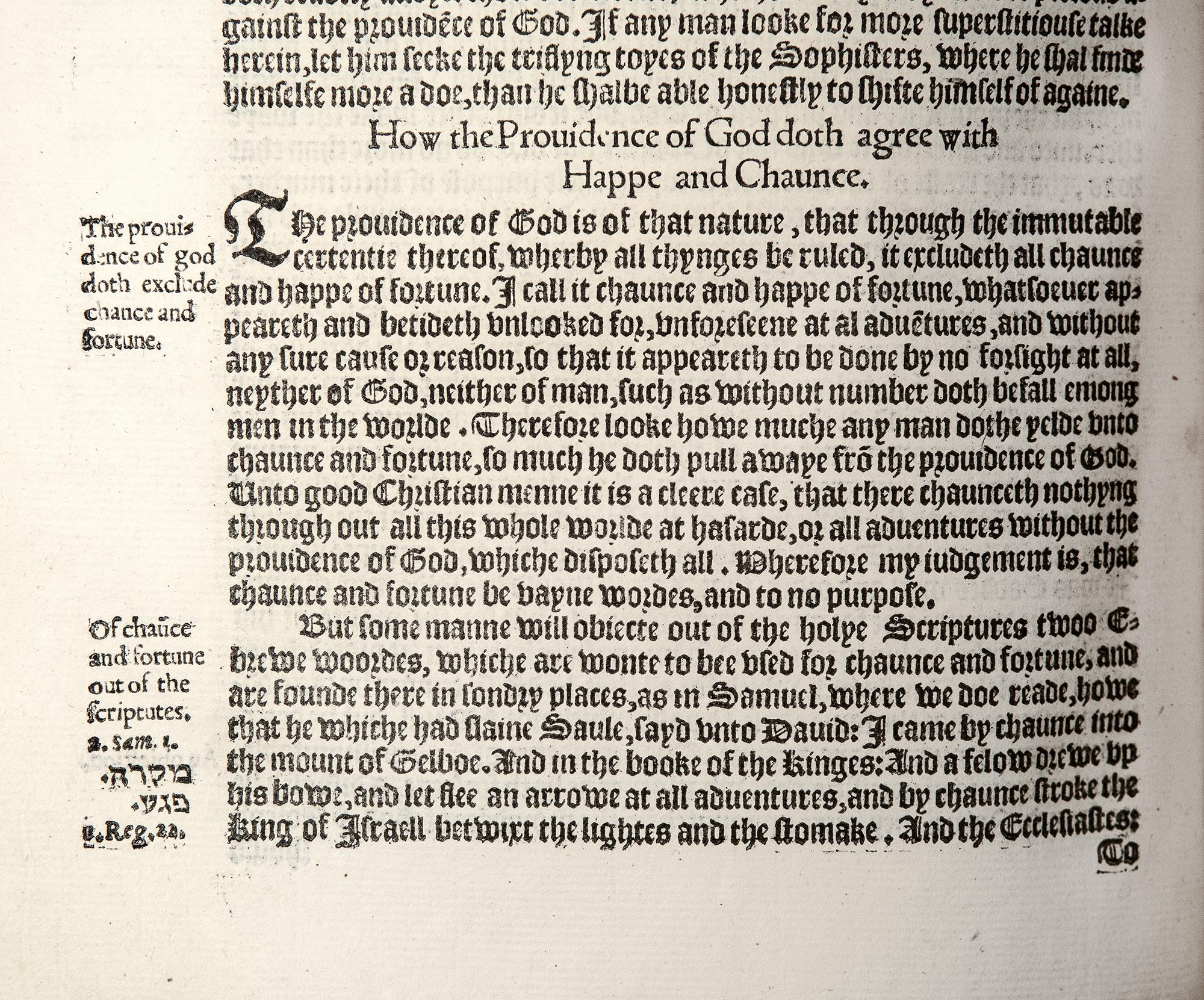
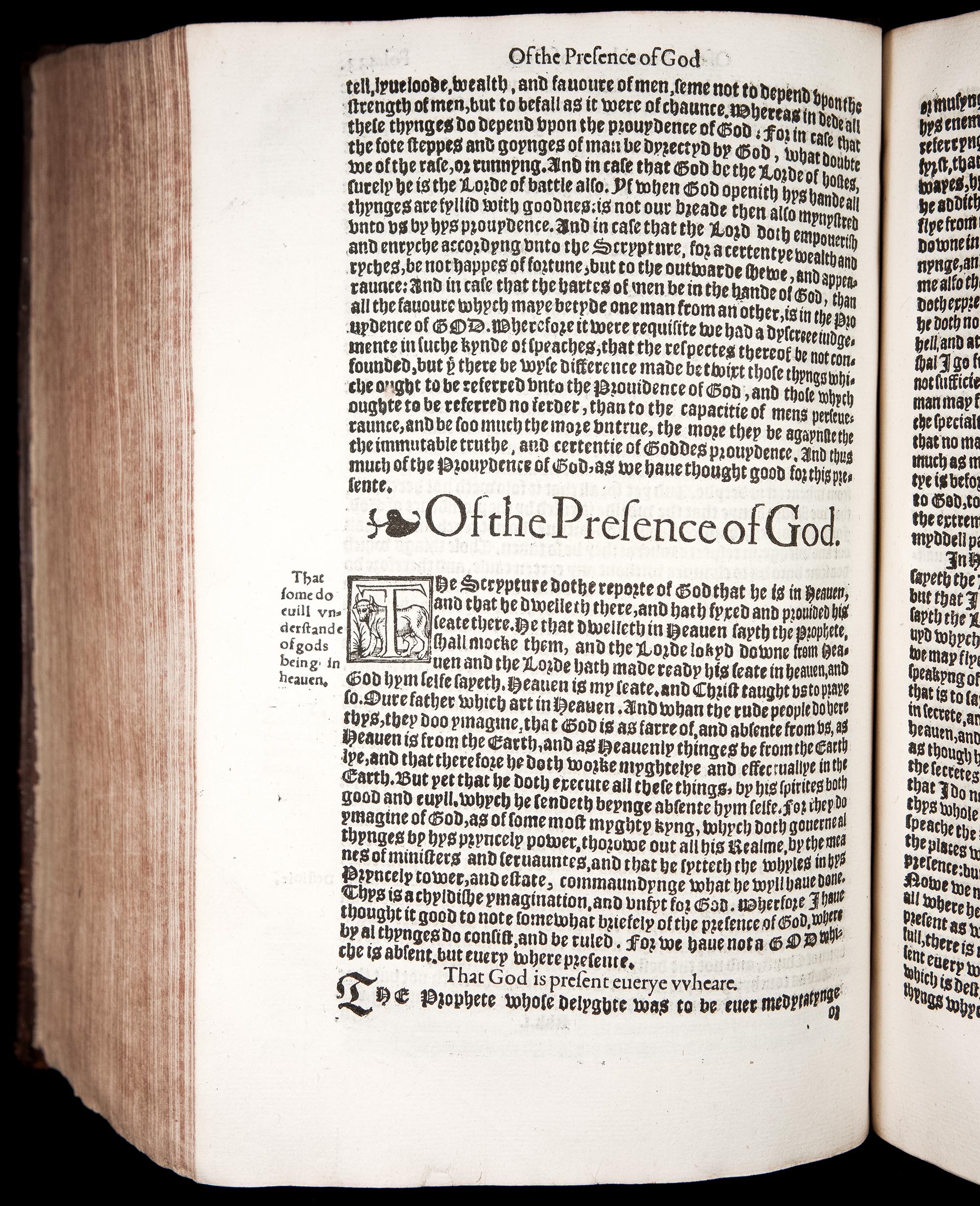
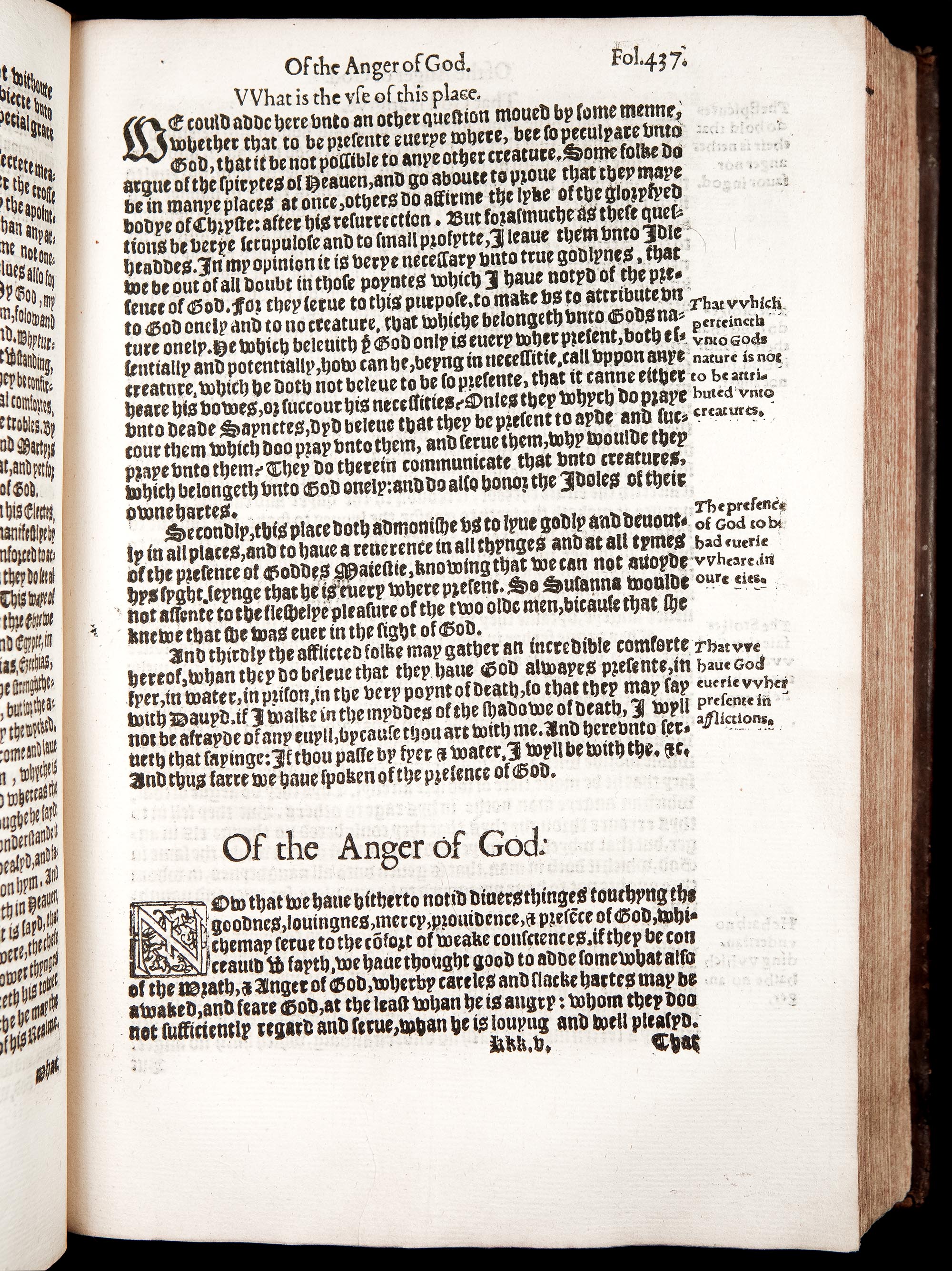
Main text printed in single column, in English gothic type (“black letter”), with an occasional use of Greek and Hebrew; printed marginalia in small roman type; some preliminaries in italic letter.
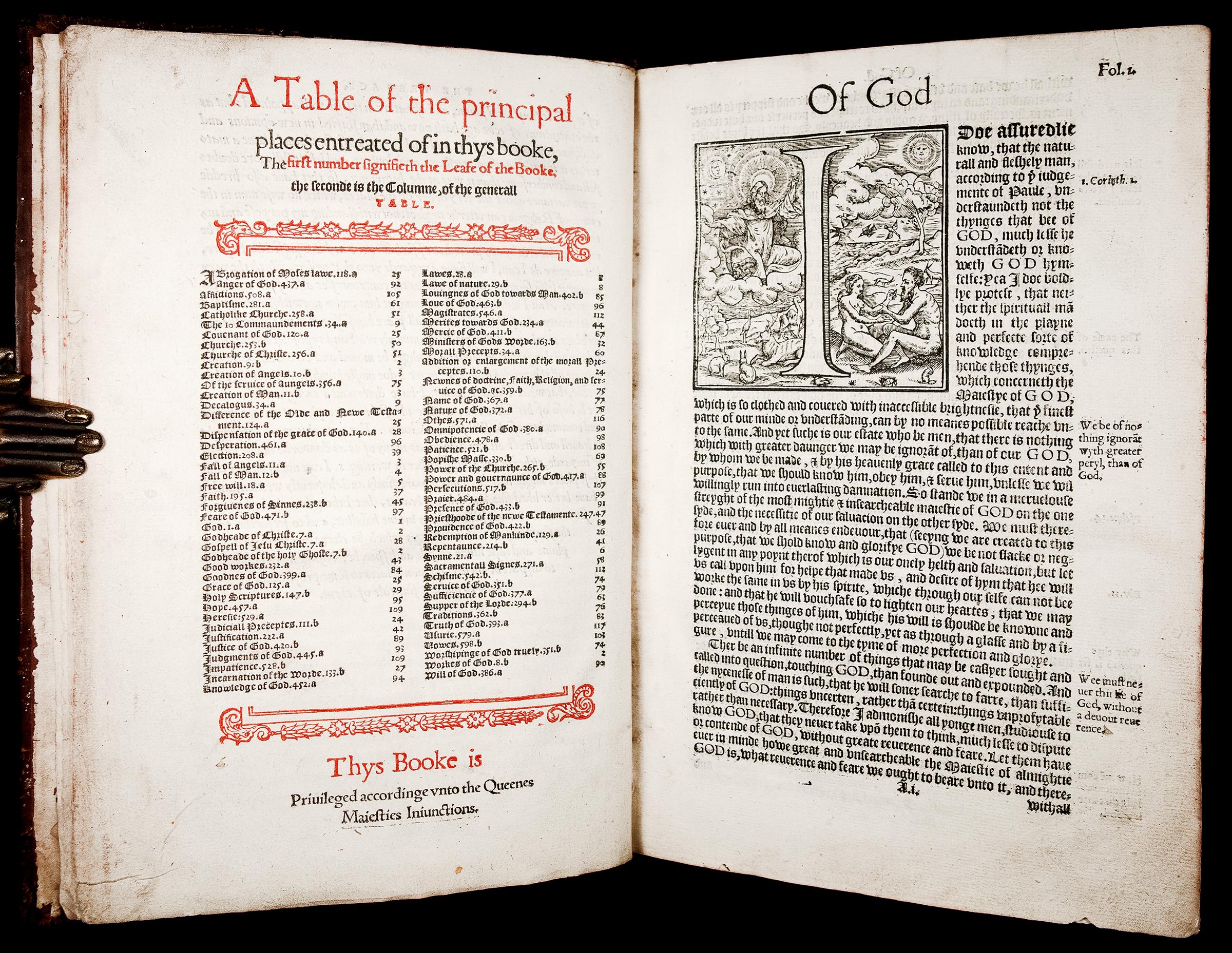
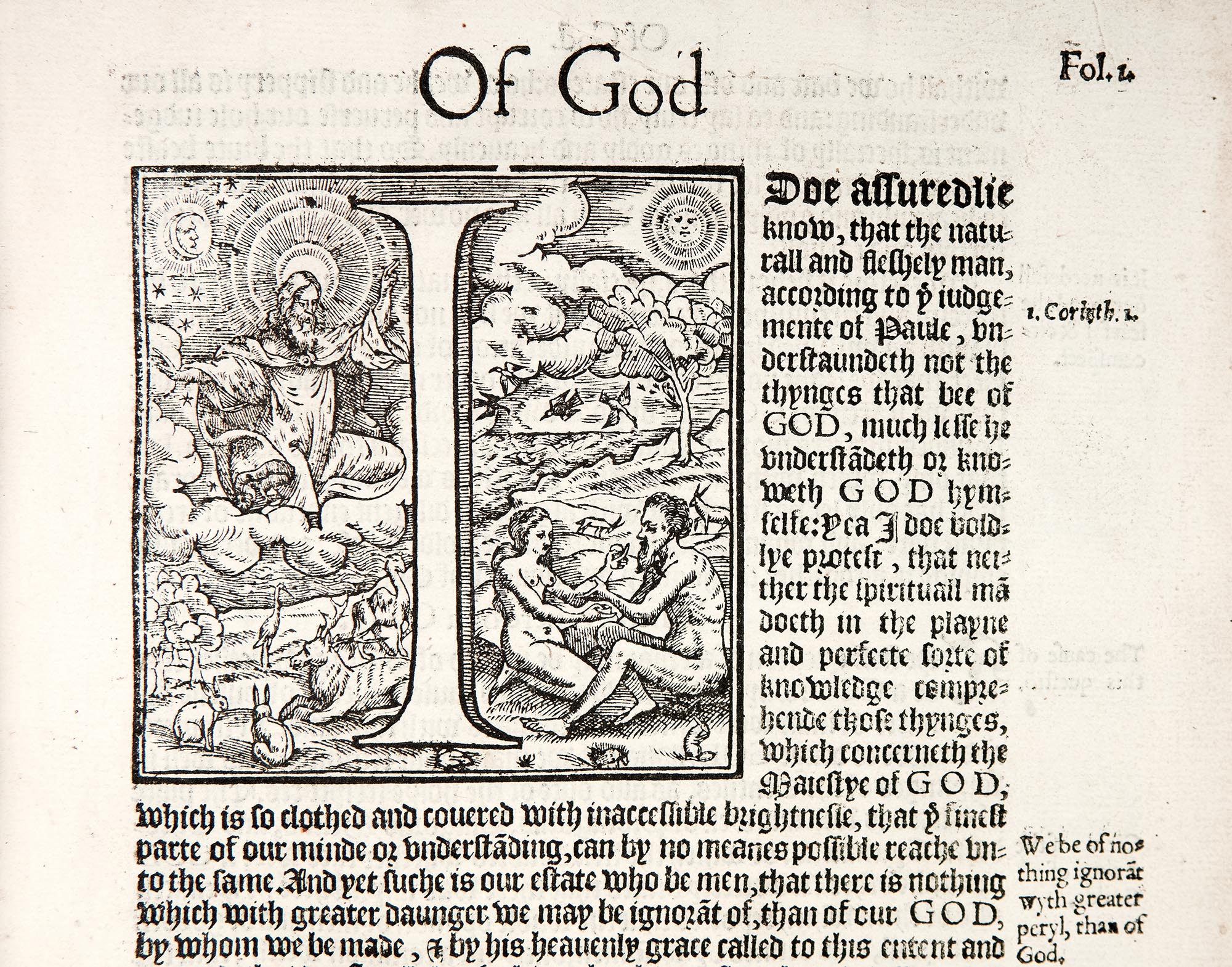
Title-page with a fine woodcut printer’s device (McKerrow, 146) depicting boys throwing sticks at a tree laden with fruit, printed in black and red. A large woodcut of dedicatee’s (archbishop Matthew Parker’s) coat of arms within a diamond-shaped historiated border on verso of title-page; page [par]6v (with a short table of contents) printed in red and black; opening page of text A1r with a huge 20-line woodcut initial ‘I’ (God looking at the newly created world, and Eve offering the apple to Adam). Numerous other woodcut decorative and historiated initials in text.
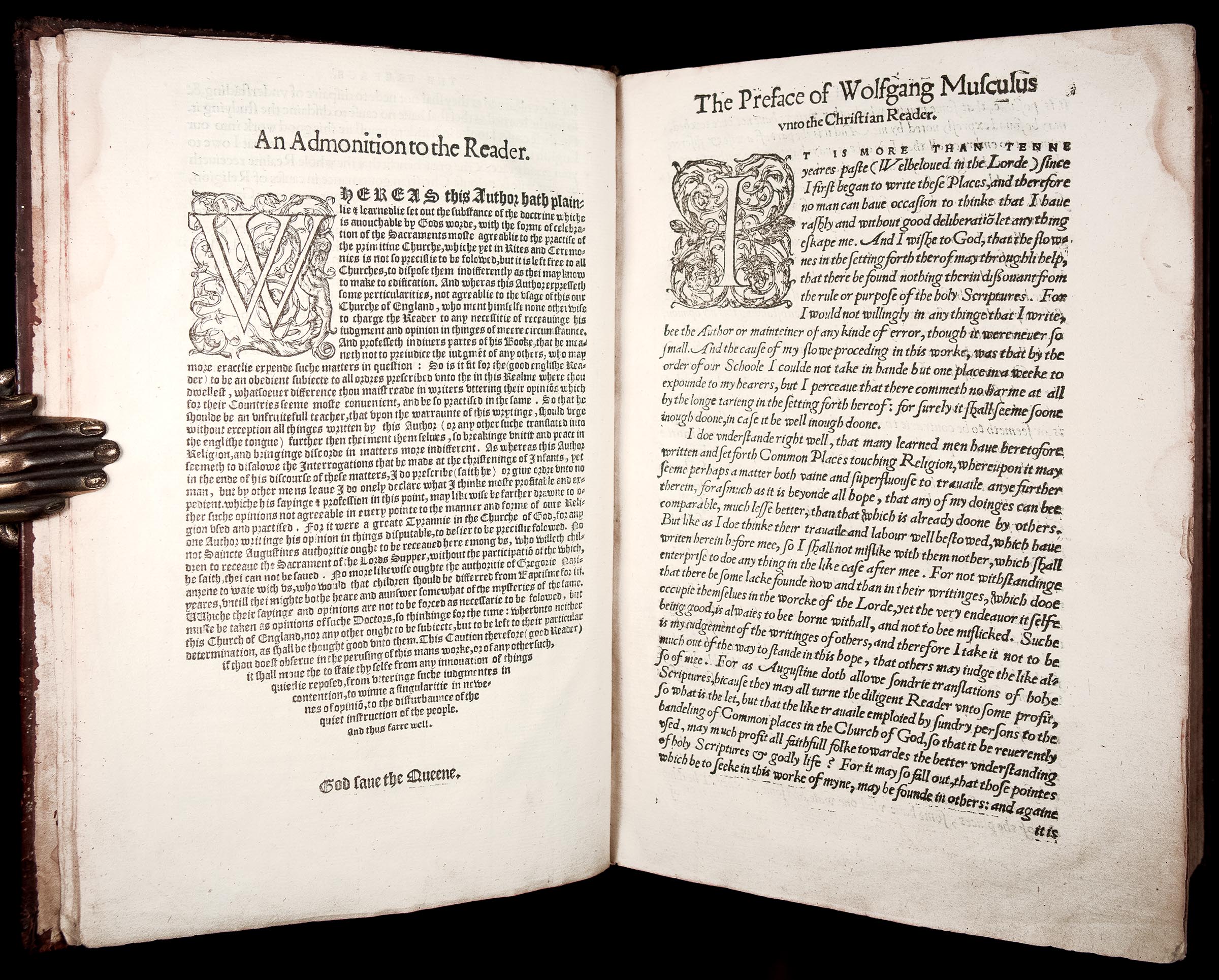
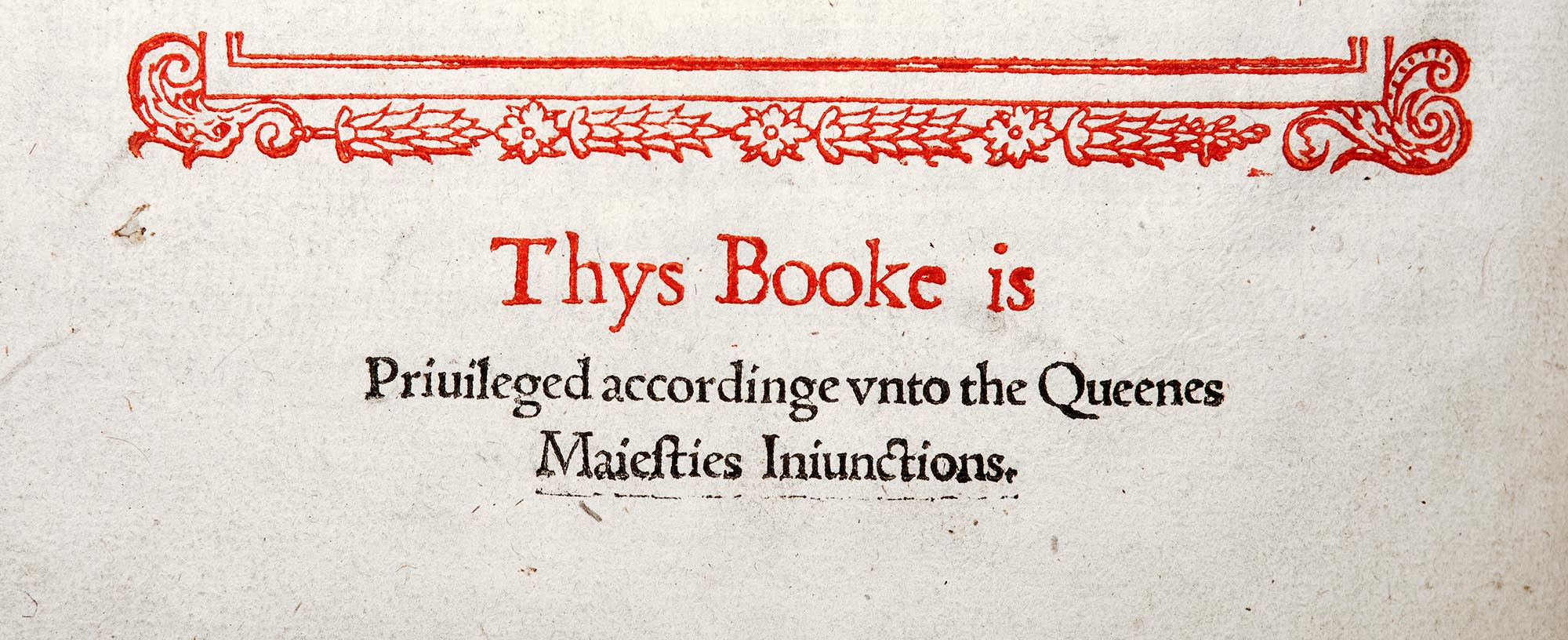
Preliminaries include archbishop Matthew Parker’s woodcut coat of arms with laudatory verses underneath (π1v); John Man’s dedicatory preface to archbishop Matthew Parker (π2r-4r); ‘An Admonition to the Reader’ (π4v); ‘The Preface of Wolfgang Musculus unto the Christian Reader’ (π5r-6r); ‘A Table of the principal places entreated of in thys booke …’ with a privilege statement at the bottom: ‘Thys booke is Priuileged accordinge unto the Queenes Maiesties Iniunctions’ (π6v).
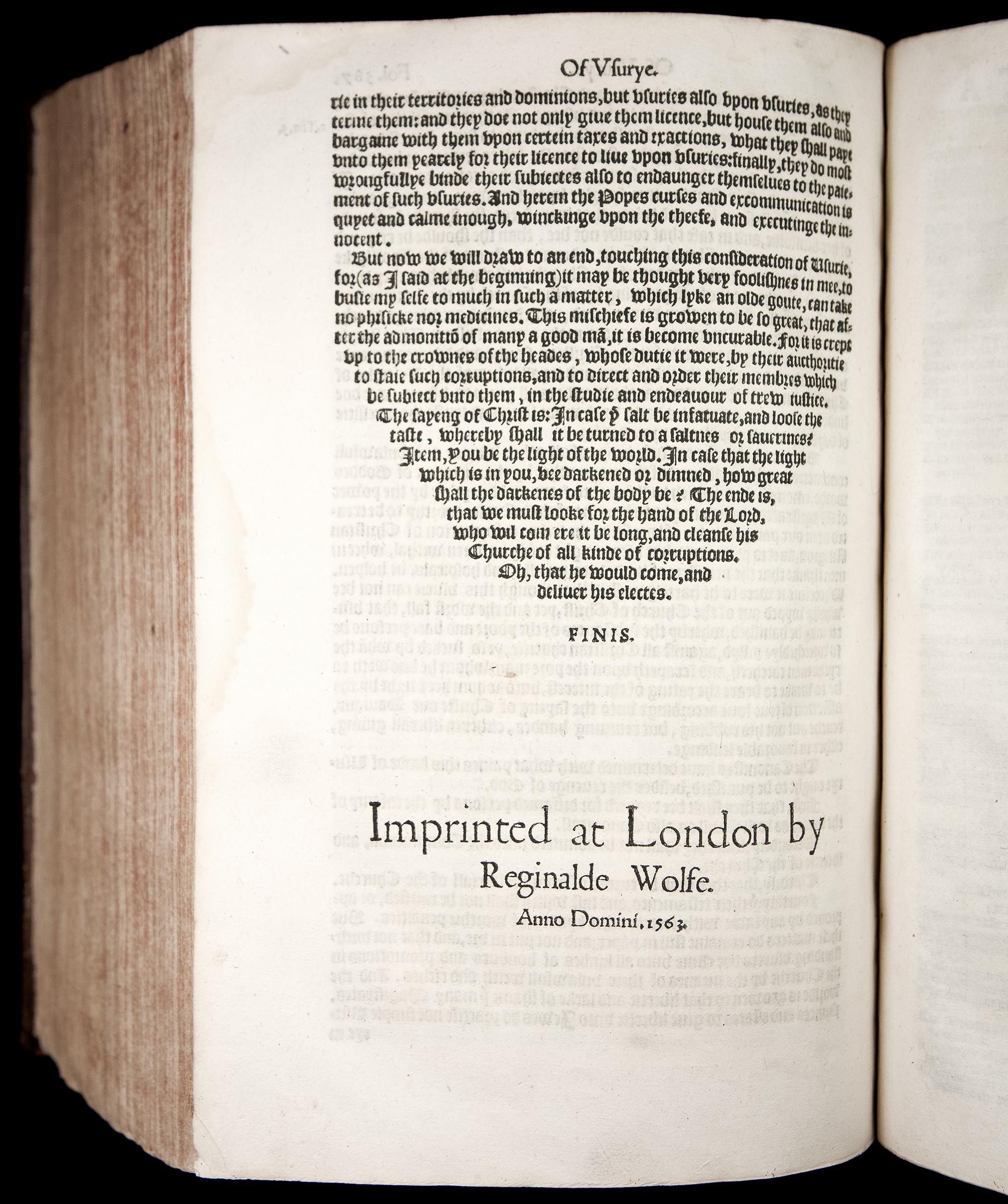
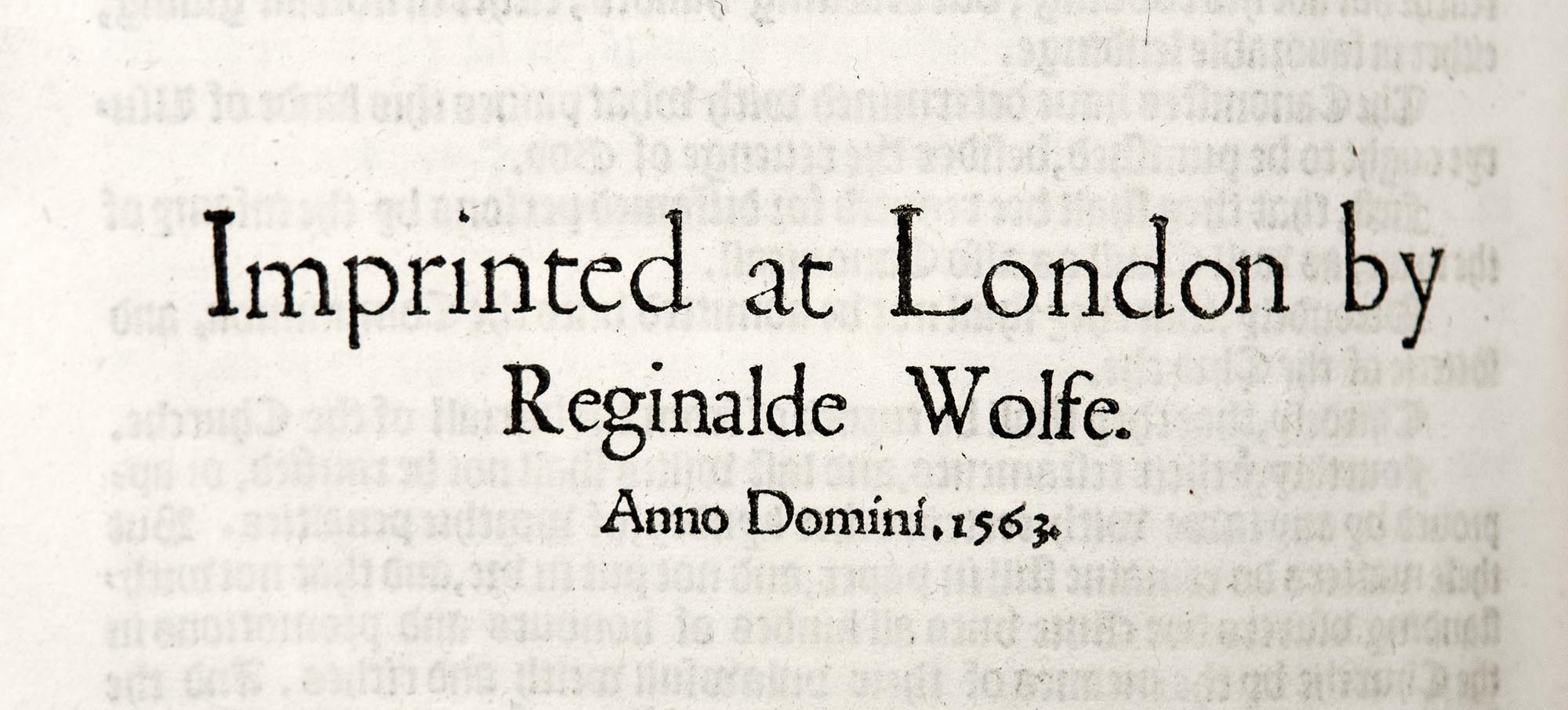
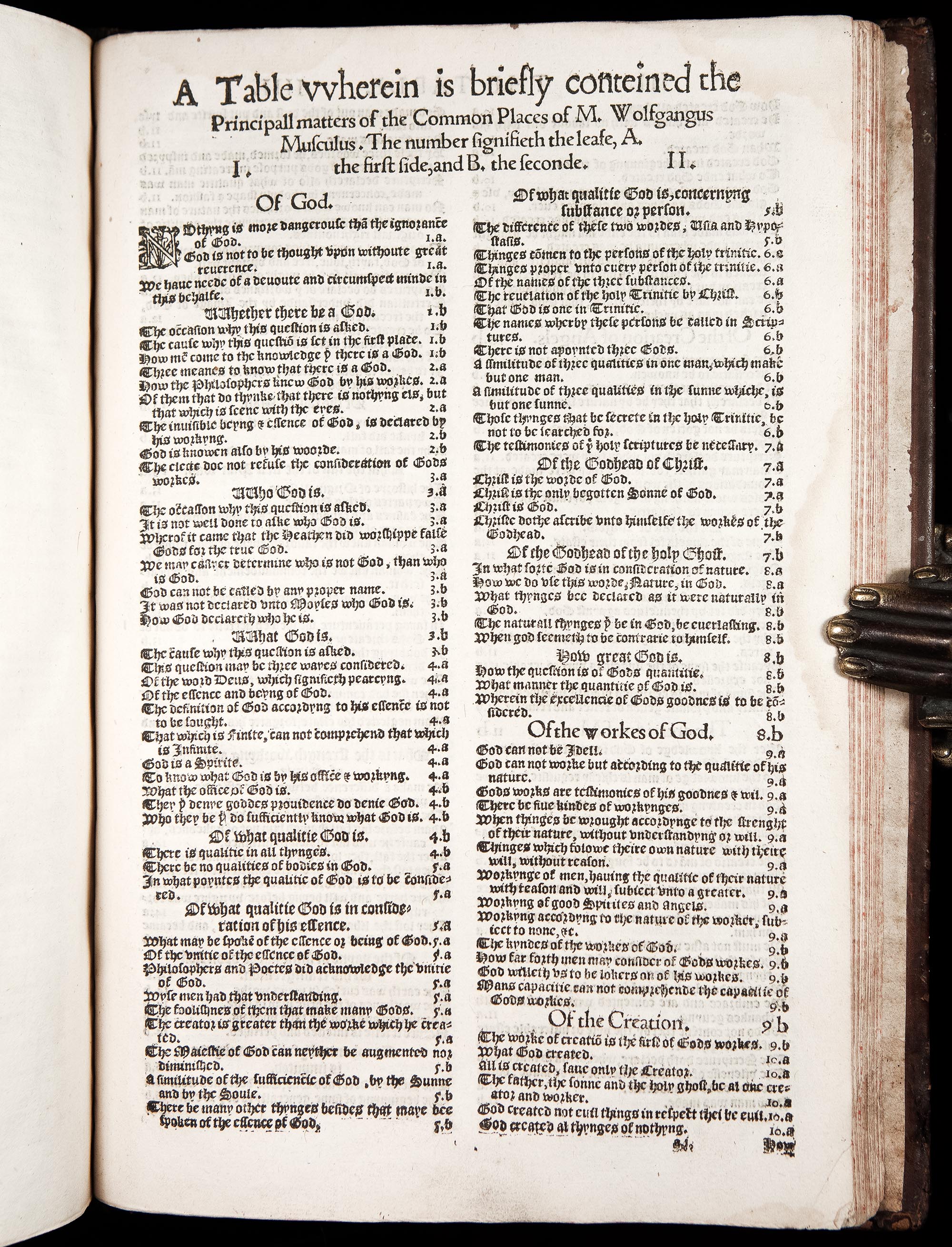
First colophon on Dddd2v, "Imprinted at London by/ me Reynolde Woulfe./ Anno Domini. 1563.". Second colophon on b9v, "Imprinted at London by/ Reginalde Wolfe./ Anno Domini. 1563.". This is followed by a comprehensive ‘Table wherein is briefly conteined the Principall matters…’ (2a1r-d6r, d6v is blank).
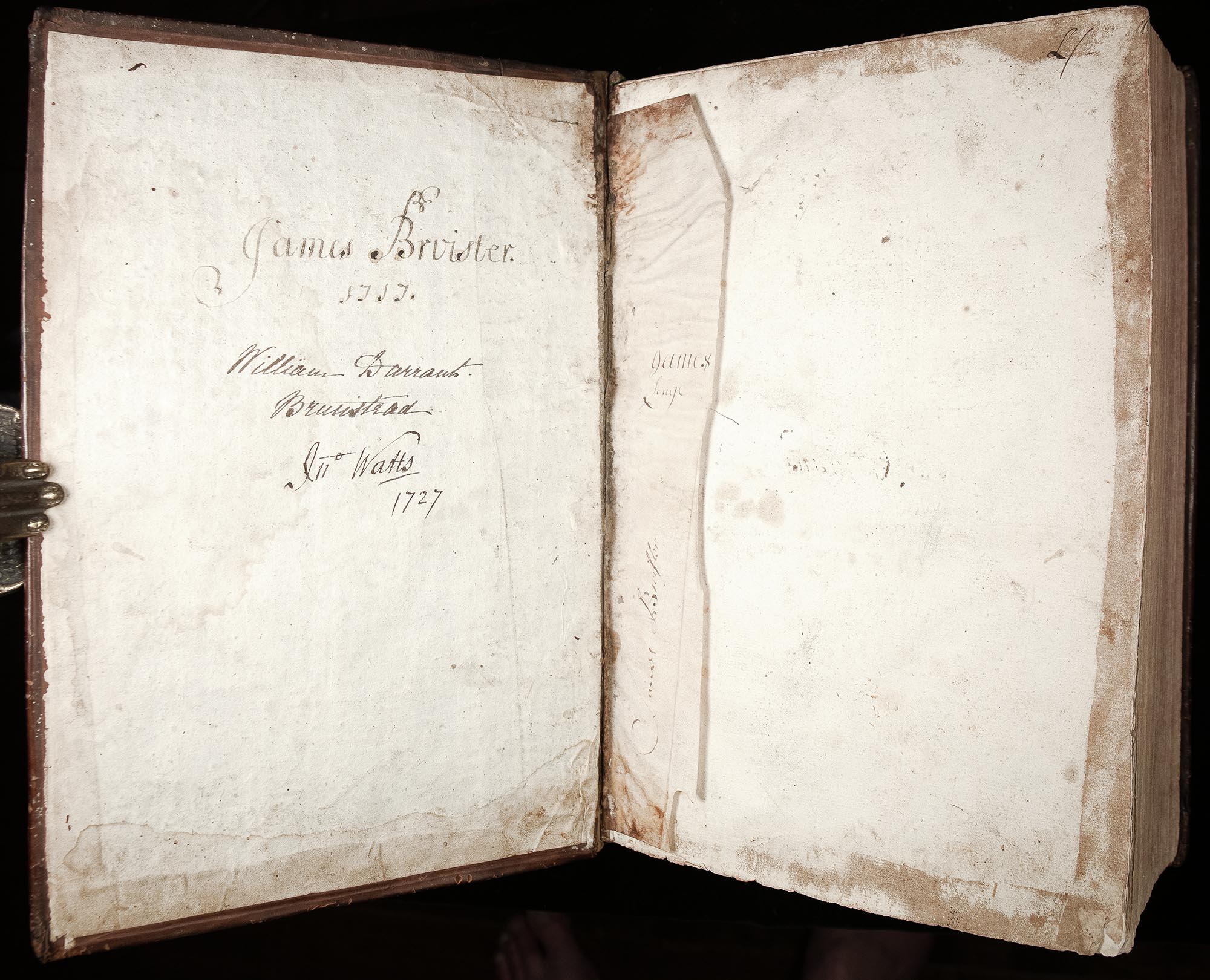
Signatures of three early 18th-century English owners (two of them dated 1717 and 1727).
Very Good antiquarian condition. Complete, including integral blank. Binding somewhat rubbed; some wear and bumping to corners; top of spine repaired. Title leaf with harmless marginal tear at gutter. First page of Dedication (π2r) with early manuscript marginal calculations in upper foremargin. Three 18th-century ownership signatures on front pastedown. Without rear free endpaper. Internally with occasional light soiling; several leaves (mostly at the beginning and the end) with very light marginal staining. Three final Index leaves with some wear to corners. A few minor marginal paper-flaws without loss. One leaf (Tt2) with a portion torn off at upper fore-corner, causing loss of some printed marginalia, and minor loss to top five lines of text (1-2 words in each line). In all, a very clean, solid, wide-margined example of this monumental, rare work.