Text in English, with some quotations in Latin.
FOUR PARTS IN 2 THICK FOLIO VOLUMES.
RARE FIRST EDITION! PROFUSELY ILLUSTRATED WITH OVER A THOUSAND OF FASCINATING WOODCUTS!
This 1577 edition is considerably rarer than the 1587 Second Edition, which had no illustrations.
Raphael Holinshed's comprehensive history of Britain, Scotland, and Ireland is ONE OF THE MOST CELEBRATED AND INFLUENTIAL ENGLISH BOOKS OF ELIZABETHAN ERA. It famously served as the source and inspiration for several Renaissance writers including William Shakespeare and Christopher Marlowe. It was the foremost British history available at the time and DID MORE TO SHAPE ELIZABETHAN LITERATURE THAN ANY OTHER ENGLISH HISTORICAL WORK. This magnificent work is, therefore, a cornerstone of any major Elizabethan or Shakespearian book collection!
An immediate success upon publication, Holinshed’s Chronicles “form a very valuable repertory of historical information. […] The chronicler fully justified his claim ‘to have had an especial eye unto the truth of things’.” (DNB)
“Whatever the long-range intellectual goals of Holinshed, he had the journalist’s eye for sensationalism; he stresses crimes, both political and erotic, physical mutilations, marvels, monstrosities and absurdities.” (Sargent, 25)
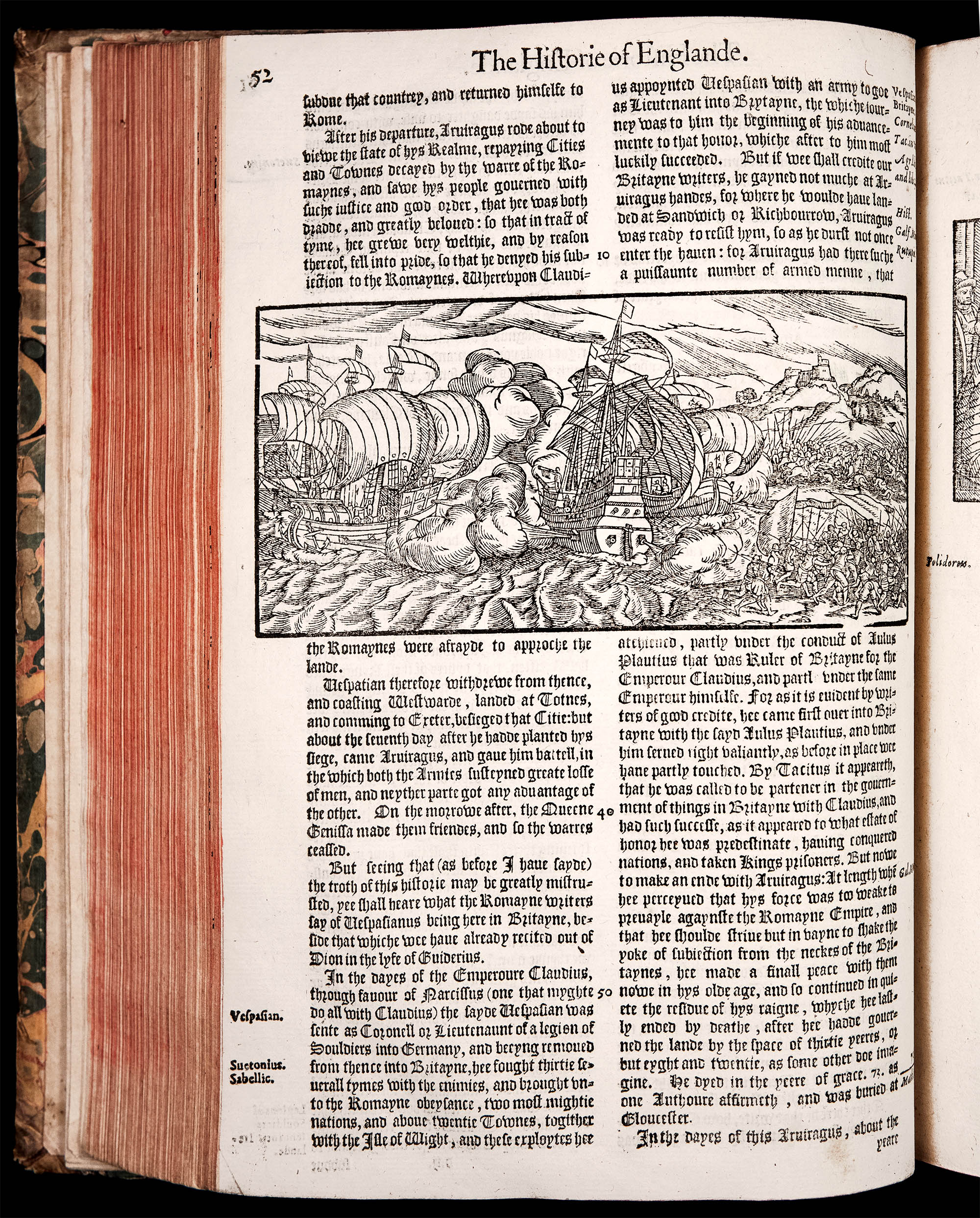
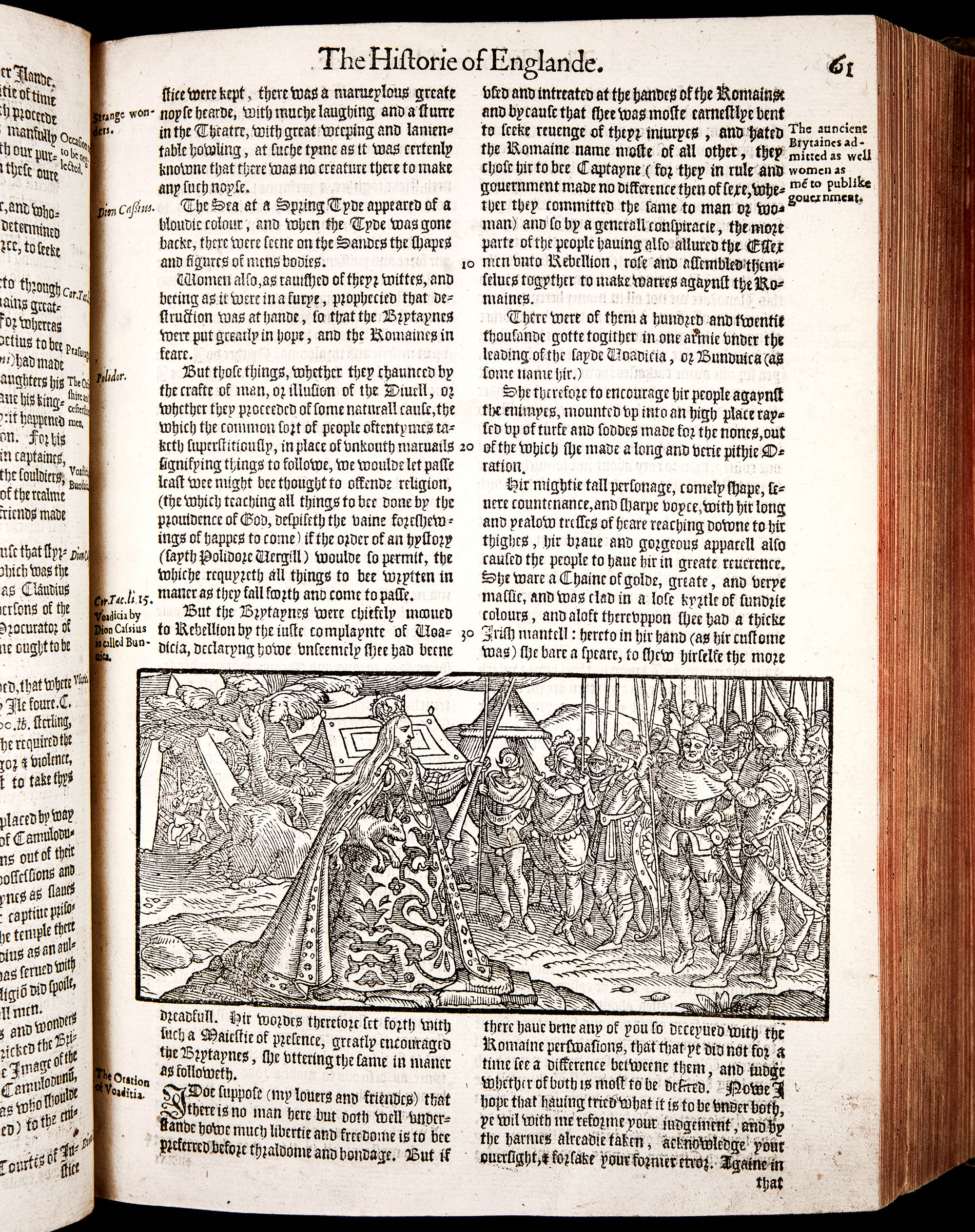
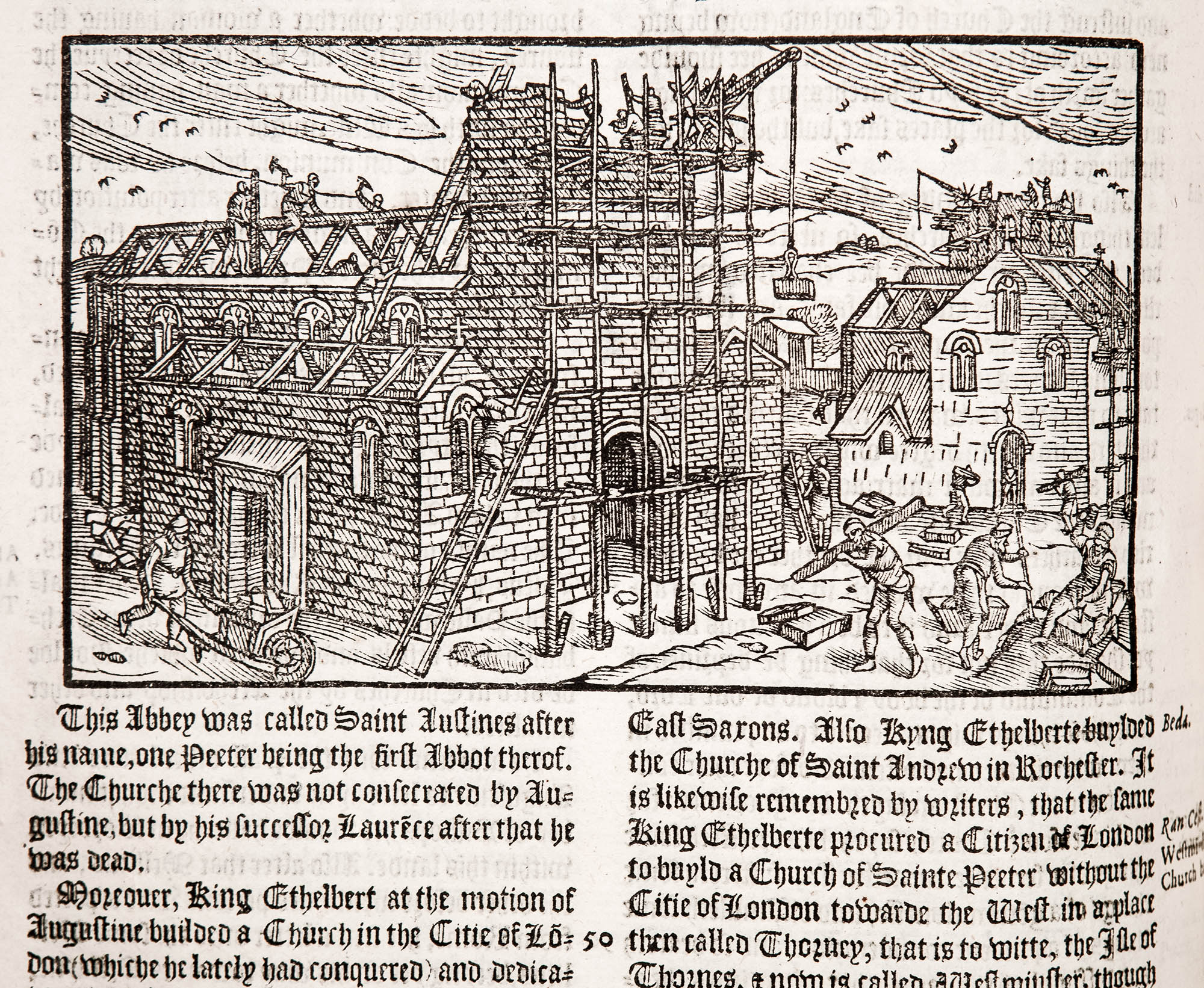
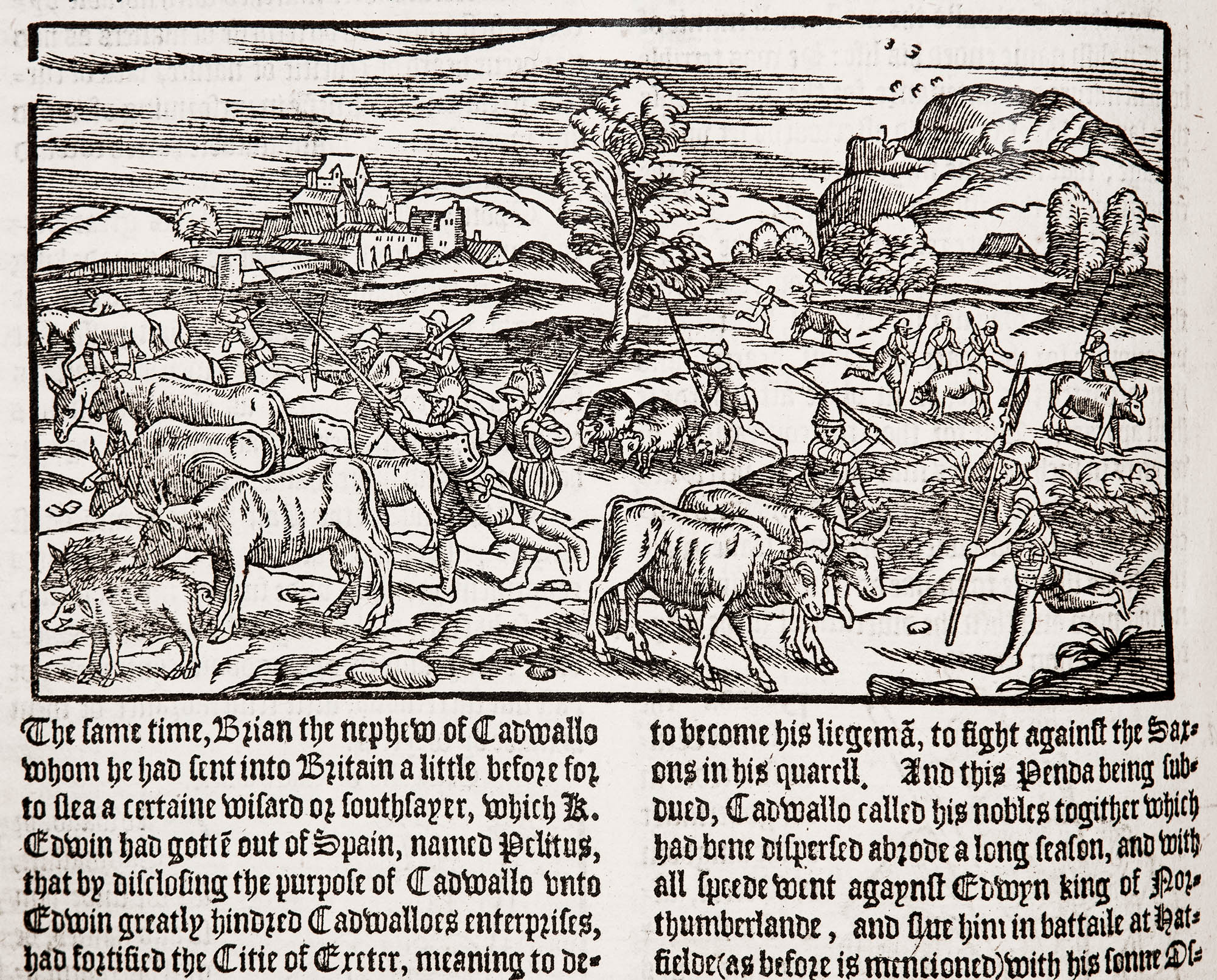
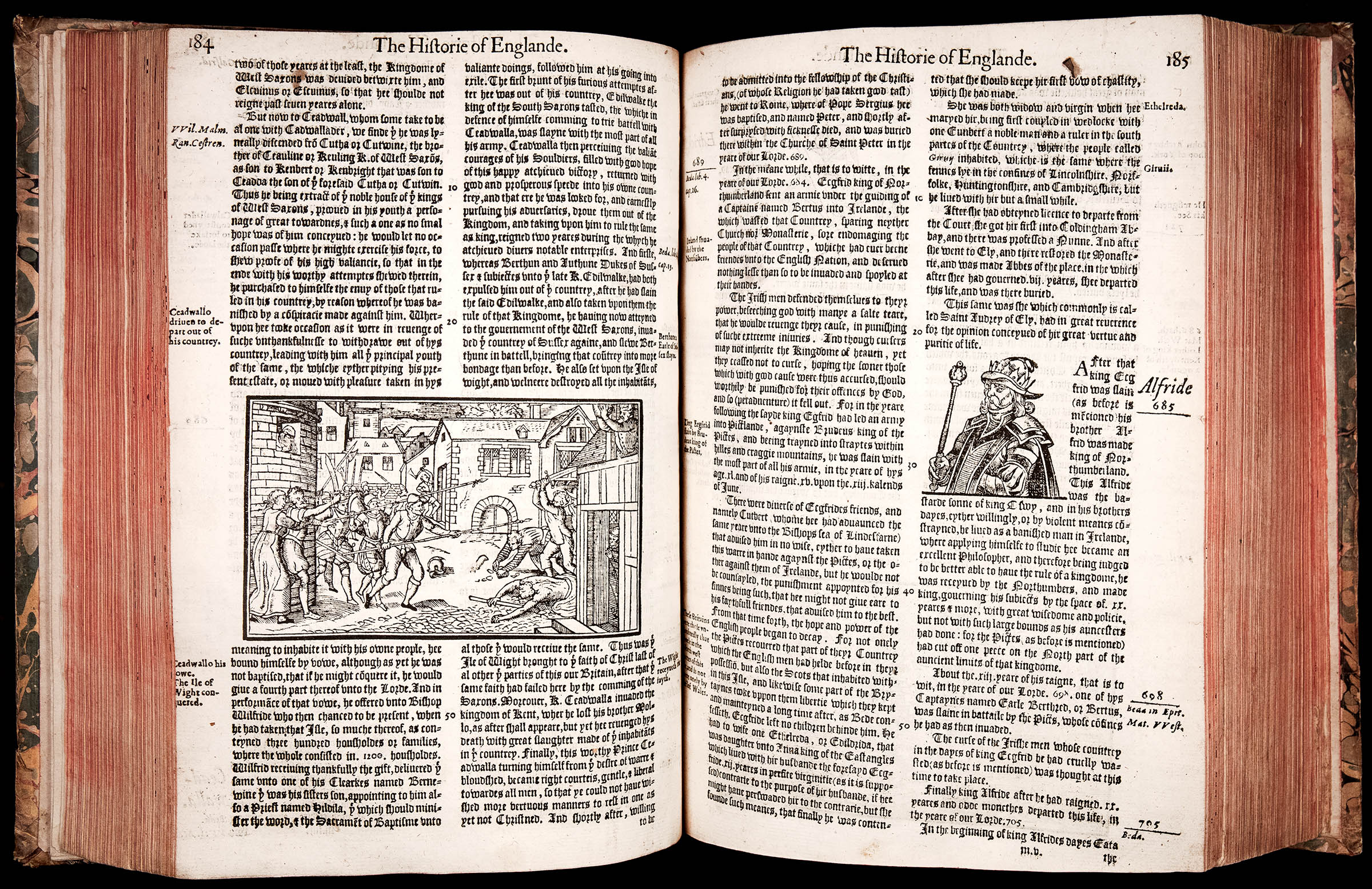
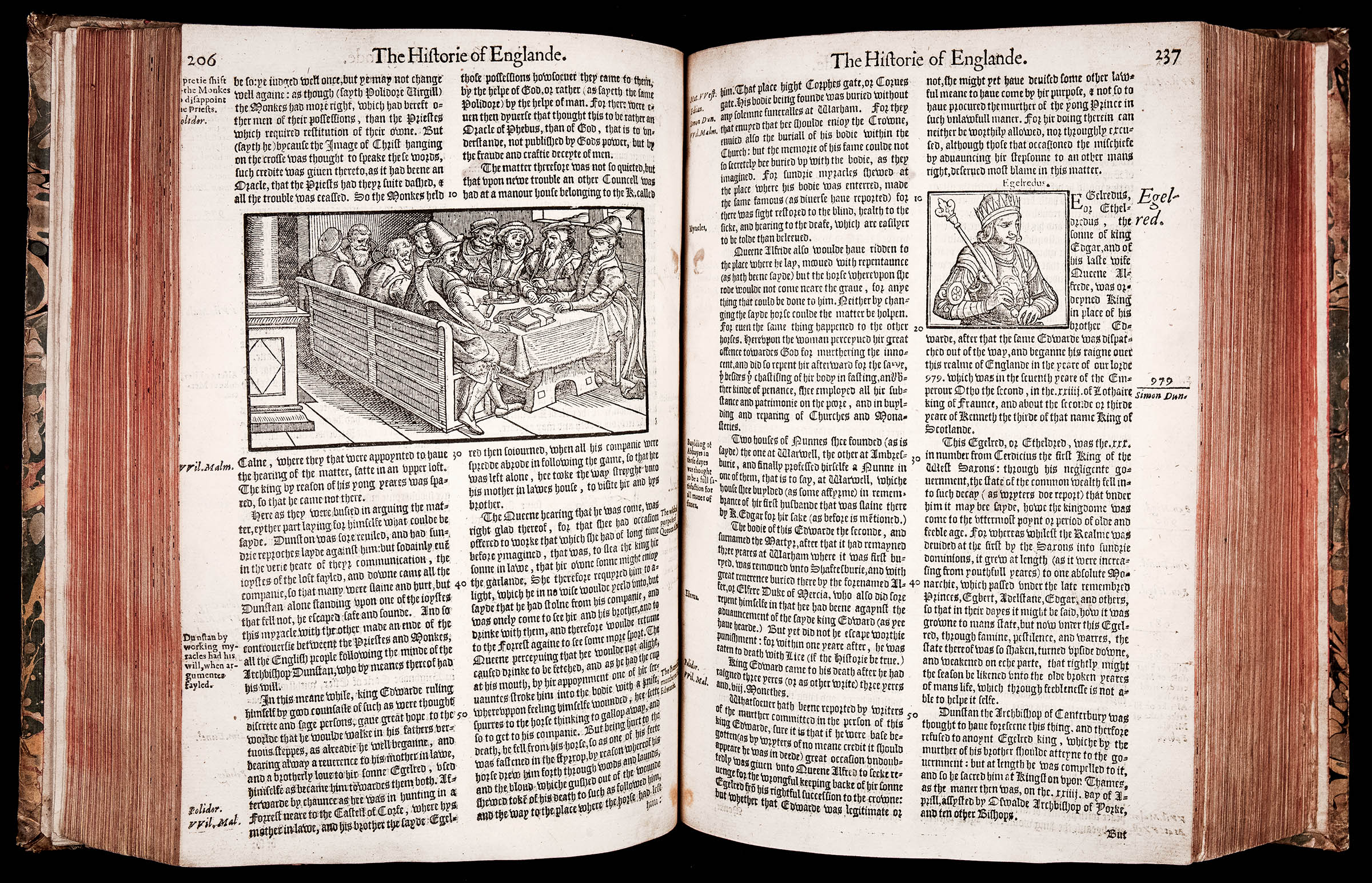
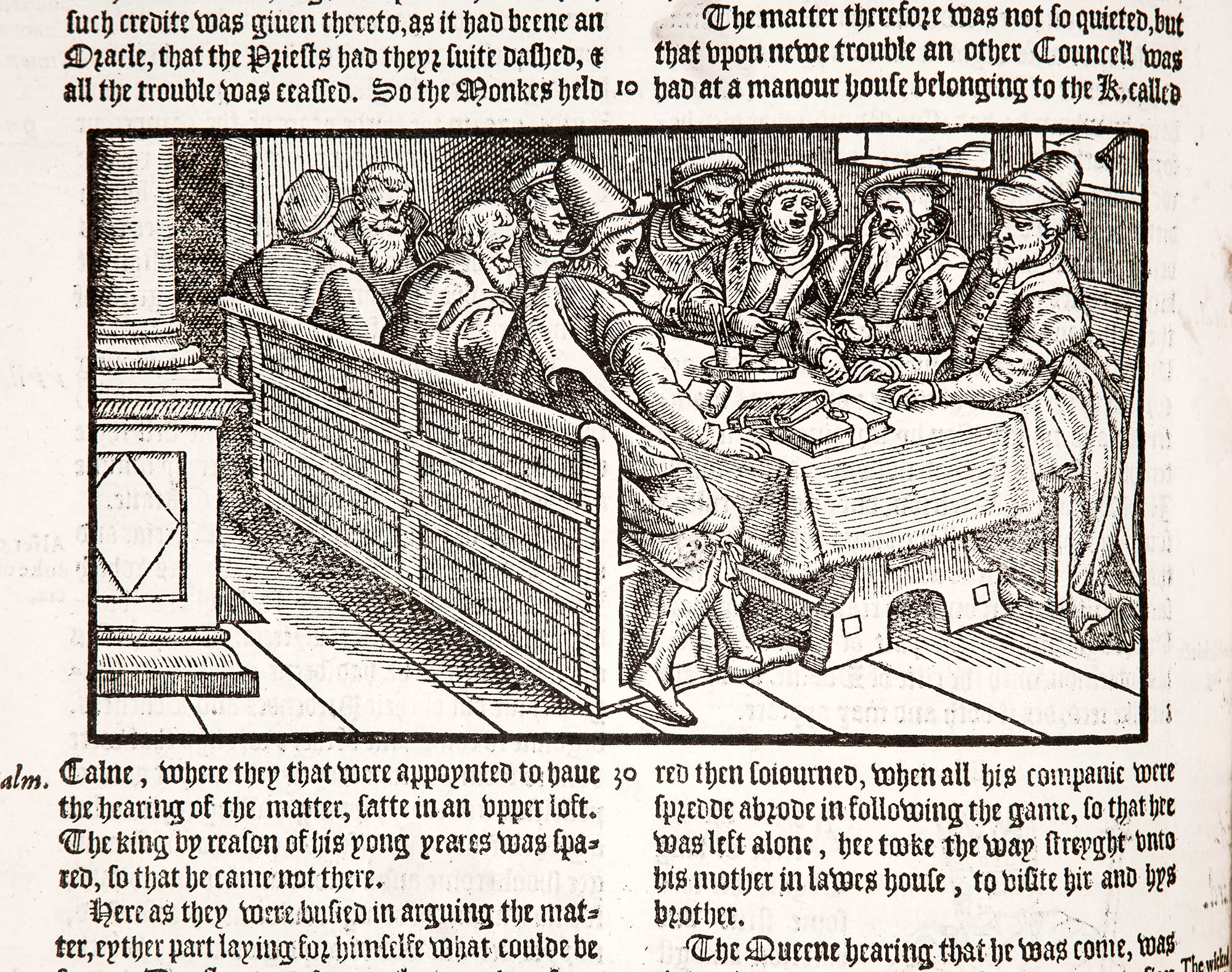
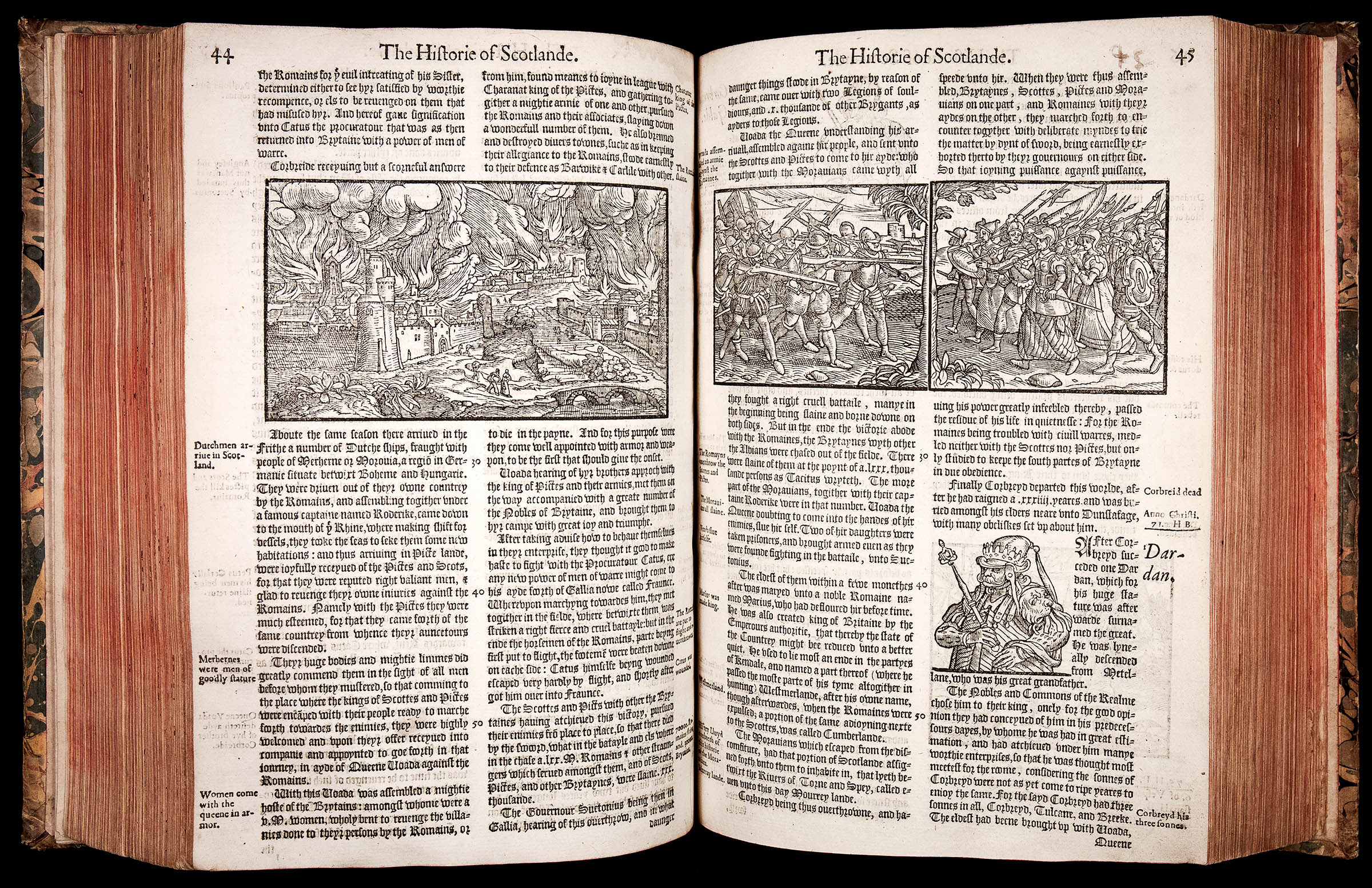
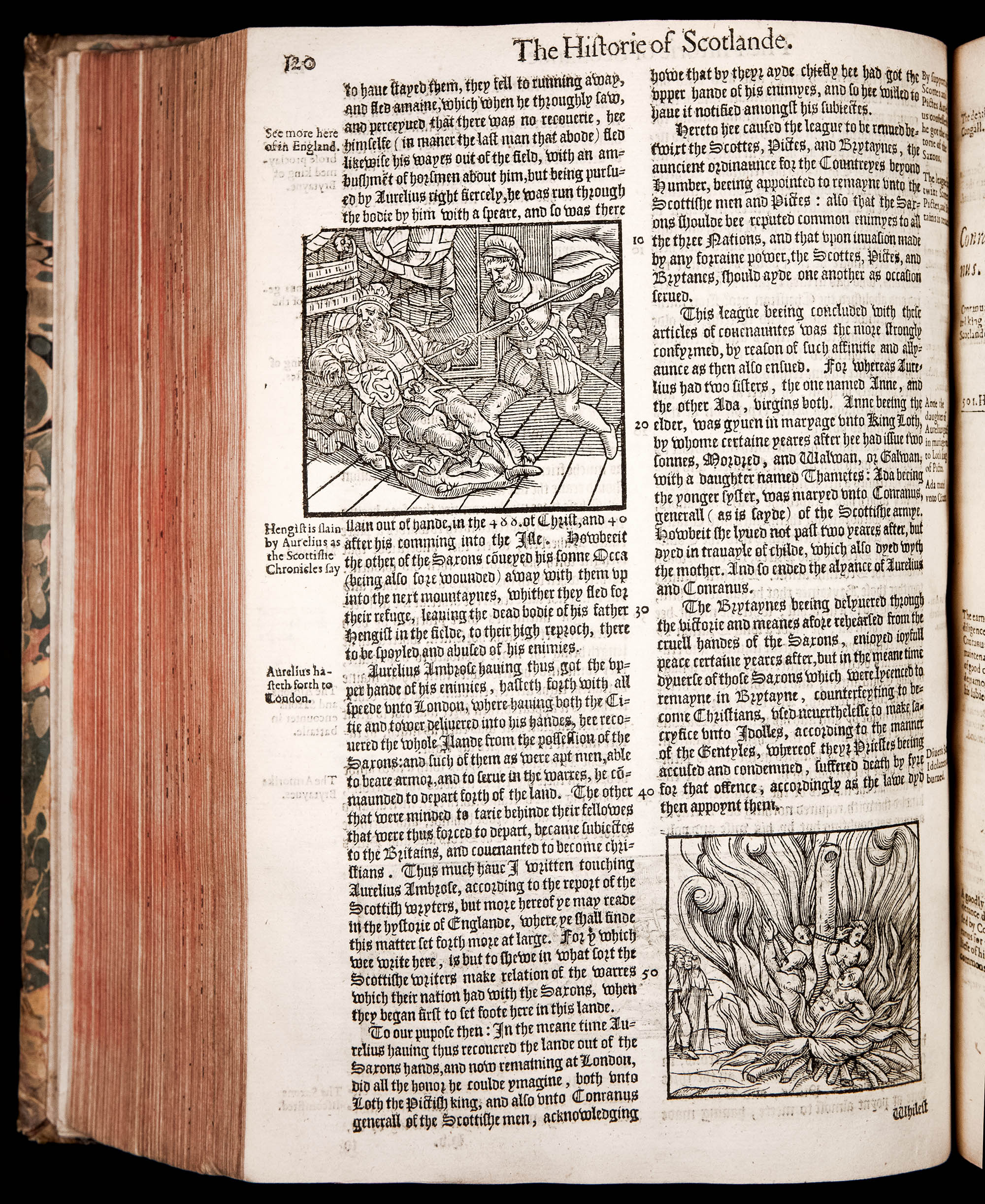
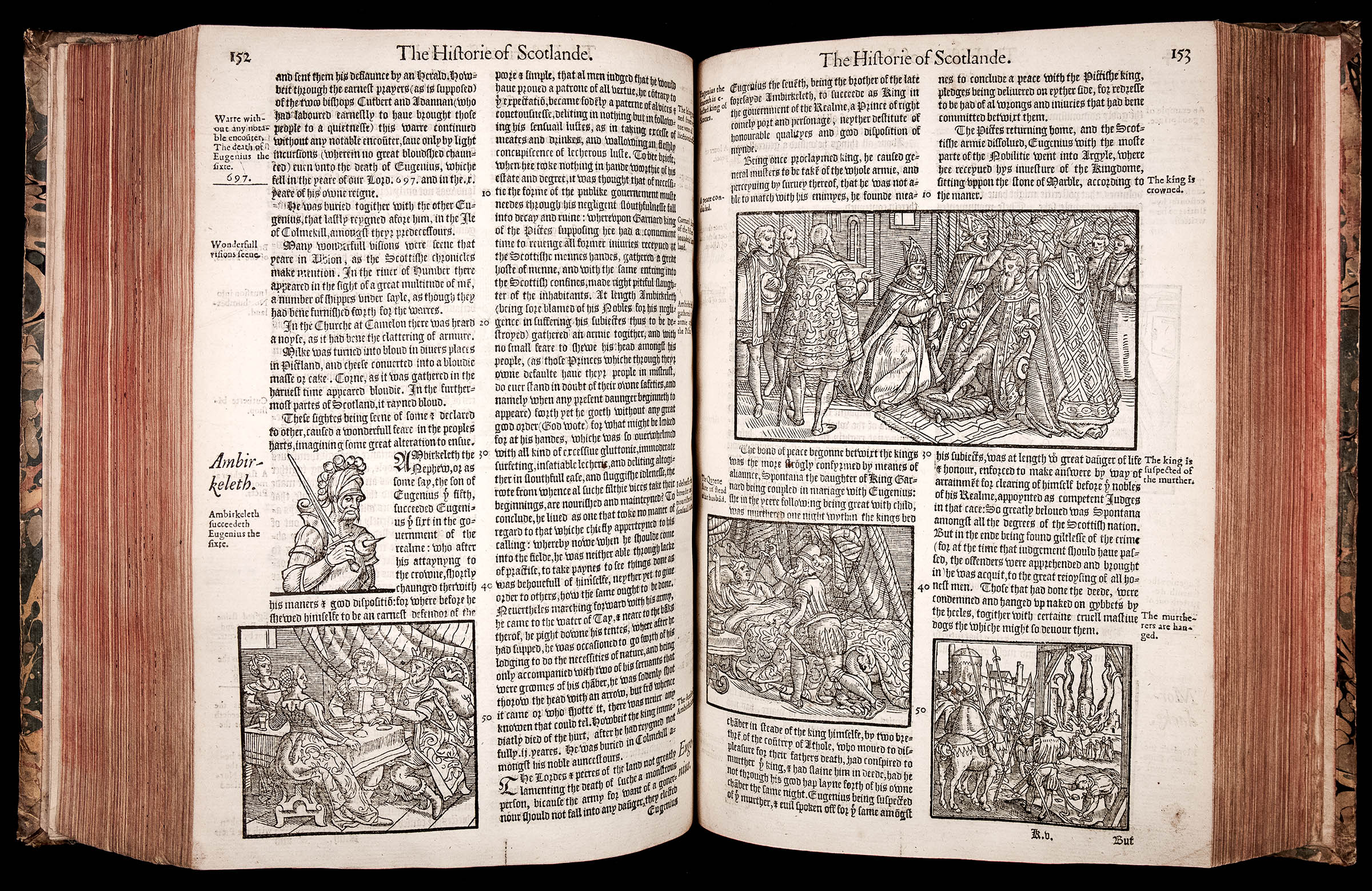
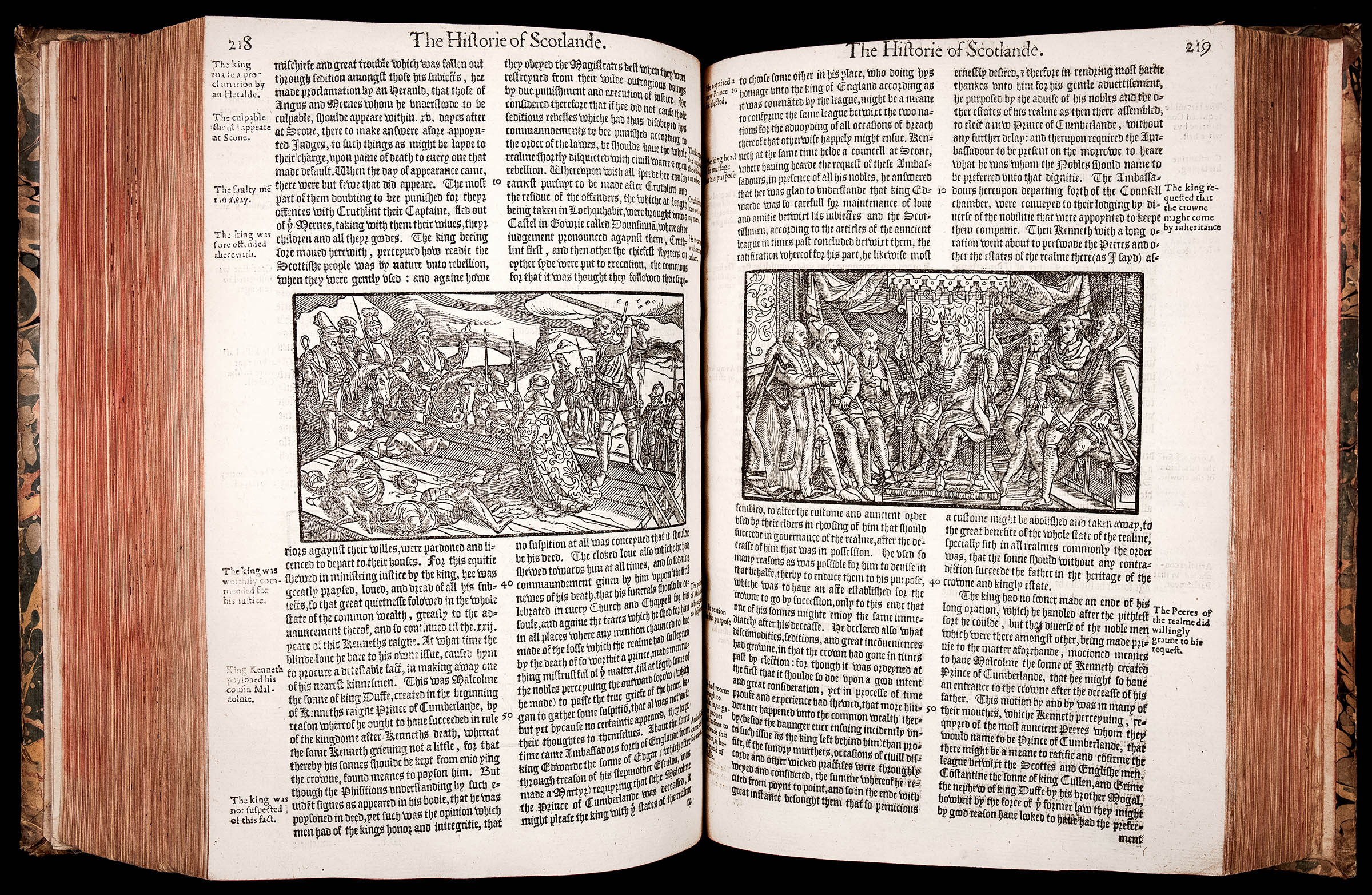
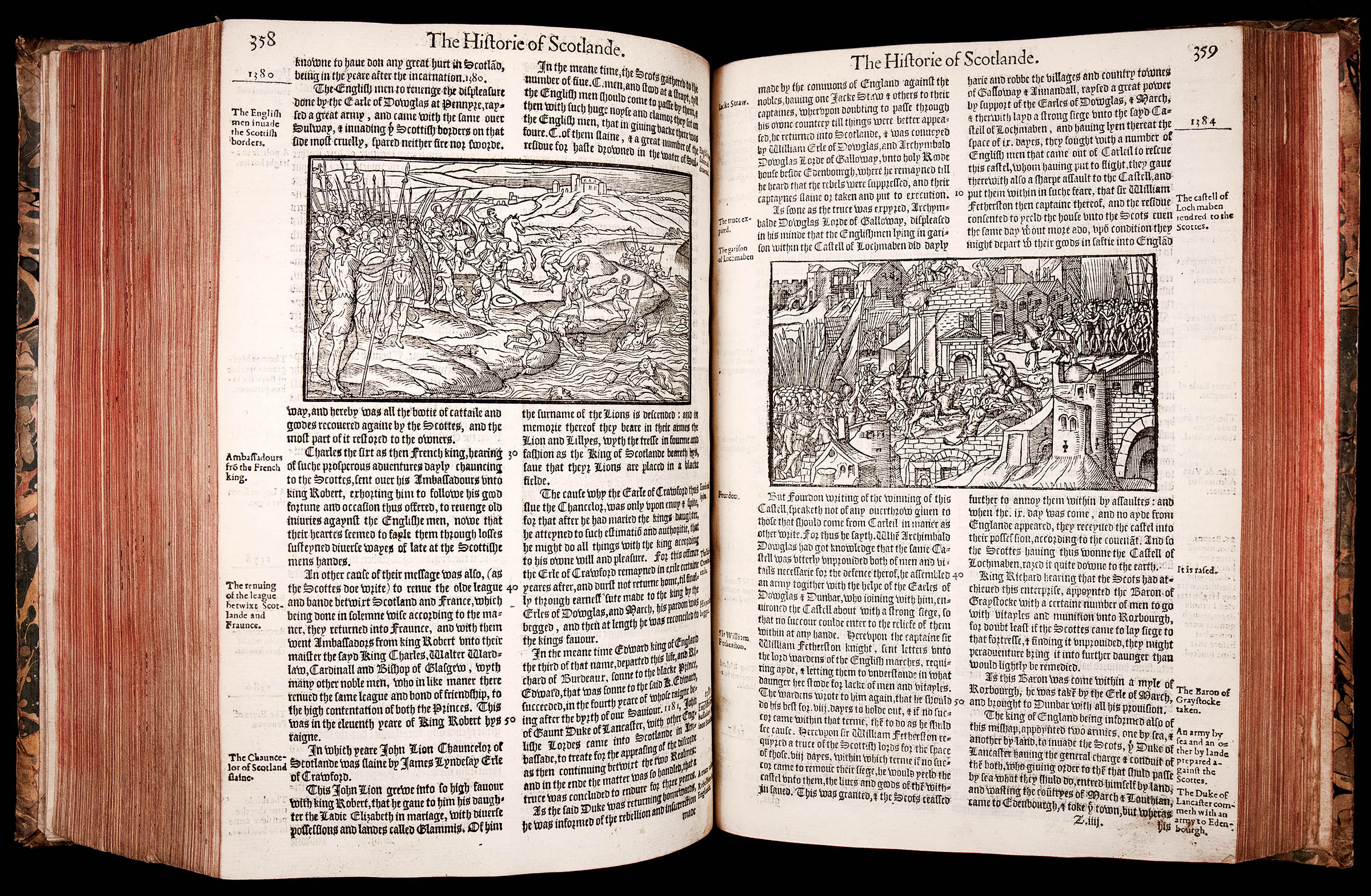
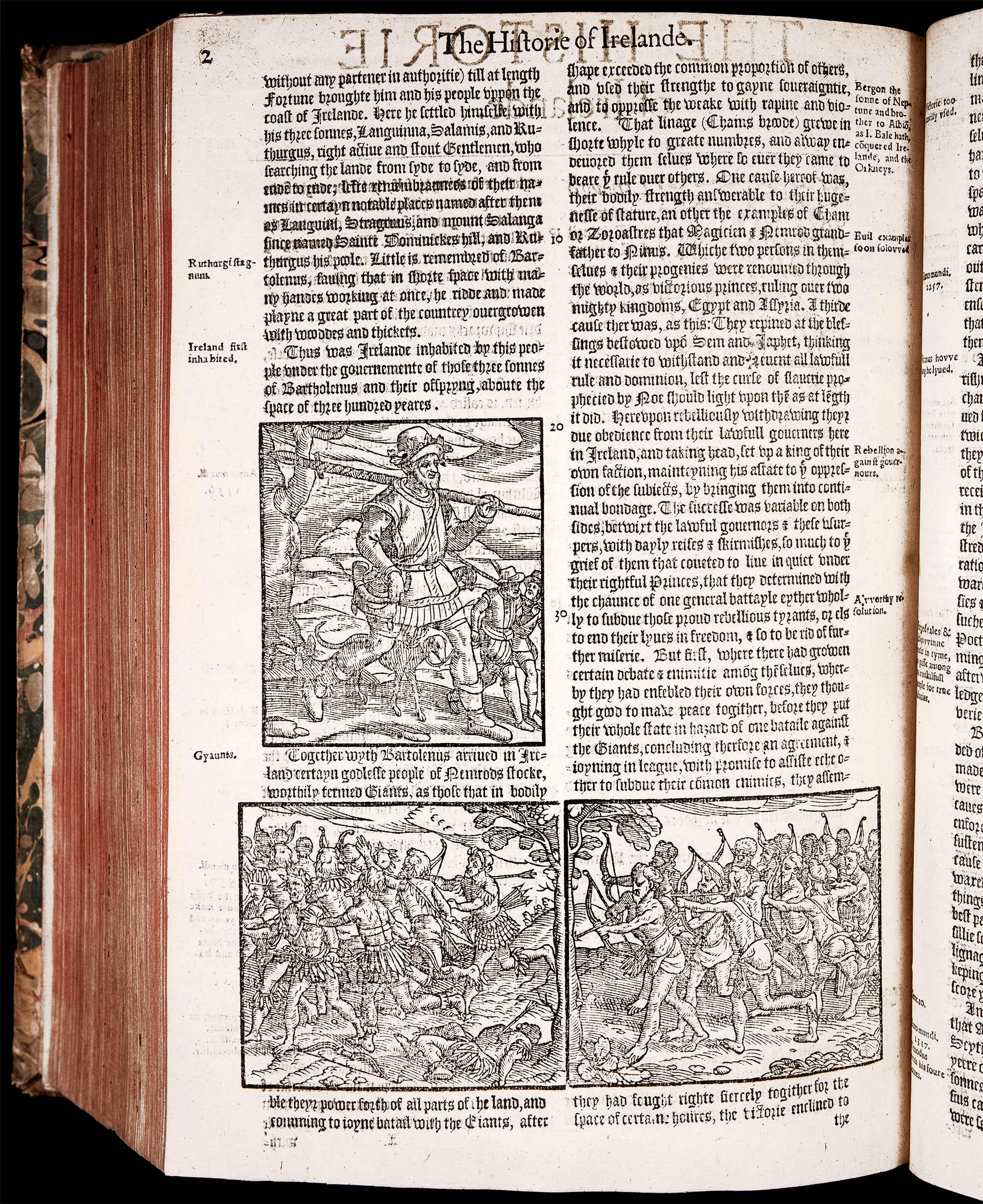
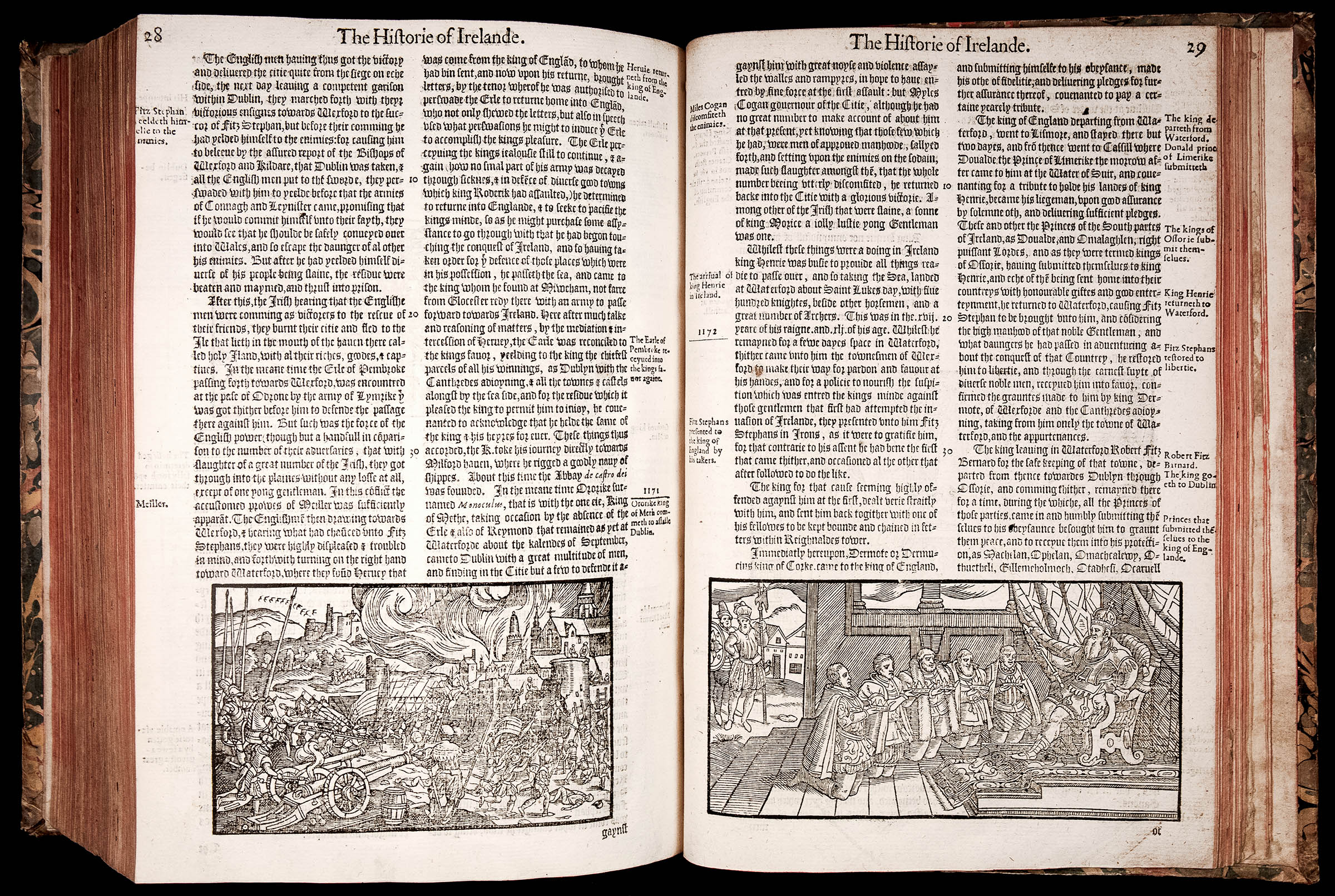
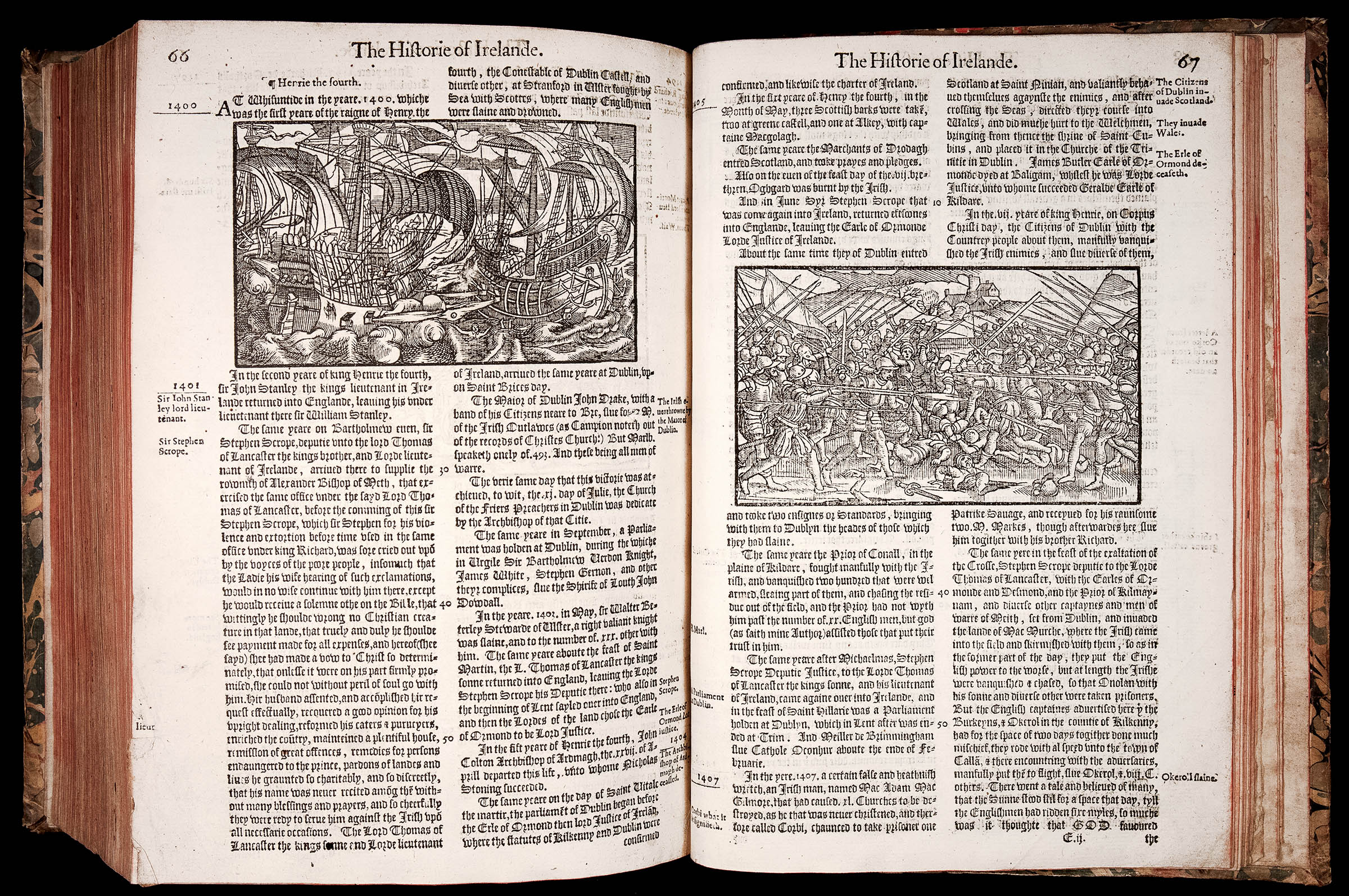
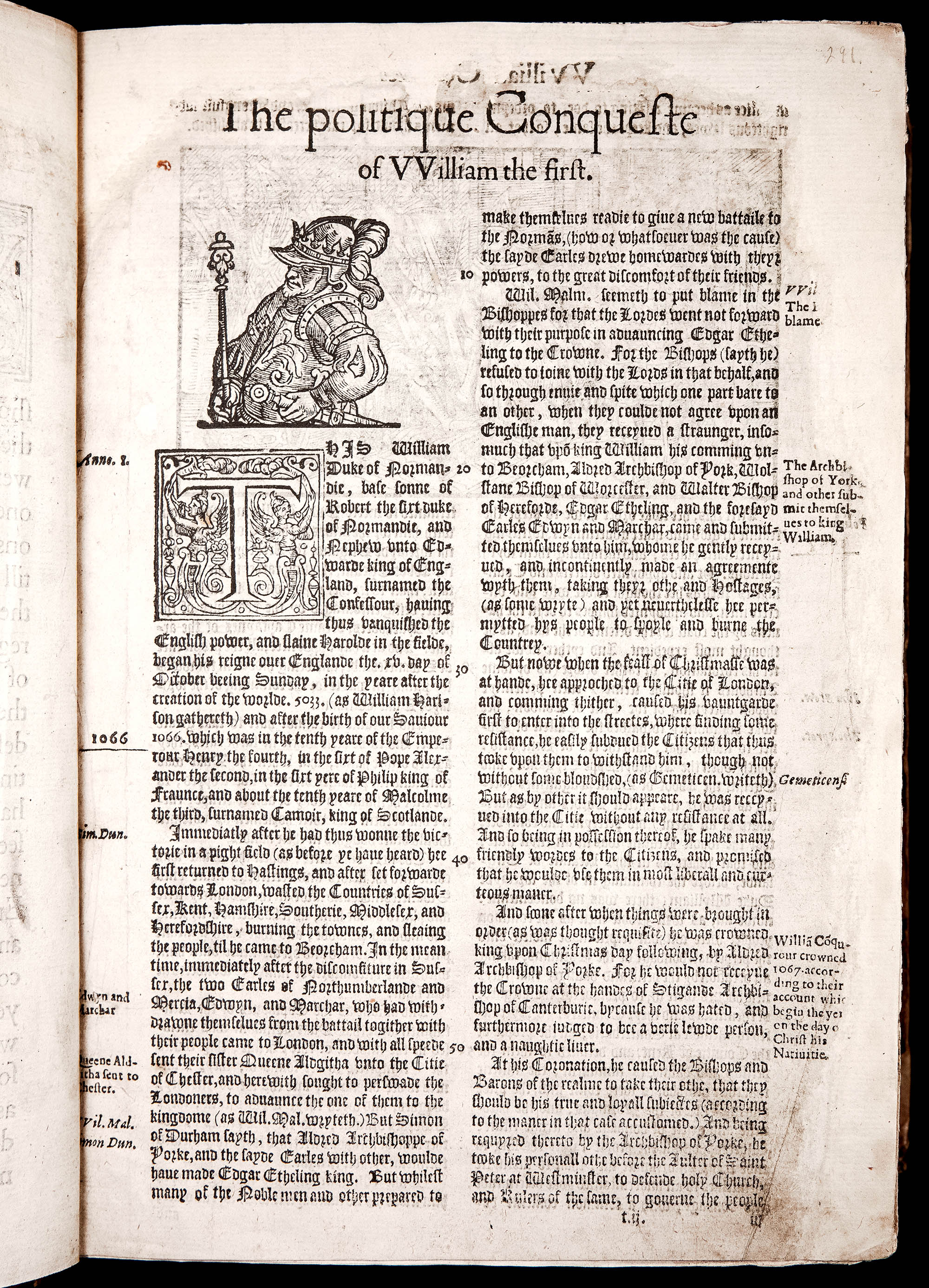
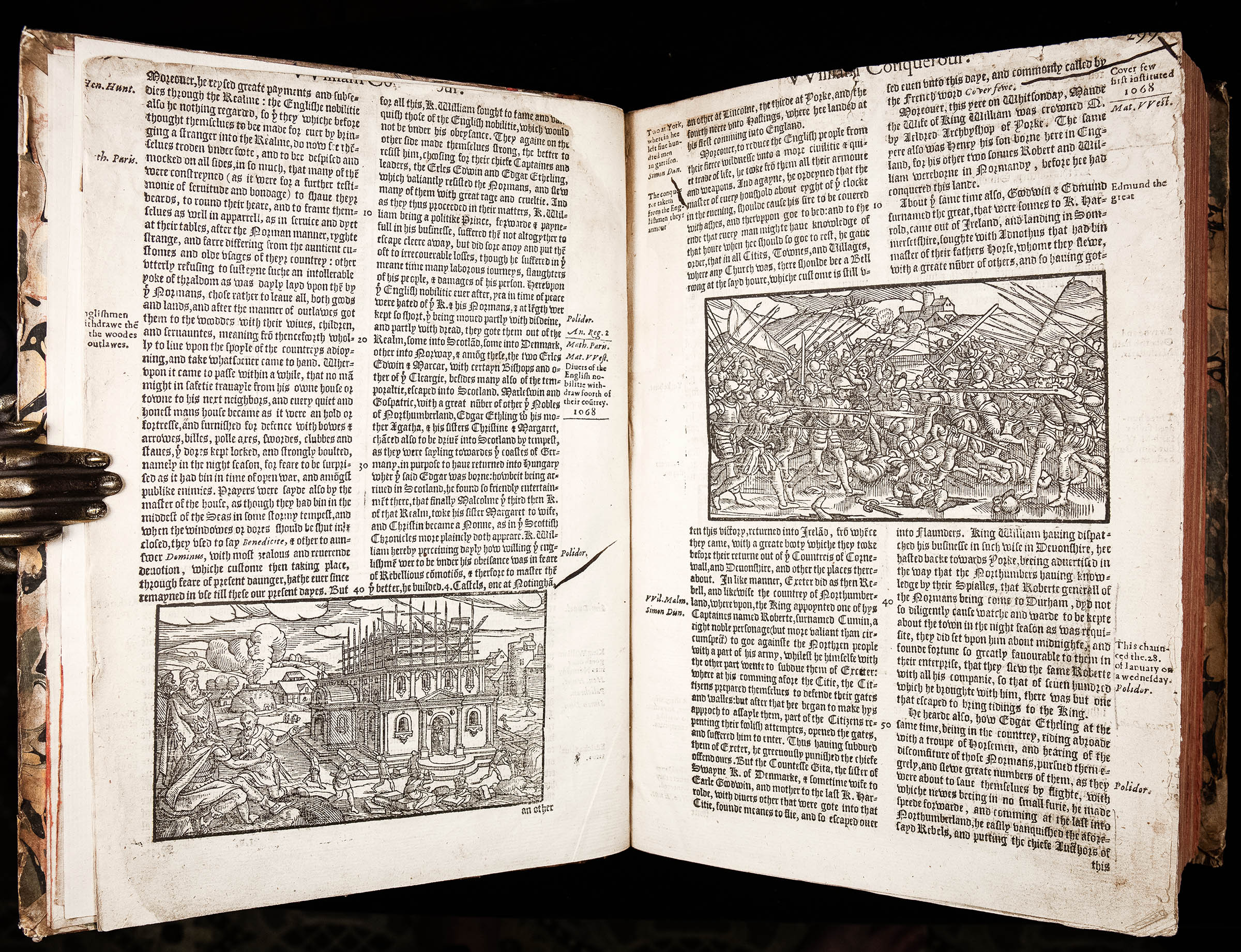
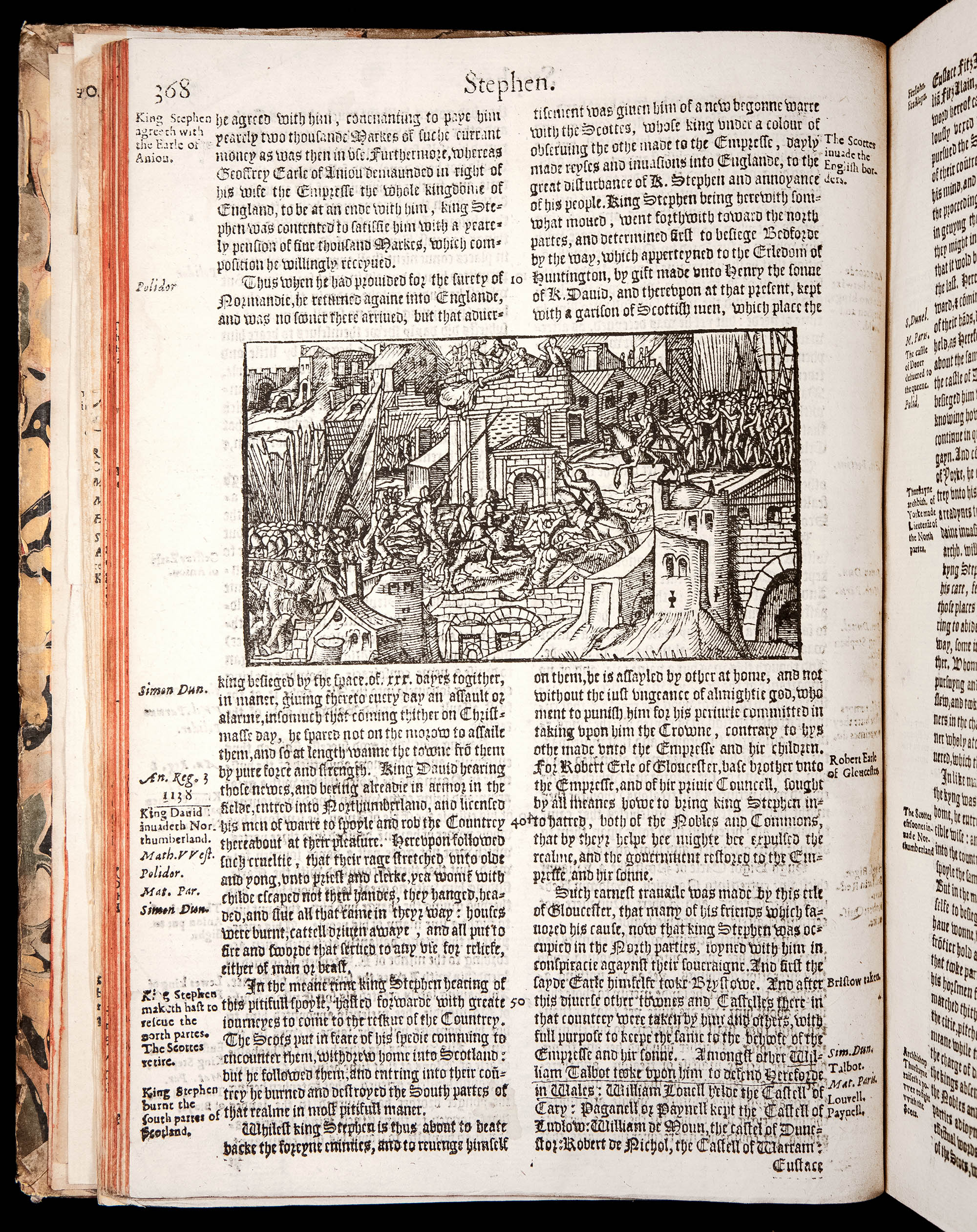
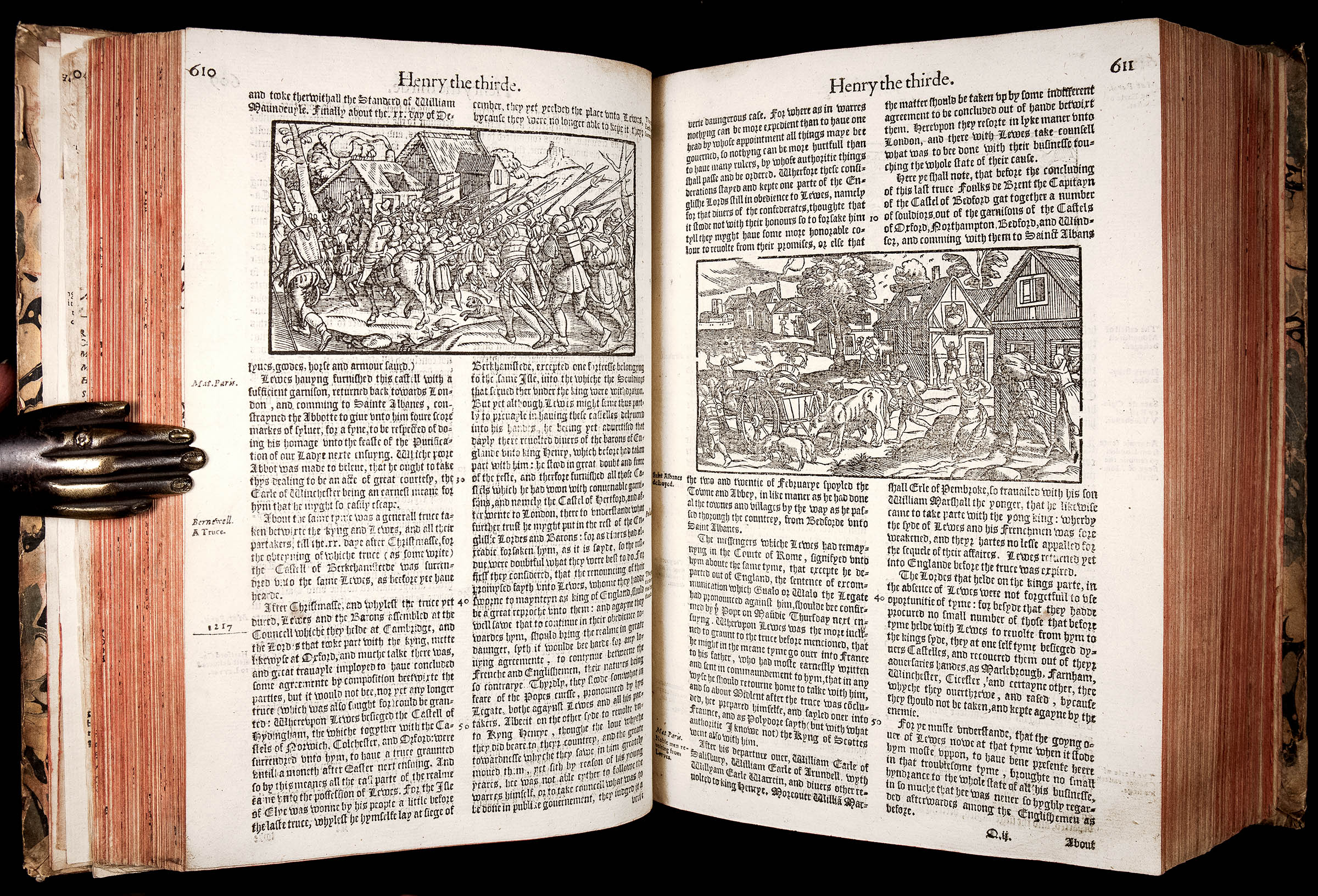
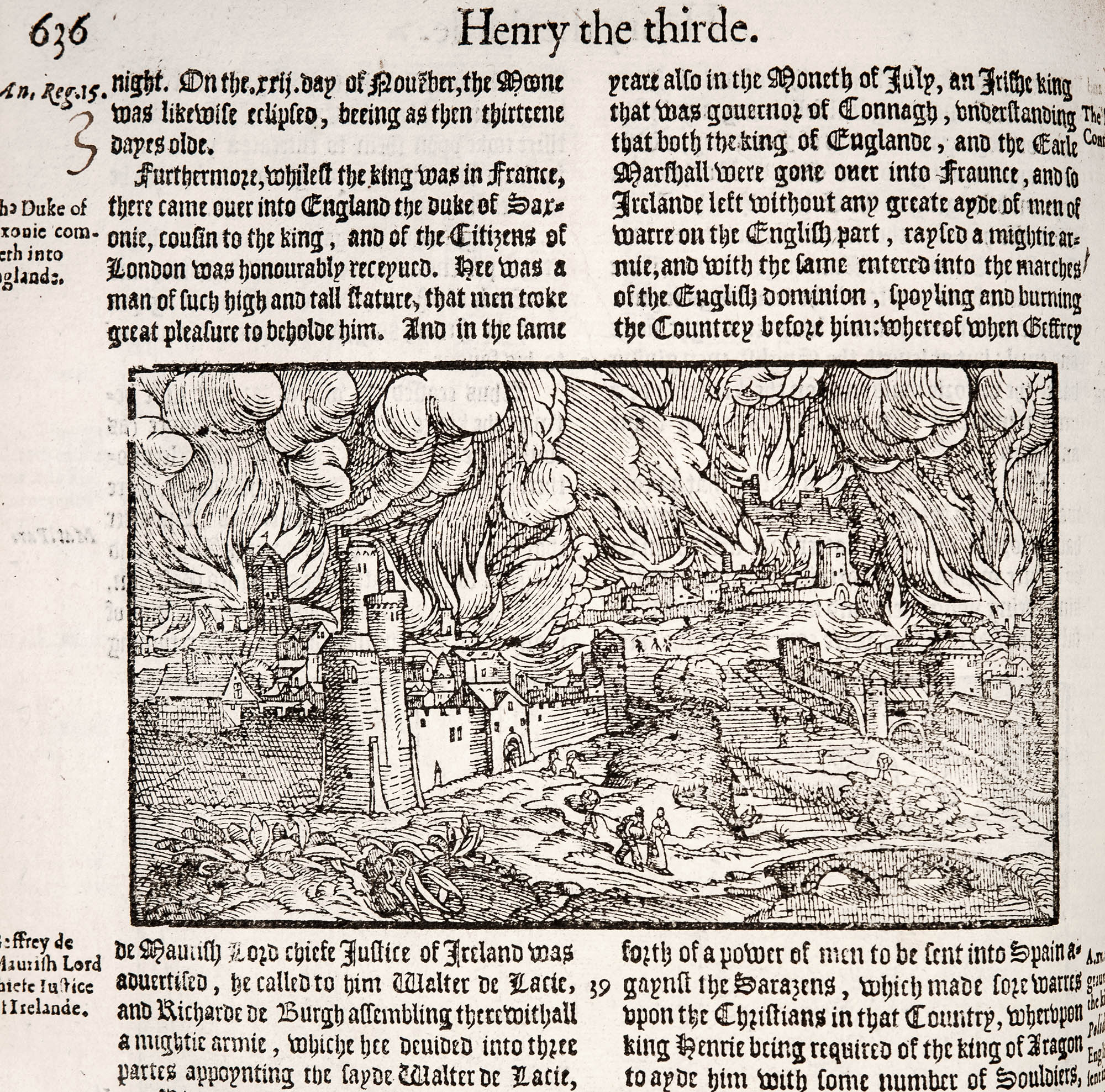
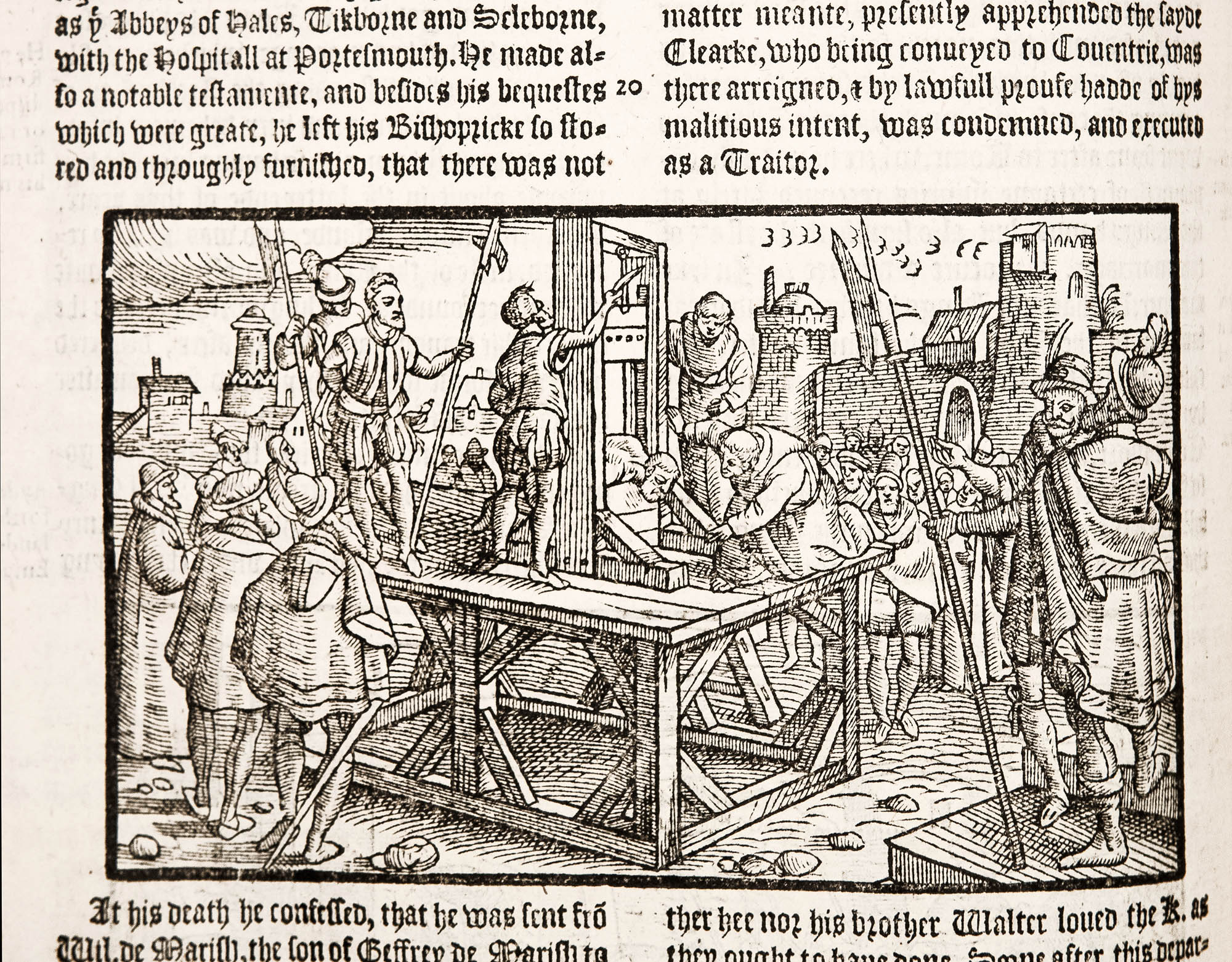
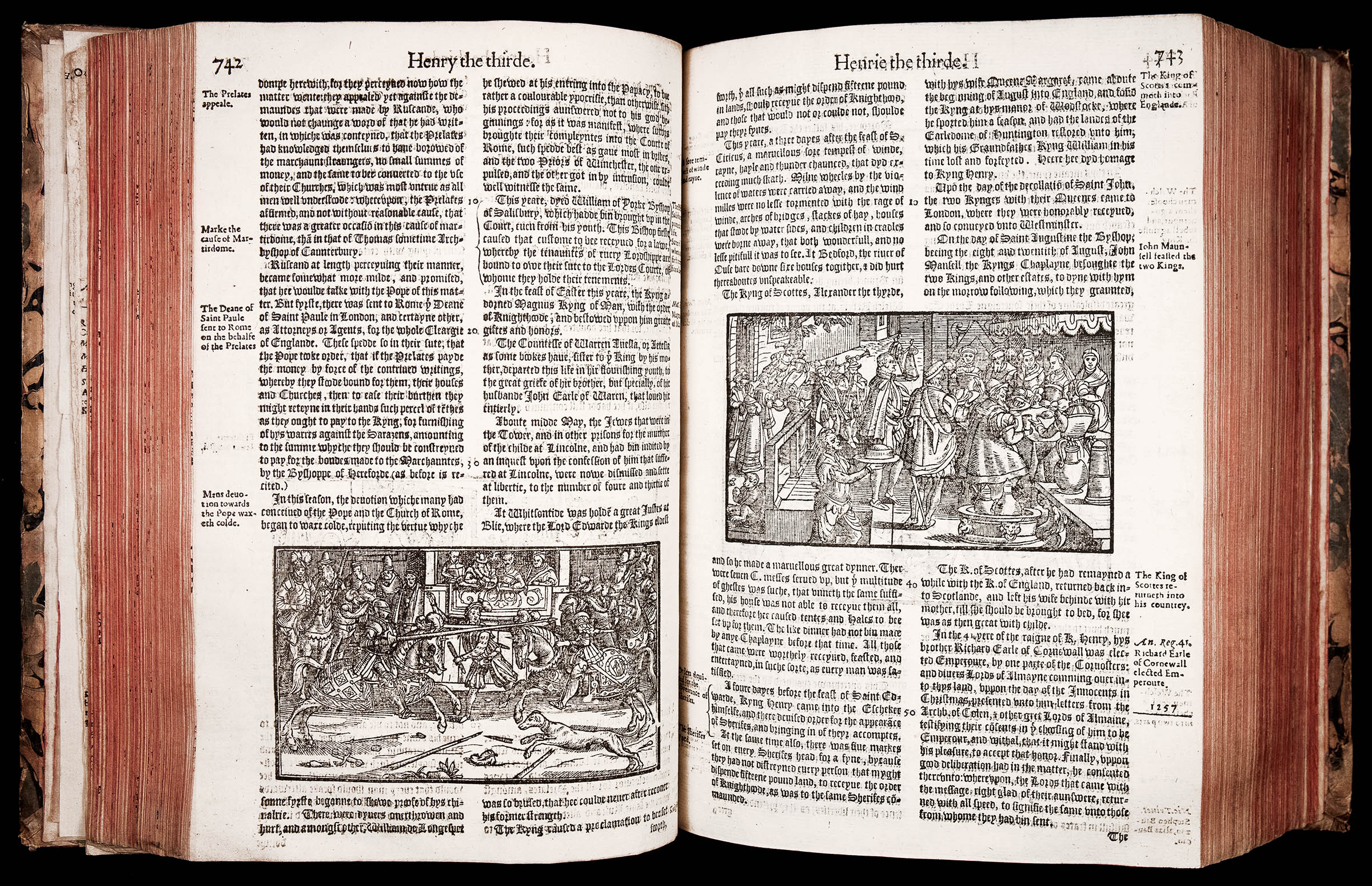
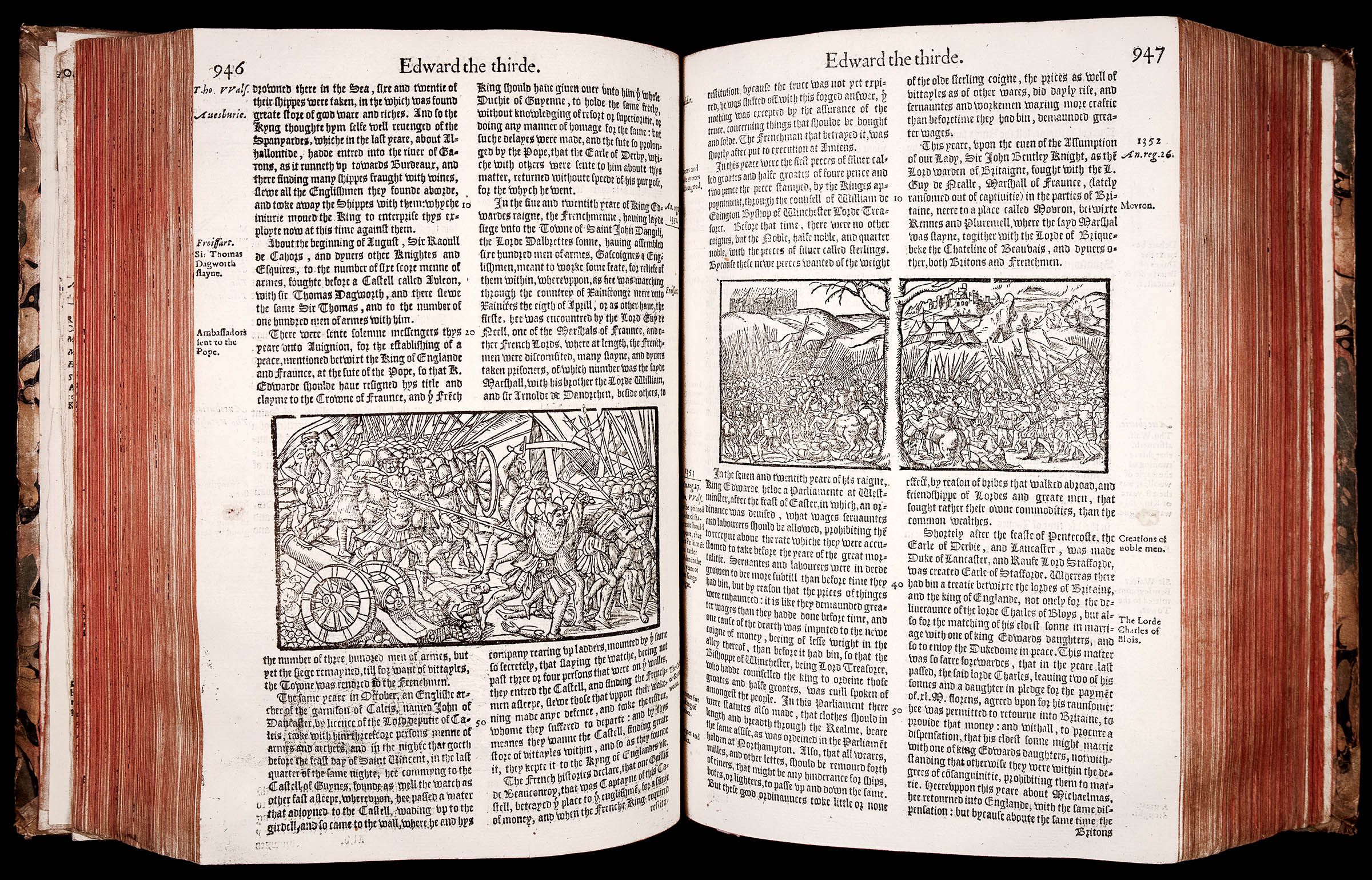
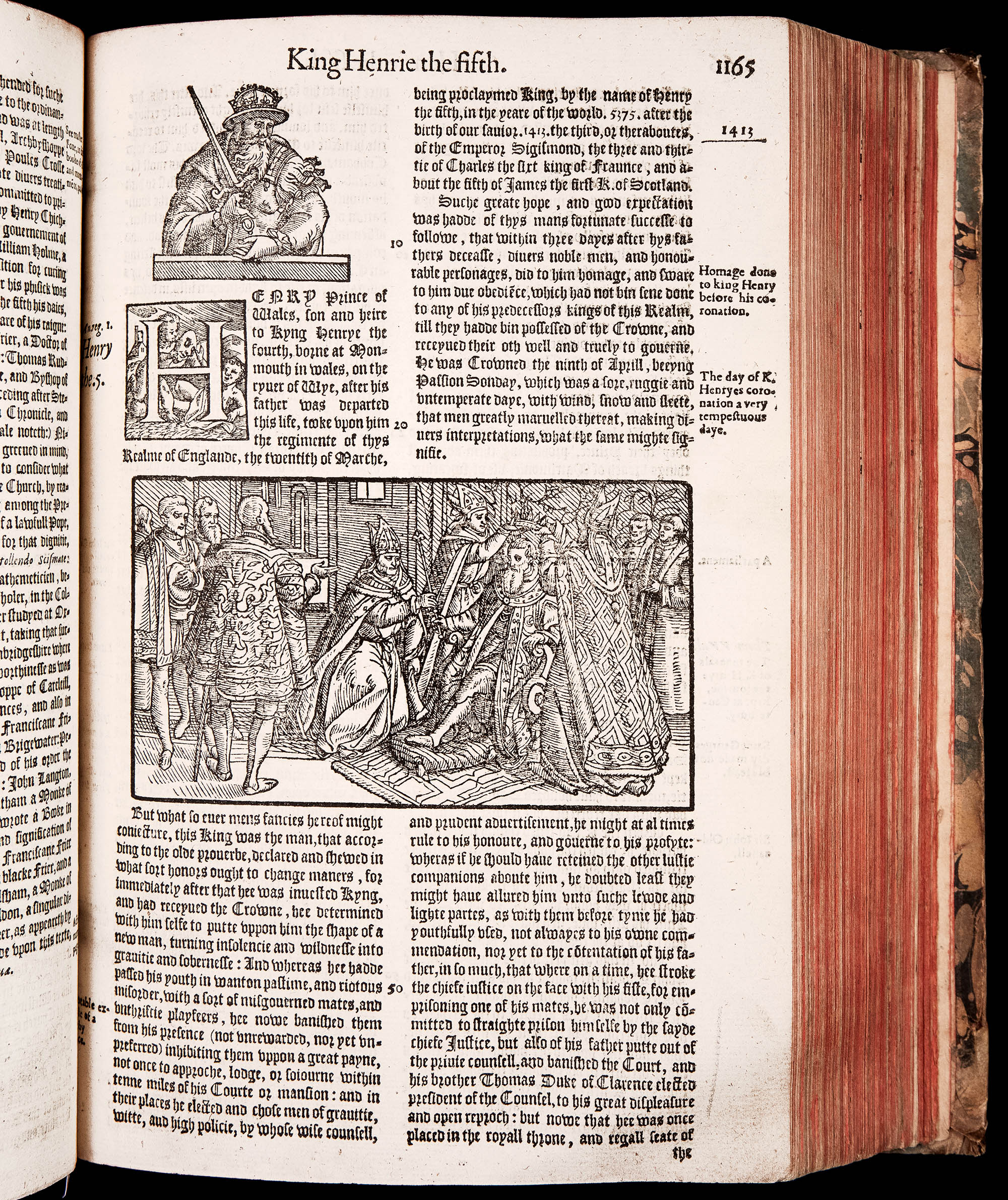
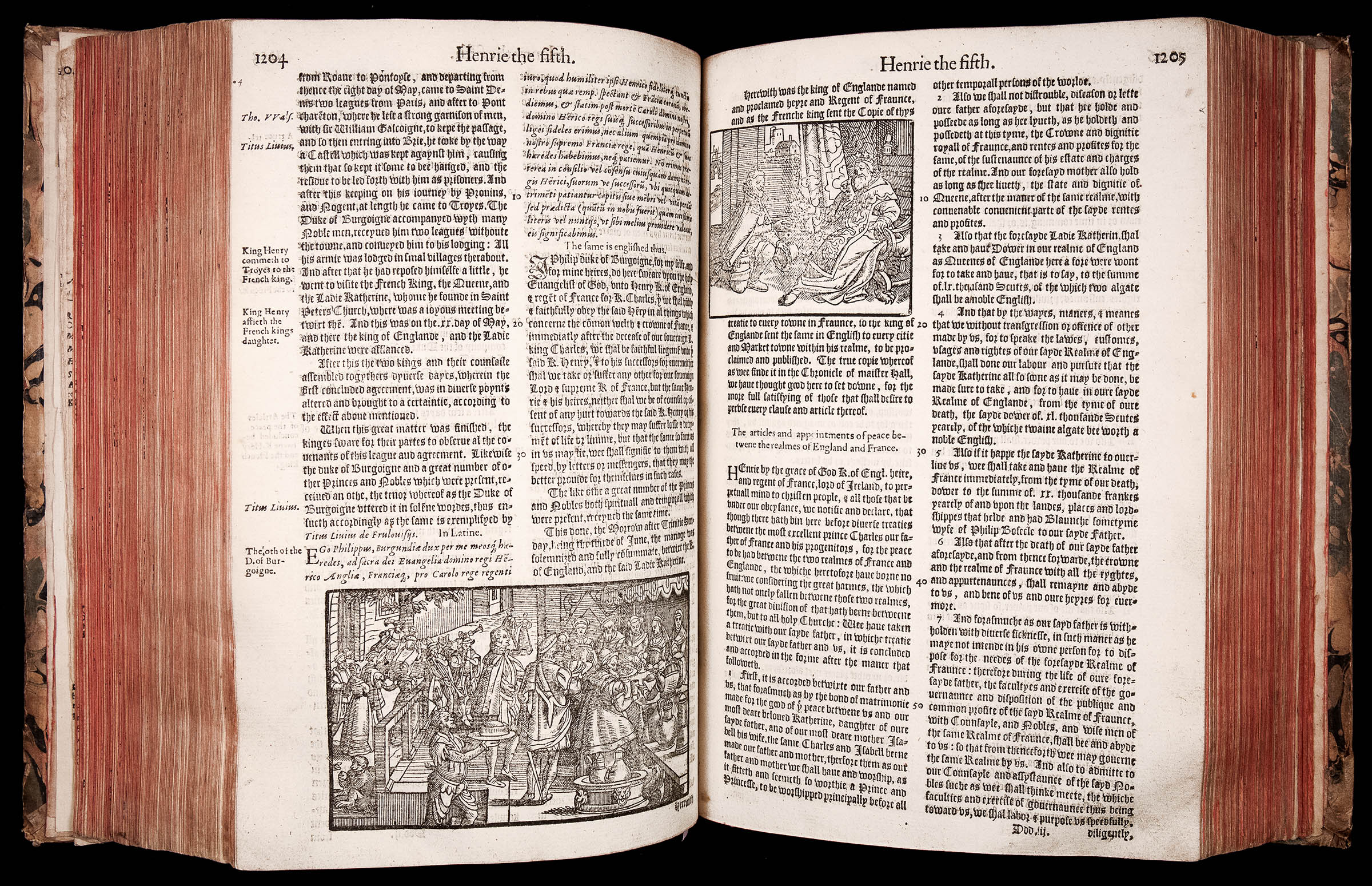
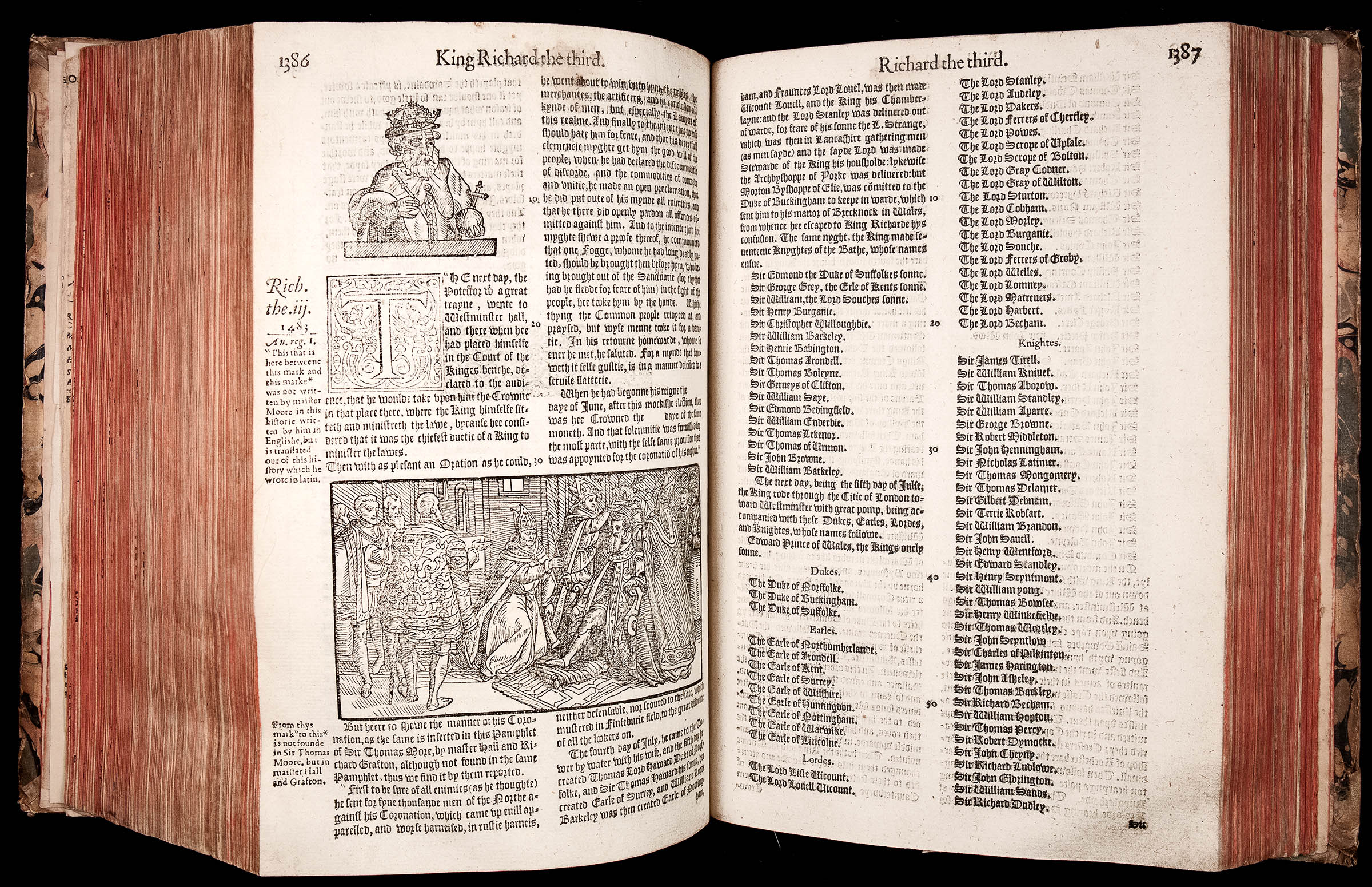
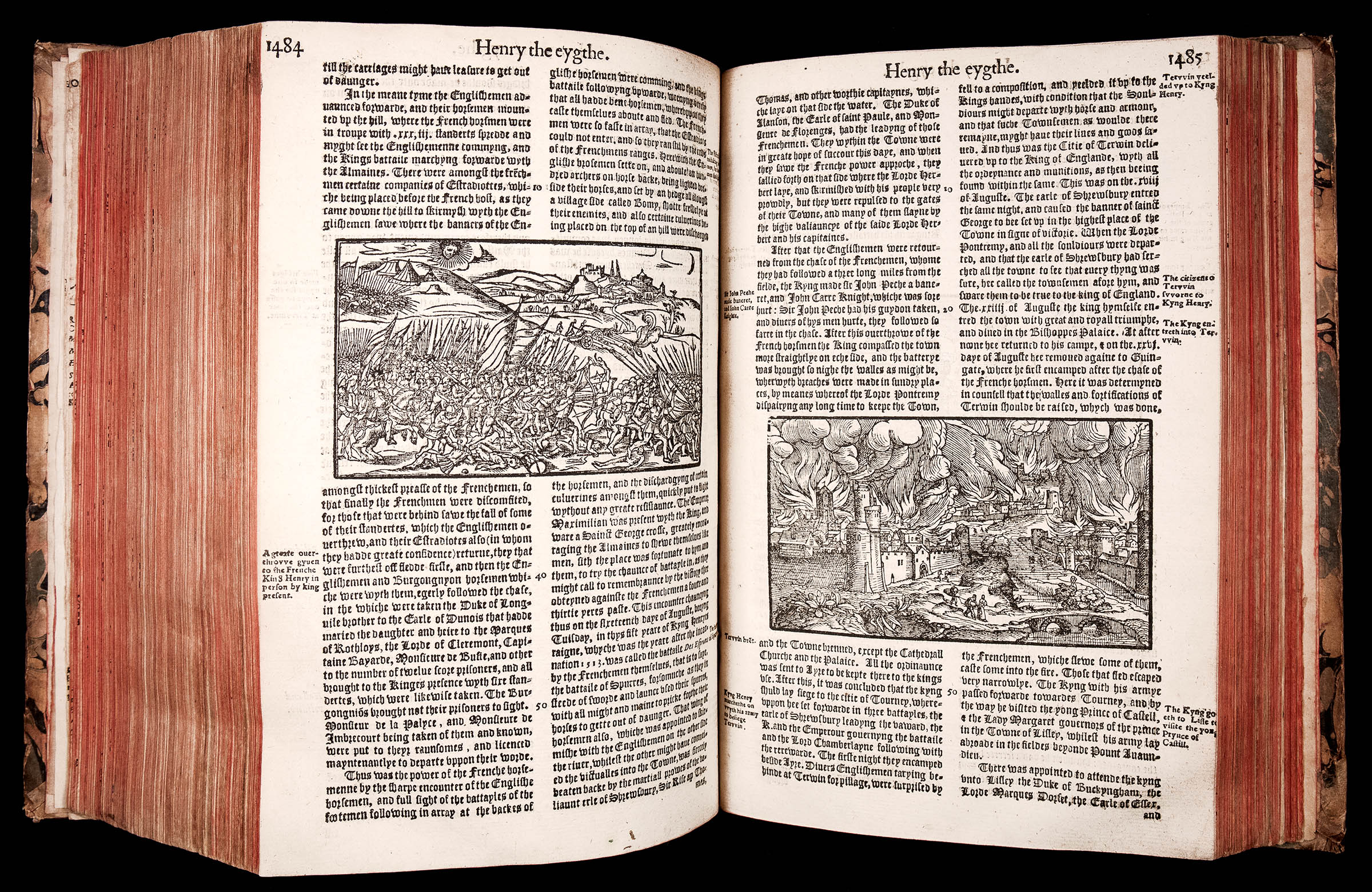
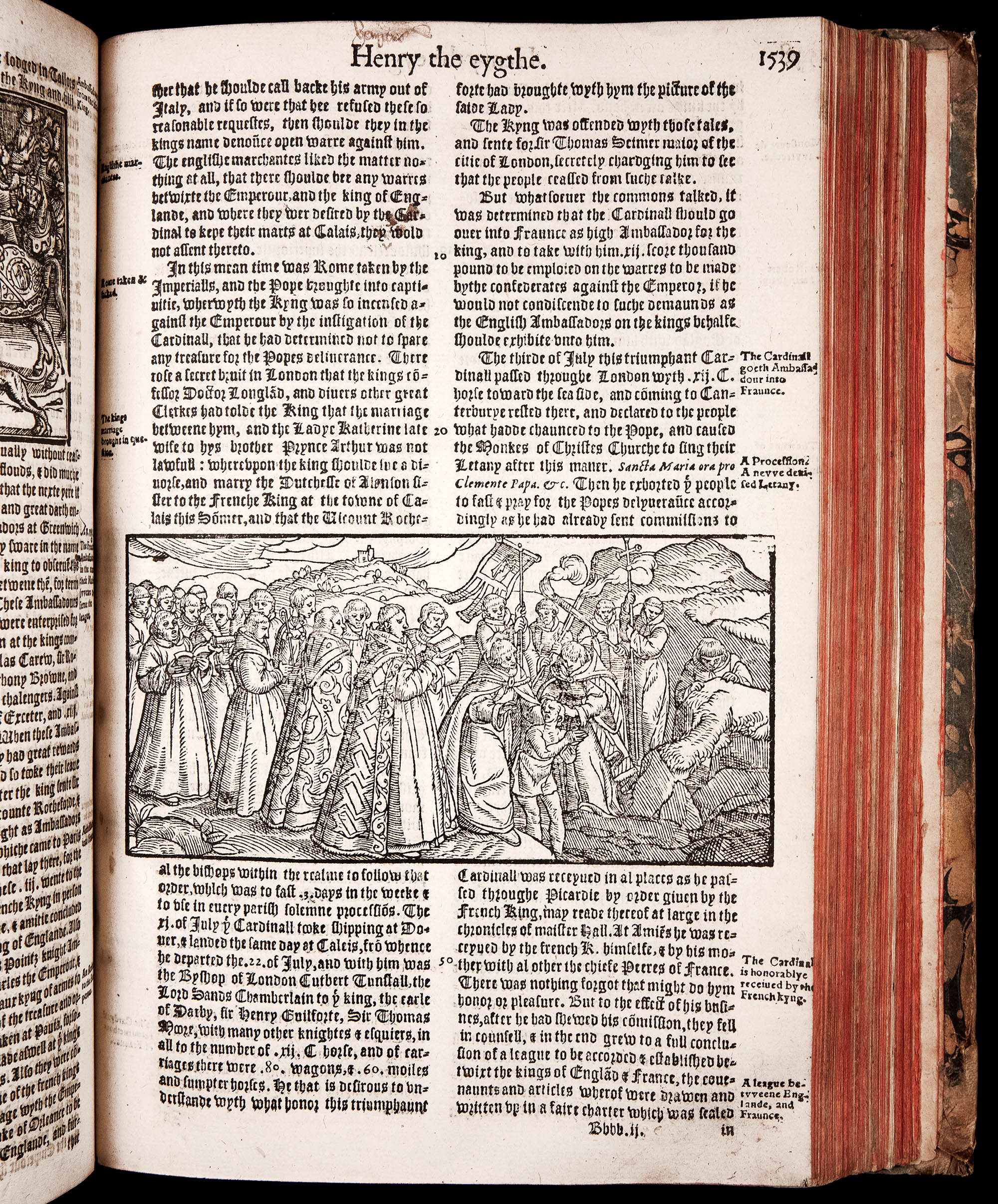
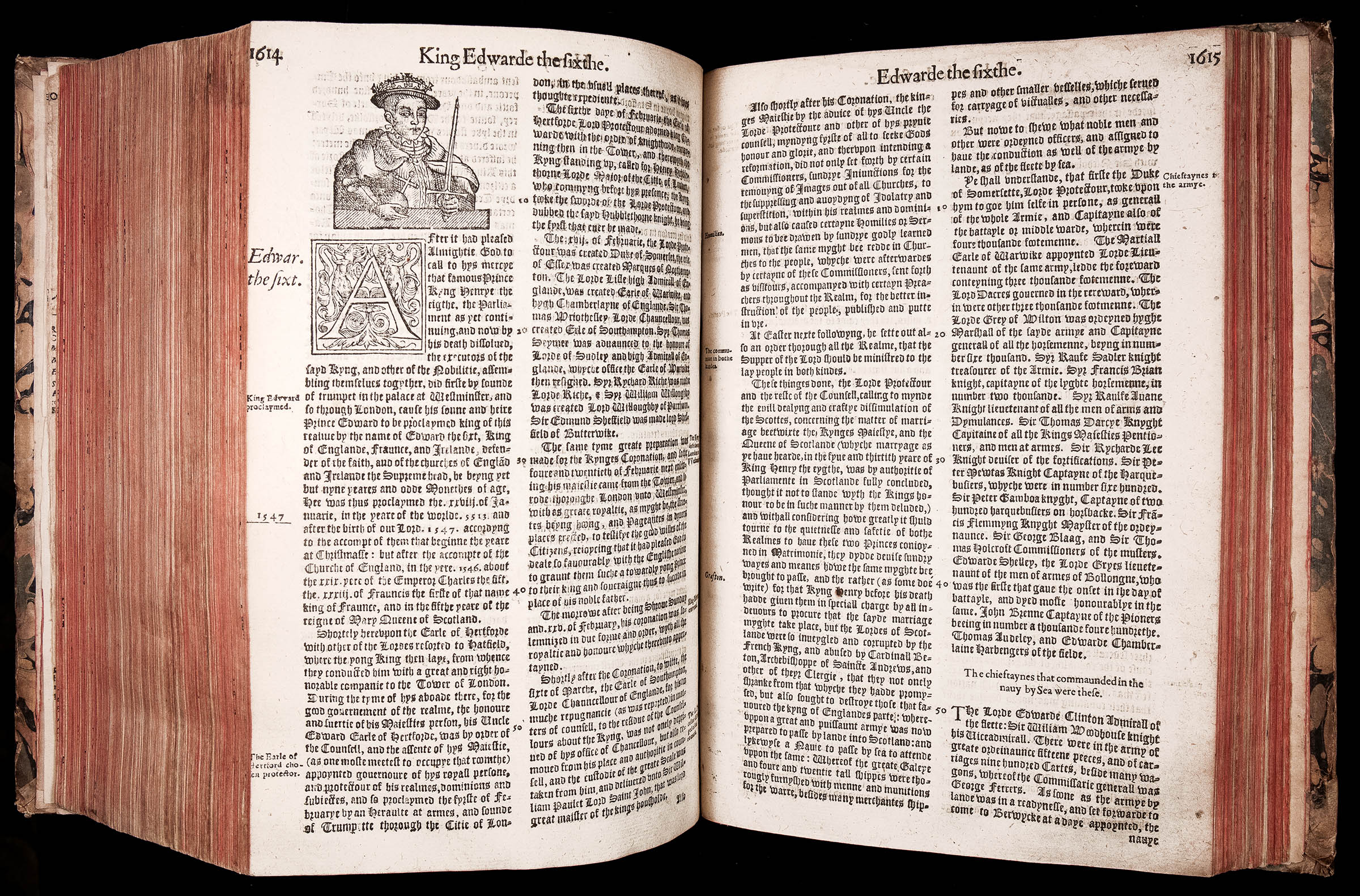
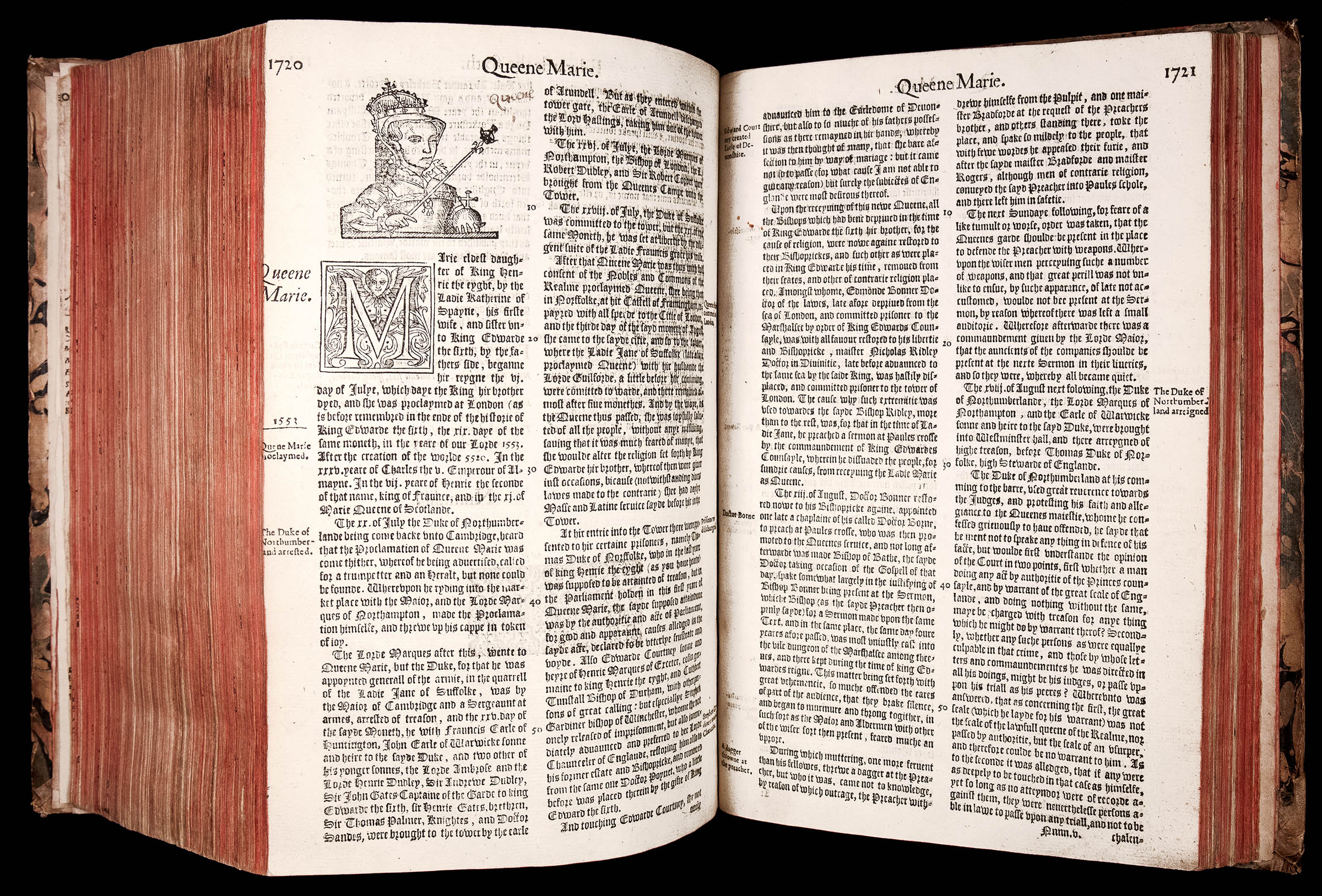
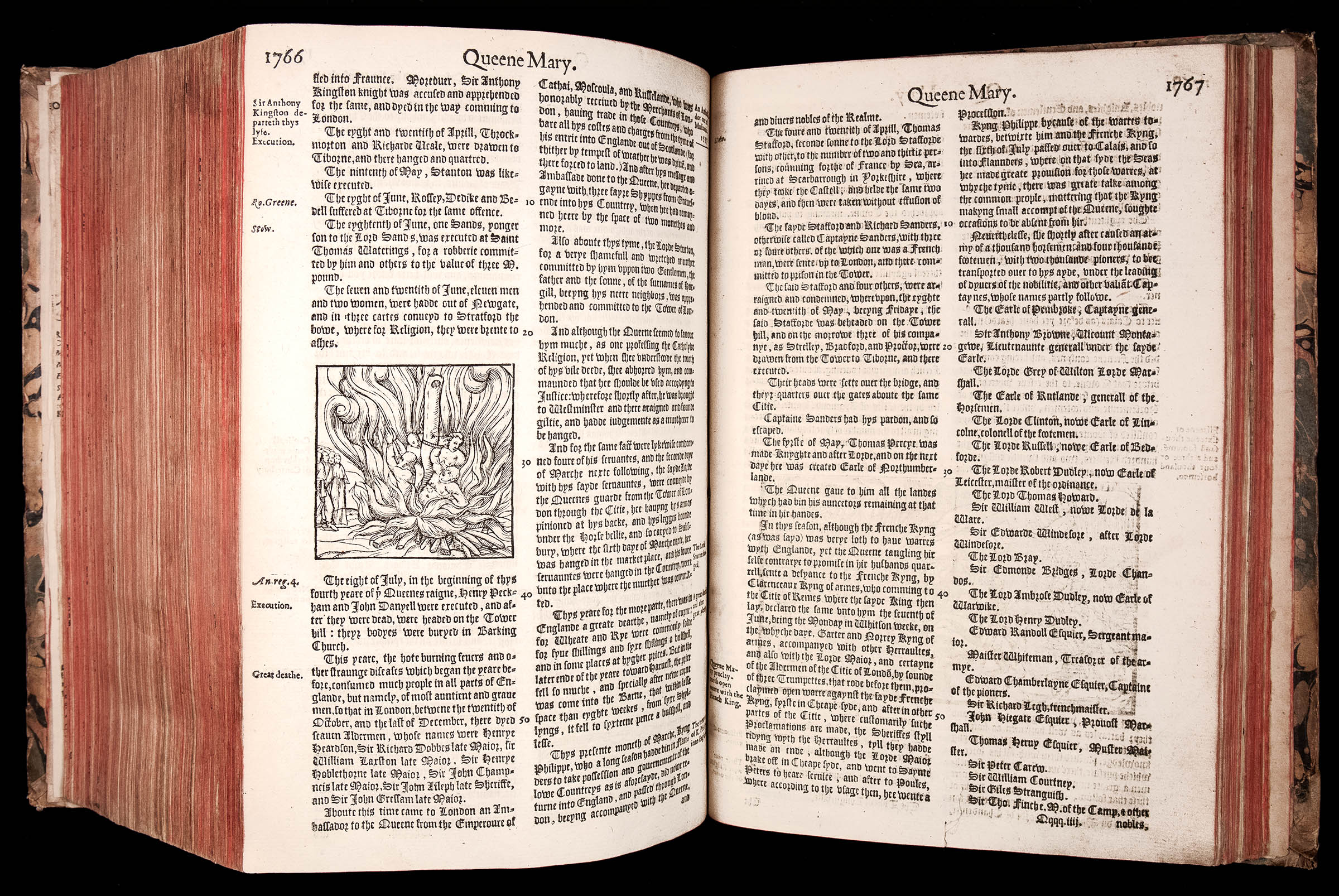
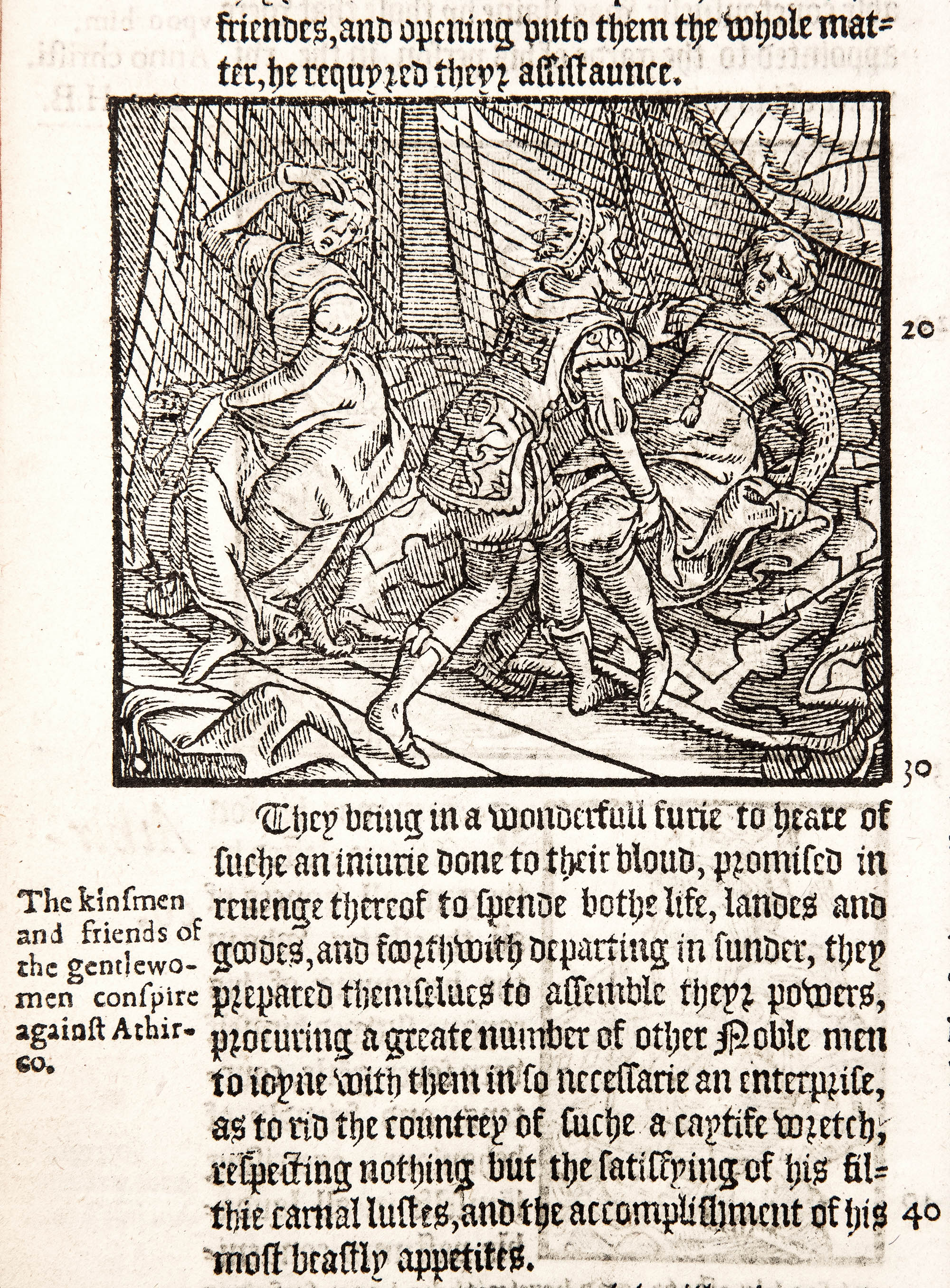
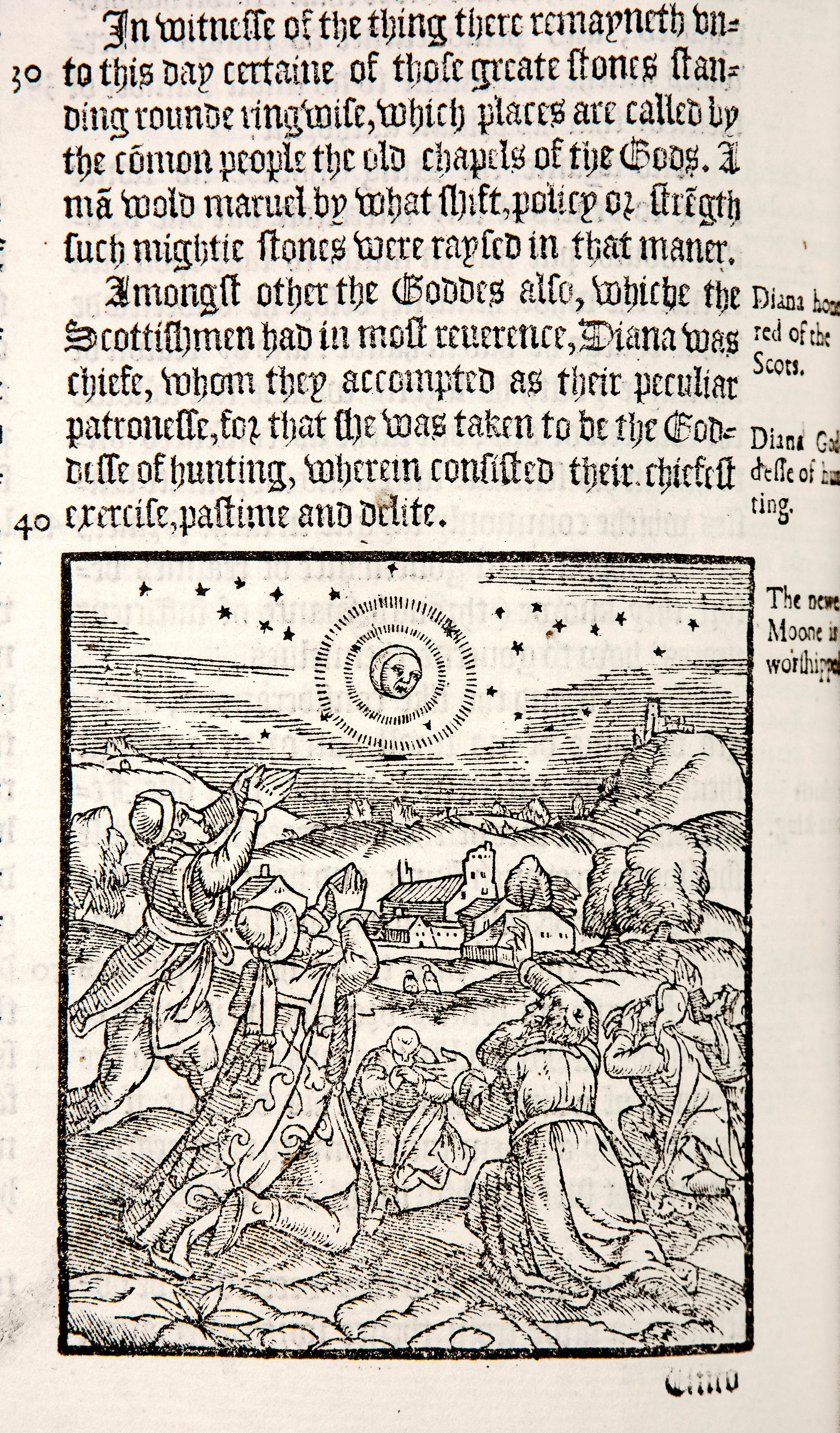
According to Luborsky and Ingram, the profusely illustrated 1577 First Edition of the Holinshed Chronicle “represent[s] (together with the herbals and emblem books) the most copiously illustrated secular texts of the Tudor era. […] Both the narrative and descriptive cuts are printed to relate to the pertinent texts; the images of the rulers function as initials do, to signal a new topic." While some of the cuts are reused, "most of the narrative and descriptive cuts are new and many artisans were engaged in their making.”
This monumental undertaking (comprising about 3000 pages in total!), while superintended by Holinshed, was, in fact, a collective effort involving several authors. The Chronicles for each of the three countries (England, Scotland & Ireland) are divided into two sections: "Description" and "History.” Holinshed himself wrote the "Historie of England." The "Description of England" is by William Harrison, rector of Radwinter and canon of Windsor. "The History and Description of Scotlande" and the "History of Irelande" are by Richard Staynehurst and Edward Campion. The entire 2nd volume (titled “The Laste volume of the Chronicles of England”) is dedicated to the “more recent” period of the history of England: from William the Conqueror to the current events of the Elizabethan Era.
The original idea for this work came with Reginald Wolfe (a Dutch-born English Protestant printer and one of the original members of the Royal Stationers' Company), who conceived the idea of publishing a "Universal Cosmography of the whole world, and therewith particular histories of every known nation". He wanted the work to be printed in English, with maps and illustrations. When Wolfe realised he could not complete this project on his own, he hired Raphael Holinshed and William Harrison to assist him. Having devoted 25 years to the compilation of the English, Scottish and Irish portions, Wolfe left it unfinished at his death in 1573. Raphael Holinshed then took over the project. He narrowed his scope to the British Isles and abandoned the plan to include maps, by then rendered unnecesssary by the preparation of Saxton's atlas.
Henry Bynneman, Reginald Wolfe's apprentice and successor, printed the work. Copies exist bearing various imprints with the names of Hunne, John Harrison, Lucas Harrison or George Bishop, who were enlisted "to defray the charges for the impression."
The perennial importance of this Chronicles lies largely in the fact that “The Elizabethan dramatists drew many of their plots from Holinshed’s pages,” (Pforzheimer, 494)
“NEAR ALL OF [SHAKESPEARE’S] HISTORICAL PLAYS, AS WELL AS MACBETH, KING LEAR AND PART OF CYMBELINE, ARE BASED ON HOLINSHED.” (DNB)
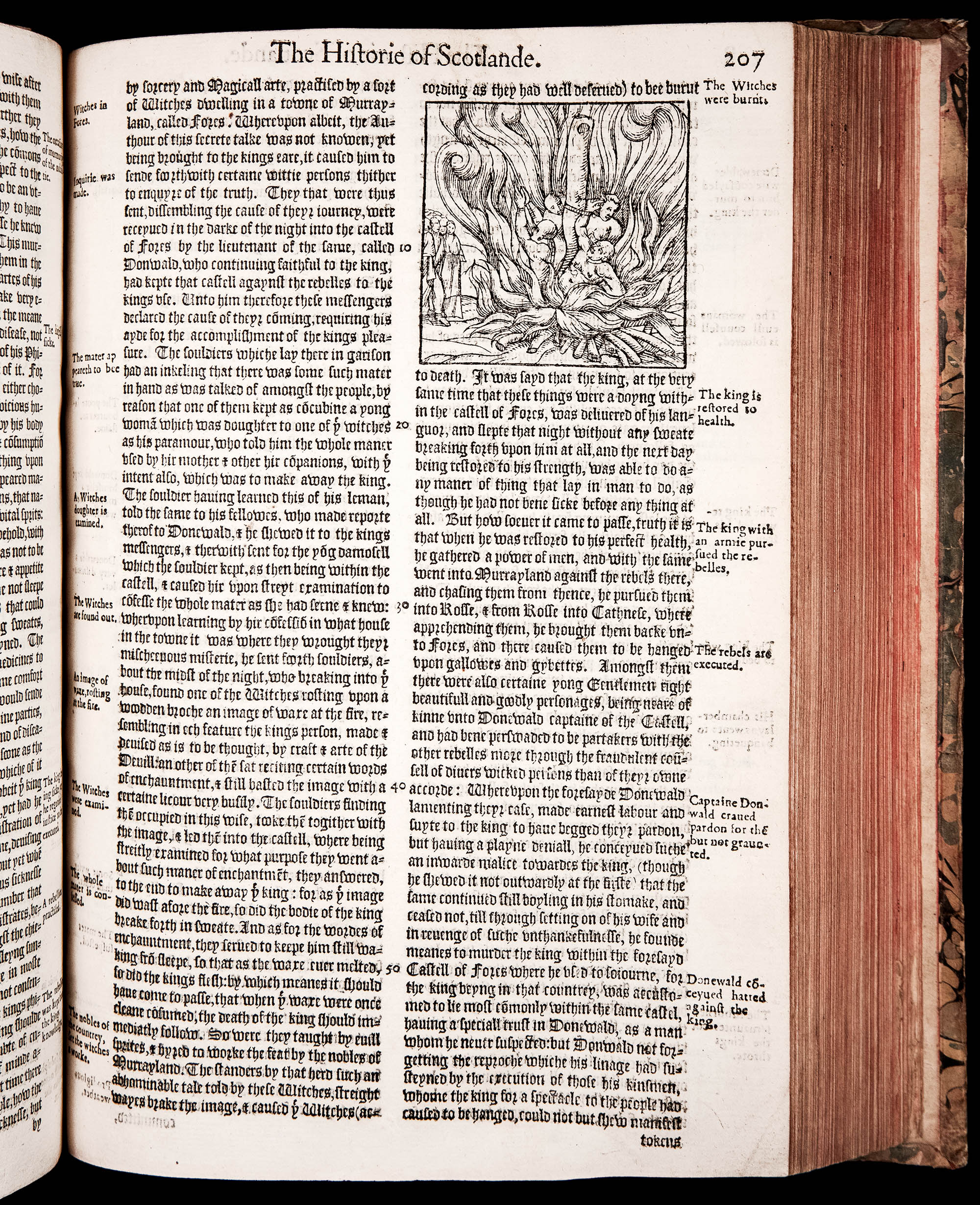
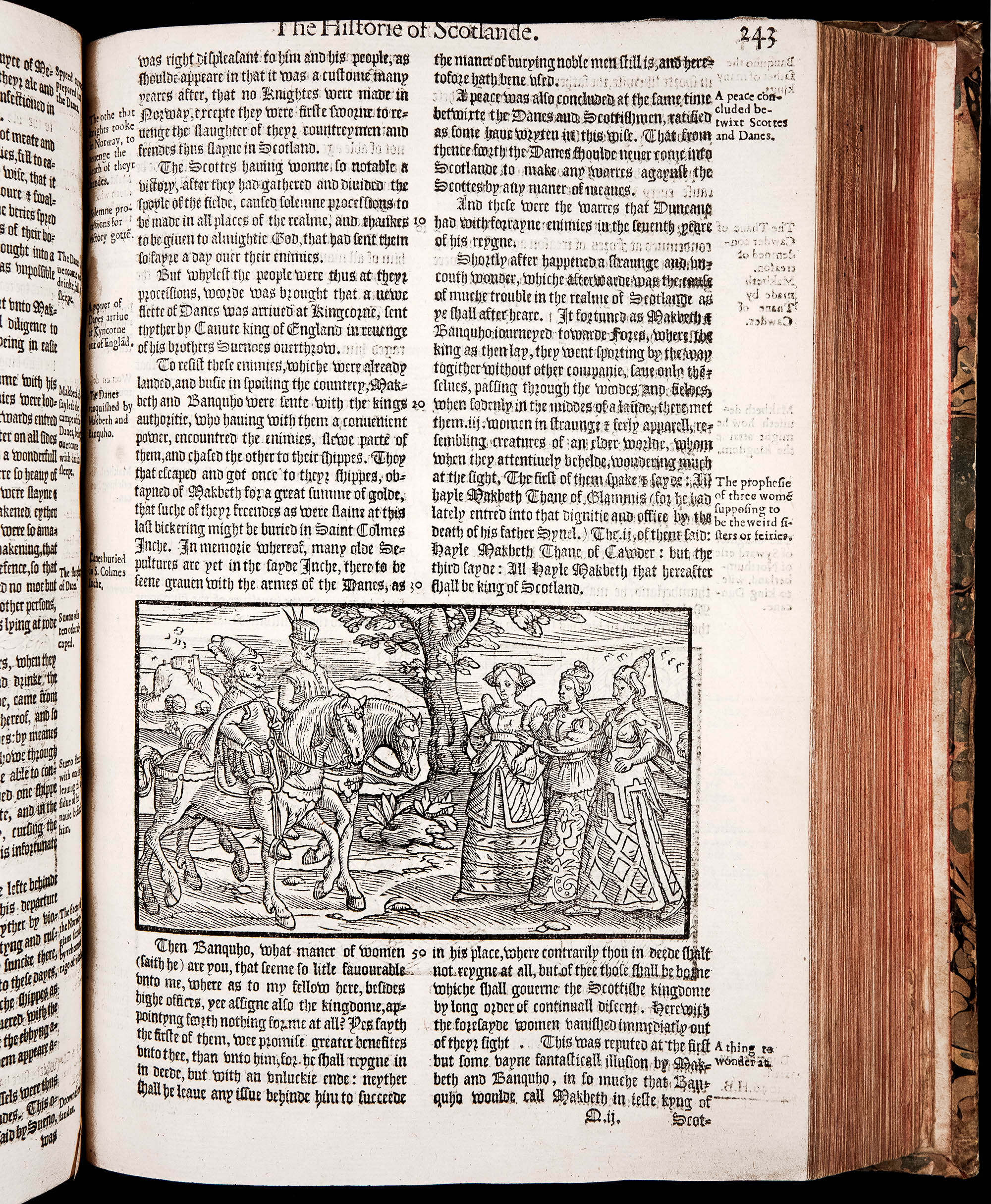
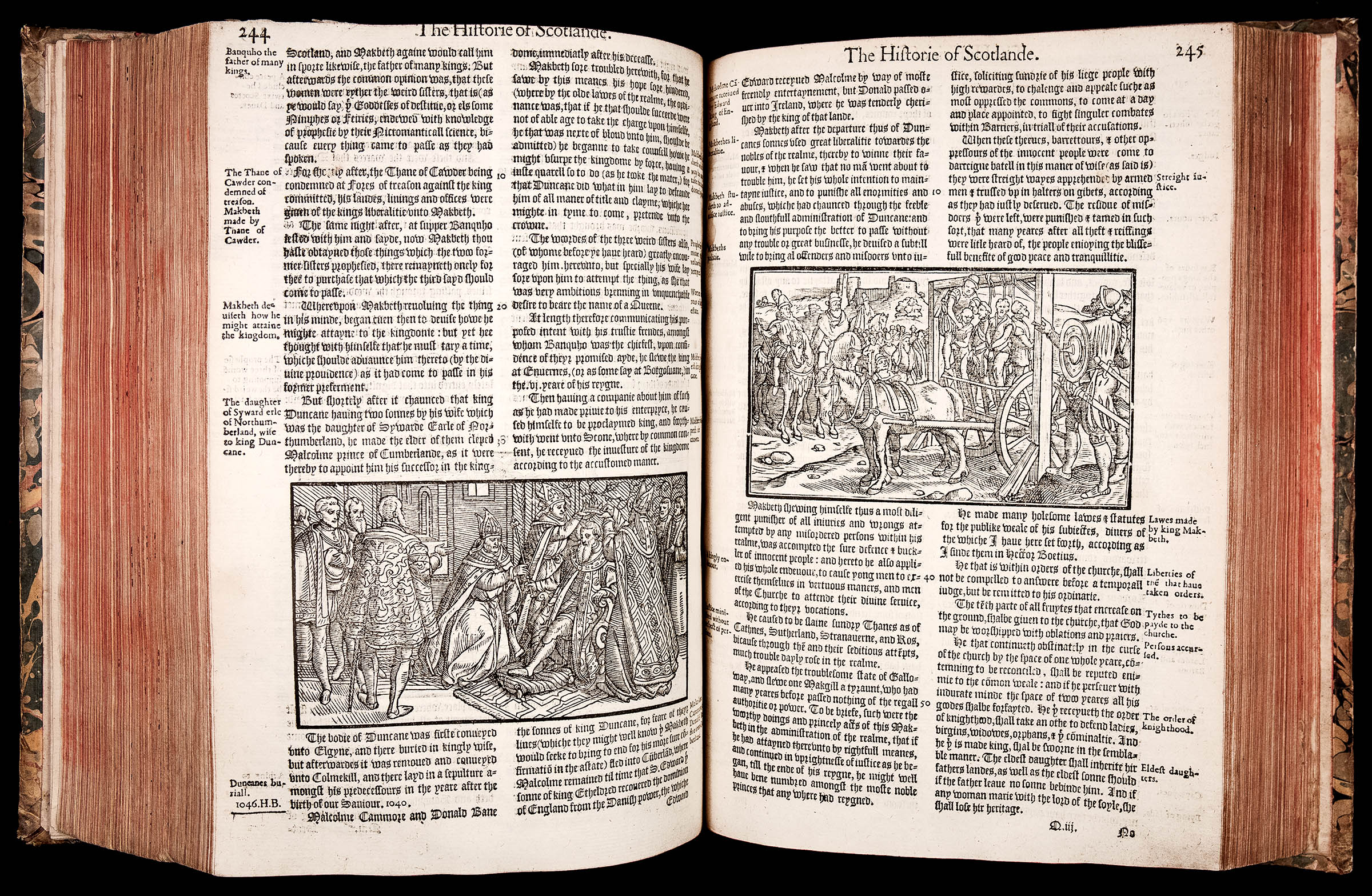
In this 1577 First Edition, the source material for Shakespeare’s Macbeth, King Lear, and Cymbeline is contained in the Firste Volume: Part II (Scotland), pp.206-8 and 242-6; Part I (England), pp.19-21; and Part I (England), pp.45-47, respectively.
“Not only is Holinshed’s Historie of Scotlande (1577) a major part of Tudor historiography, it is also of immense value to readers and researchers as a source text for William Shakespeare and his contemporaries. The Chronicles gave rise to more plays than any other historiographical work of its time and there is an impressive range of dramatic genres and literary adaptations that have emerged from Holinshed’s work. Shakespeare probably used the second edition of Holinshed’s Chronicles (1587) as a key source for his English history plays (for instance, to write Richard III and Henry V) as well as an inspiration for Cymbeline and King Lear.
Holinshed’s Historie of Scotlande was an important source text for Shakespeare’s Macbeth (c. 1606-1607). It allowed Shakespeare to engage with the history of Scotland at a point in time when, following the death of Elizabeth I., England had become a nation ruled by a Scottish Stuart King. Shakespeare’s adaptation of stories found in Holinshed’s Historie are therefore not only a source of creative inspiration, but a way of facing pressing political questions through the lens of history.
Shakespeare’s Macbeth presents a fascinating engagement with Holinshed’s historiography and a creative rewriting of Holinshed’s account of different events and time periods. Macbeth draws on at least two periods of medieval Scottish history that are portrayed separately by Holinshed: the reign and murder of King Dubh (sometimes also spelled as ‘Duff’), who ruled Scotland from about 962 to 967 AD. Shakespeare takes events from these two periods and merges them together to weave the plot for Macbeth.
Especially the portrayal of Lady Macbeth and the three ‘weird sisters’ or witches in Shakespeare’s play draws on Dubh’s and Duncan’s stories in Holinshed. In Holinshed’s account of the short reign of Dubh, one of his nobles, Donwald, becomes dissatisfied with the King’s rule and is persuaded by his wife to act on his feelings of frustration and anger: ‘She […] counselled him […] to make him away and shewed him the meanes whereby he might accomplishe it. Donwalde thus being the more kindled in wrath by the words of his wife, determined to follow hyr advice in the execution of so haynous an acte.’ (Historie of Scotlande, p. 208)
Donwald and his wife plot to kill Dubh: they organise a banquet and make his chamberlains drunk, so that the King’s murder can be committed without witnesses or interruption. These events are echoed in Act II of Shakespeare’s play, when Macbeth and Lady Macbeth devise their plan to assassinate King Duncan. Lady Macbeth and Donwald’s wife are framed as women with considerable influence over their husbands and become the instigators of regicide. Although Shakespeare gives a much greater role to Lady Macbeth, Holinshed’s text, through further annotations in the margins, already draws special attention to the events as a consequence of female influence: ‘The womans evill counsell is followed’ (p. 208).
Shakespeare also drew substantially on Holinshed’s account of the reign of King Duncan, especially when Macbeth and Banquo encounter three women who prophesy that Macbeth will be King of Scotland: ‘It fortuned as Makbeth and Banquho journied towards Fores, where the king as then lay, they went sporting by the way togither without other companie, save only themselves, passing through the woodes and fieldes, when sudenly in the middes of a laund, there met them three women in straunge and ferly apparell, resembling creatures of an elder worlde, whom when they attentively behelde, wondering much at the sight, the first of them spake and sayde; All hayle Makbeth, Thane of Glammis (for he had lately entred into that dignitie and office by the death of his father Synel.) The second of them said: Hayle Makbeth thane of Cawder: but the third sayde; All hayle Makbeth that hereafter shall be king of Scotland.’ (p. 243)
Holinshed’s text, like Shakespeare’s, gives these three women immense power as it is their prophecy which sets the following events into motion. However, Holinshed’s text describes the women as dressed in ‘strange and ferly apparel’ […] and Macbeth and Banquo initially do not believe their eyes. The encounter appears to them as a ‘fantasticall illusion’. The three women are presented variously as ‘creatures of an elder worlde’, ‘weird sisters or feiries’, and as ‘Goddesses of destinie, or els some Nymphes or Feiries, endewed with knowledge of prophesie by their nicromanticall science’(p. 244). Holinshed’s text does not, in fact, call them witches. The phrase ‘weird sisters’ is taken up by Shakespeare in the women’s first encounter with Macbeth.
Interweaving elements of the story of King Duff with an account of King Duncan’s assassination by Macbeth, Shakespeare constructs an entirely new vision of events for his play.” (Holinshed’s Historie of Scotlande & William Shakespeare’s Macbeth from The Munich Shakespeare Library website)
While Holinshed’s influence on Shakespeare is notorious, it is less well known that even in the next century, the Chronicles were a great inspiration for, and influence on, another luminary of English literature - John Milton. “Holinshed's most learned literary reader, John Milton, […] studied Holinshed extensively over the years building up to the Civil War (1639–42), making annotations in his commonplace-book and working directly on plans for an historical epic. He turned to the Chronicles again as he composed his ‘History of Britain’ during a second intense period of political crisis between 1647 and 1649. On both occasions Milton applied his reading of Holinshed to contemporary developments and in the former he also planned to use the Chronicles as a literary source. Although the poet abandoned his plans for an Arthurian epic because he decided there was no basis in truth for these 'legends' […]. The story of King Lear and his daughter Cordelia was especially important to him and he seems to have combined his reading of Holinshed with Shakespeare's tragedy as he worked on the prose construction of this tale.” (Paulina Kewes et al., The Oxford Handbook of Holinshed's Chronicles, p.587)
STC 13568.5; Pforzheimer 494; Bartlett 222; Grolier/Langland to Wither 146; Grolier/English 6; Luborsky & Ingram, English Illustrated Books, I, pp. 452-68.
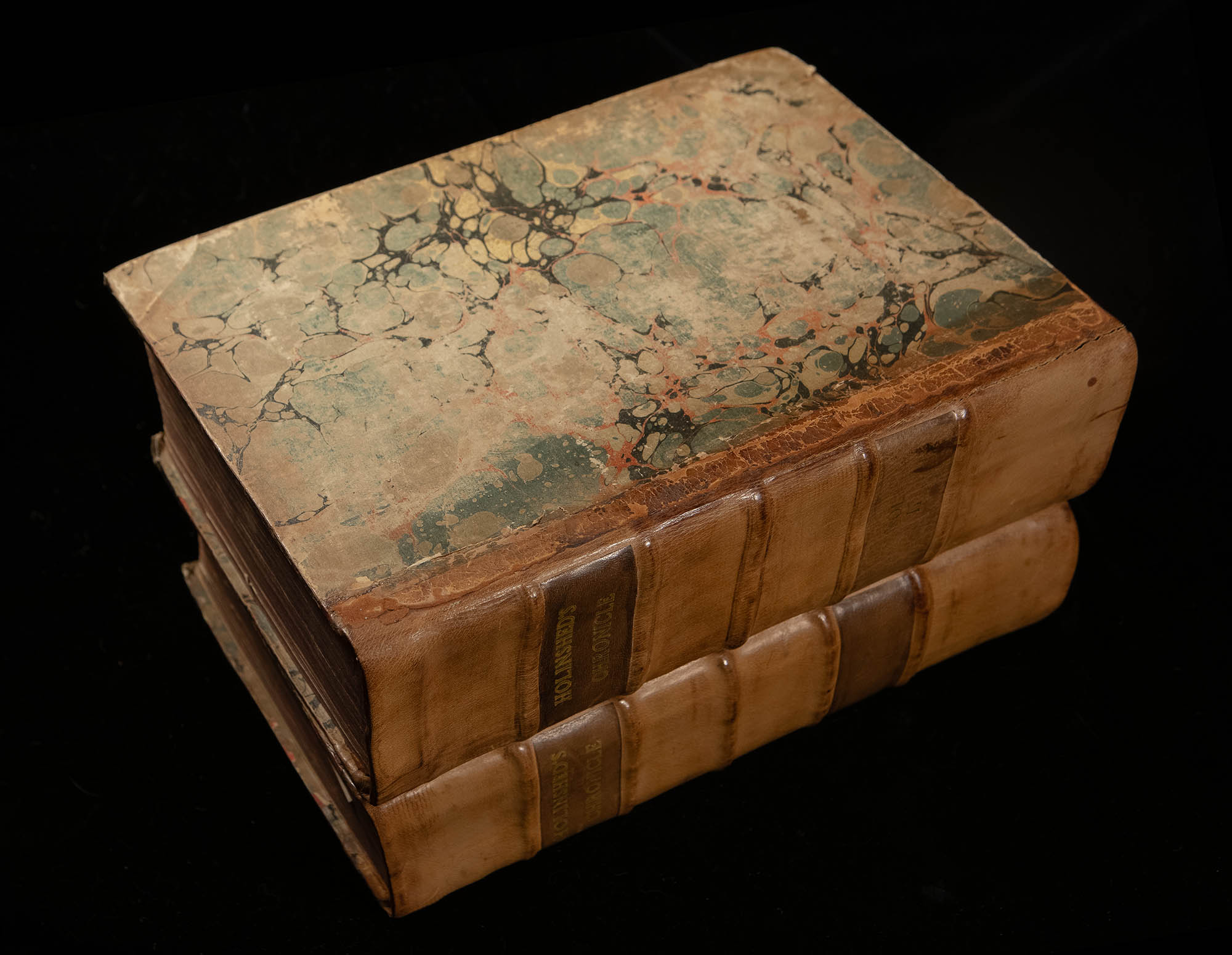
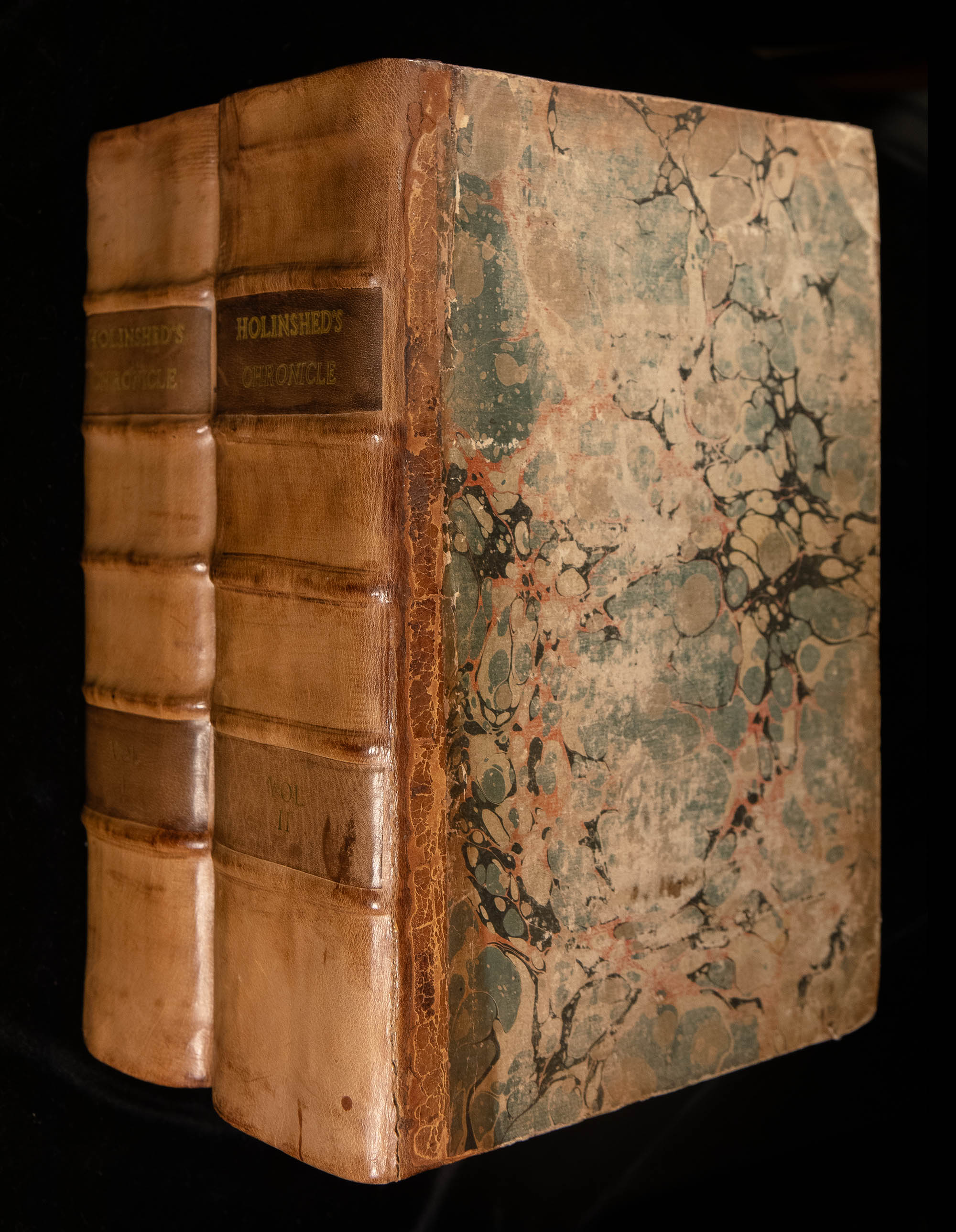
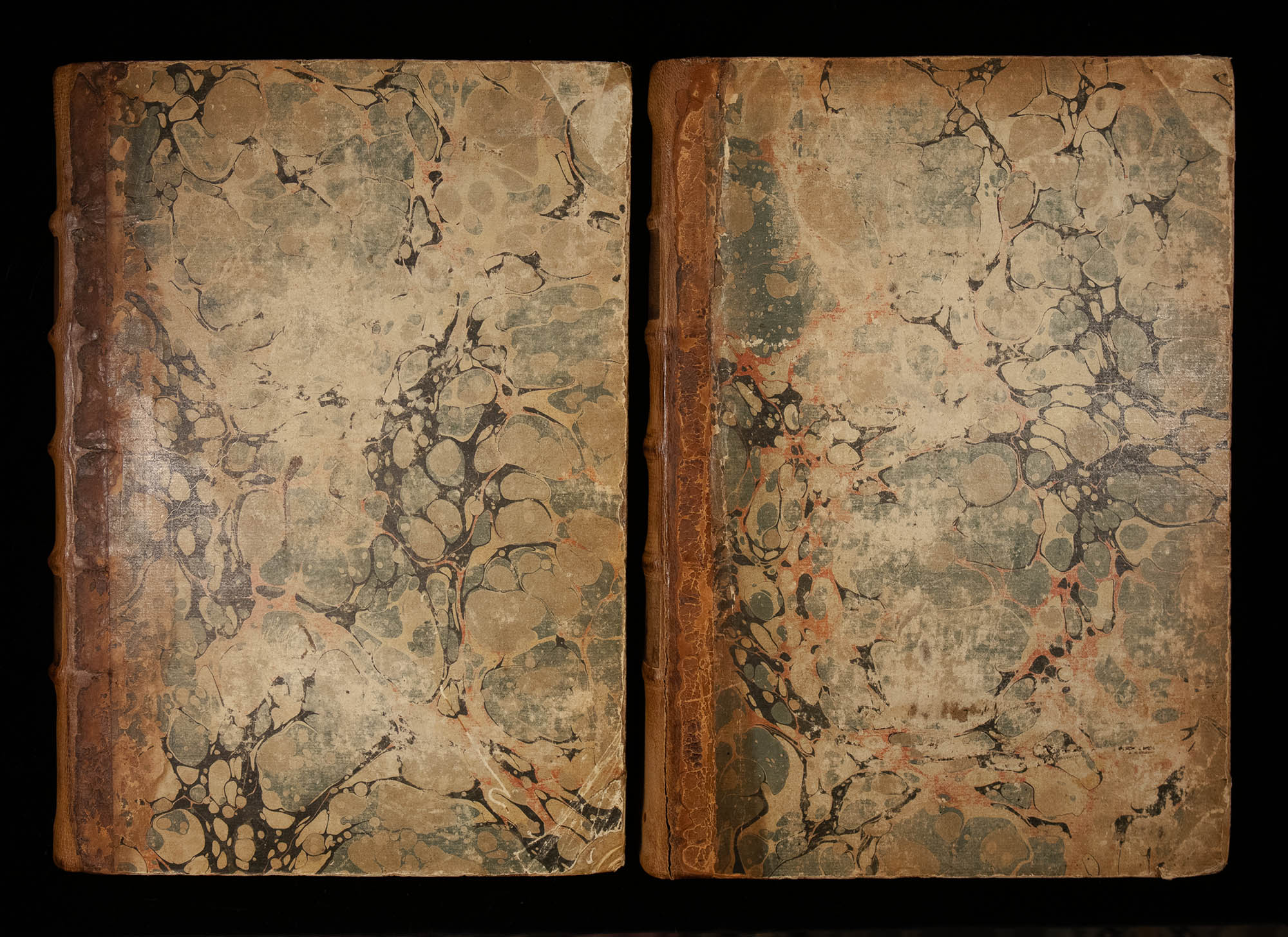
Four parts in two thick Folio volumes; leaves measure 277 mm x 195 mm. Bound in 18th-century quarter-leather over marbled boards, sympathetically rebacked in modern light-brown calf; spines with raised bands, each with two gilt-lettered labels. Original endpapers retained. Edges rouged.
Pagination:
Volume I: [18] pages, 126 leaves [=252 pages], 289, [1] pages; [8], 22, 518, [26] pages; [4] pages, 28 leaves [=56 pages], 115, [7] pages;
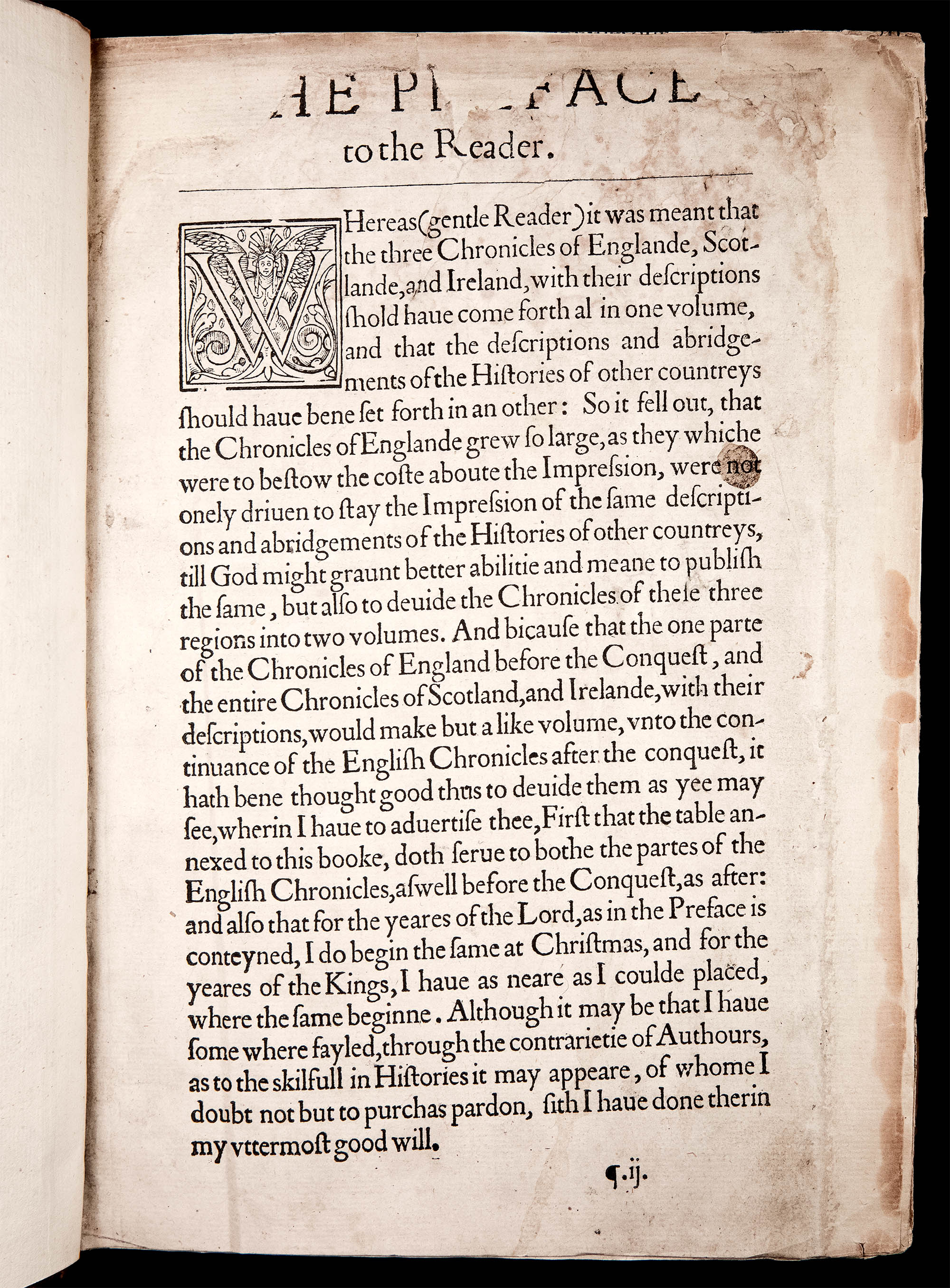
(In the preliminaries leaves ¶4-6 ’The names of the Authors…’ and ‘The Preface to the Reader’ bound before the Dedication (¶1-2; and the errata (‘Faultes escaped’), leaf is here bound at the end of the preliminaries.
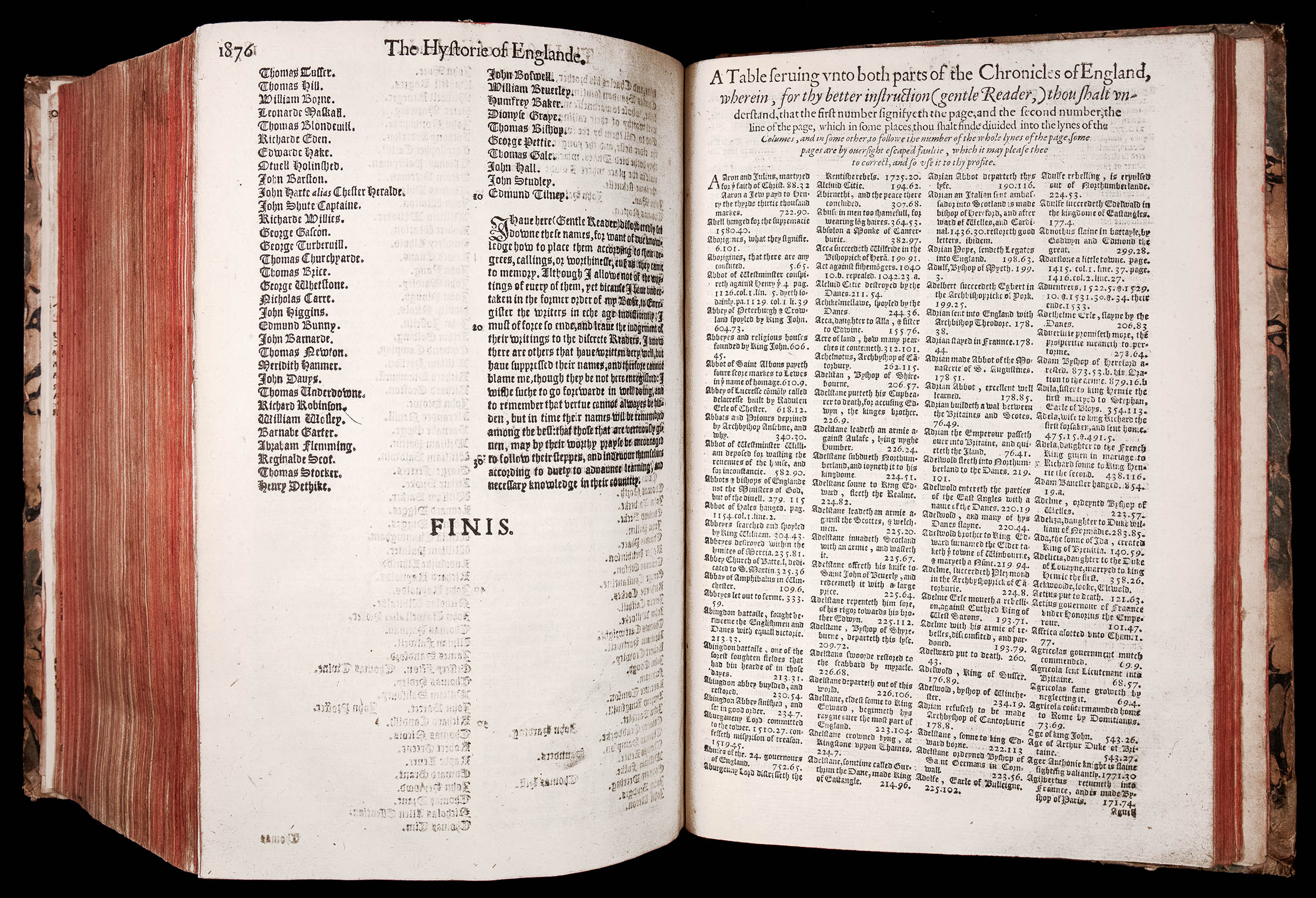
Volume II: [2], 291-659, 700-981, 990-1593, [1], 1593-1876, [104 Index and Errata], plus one double-page plate.
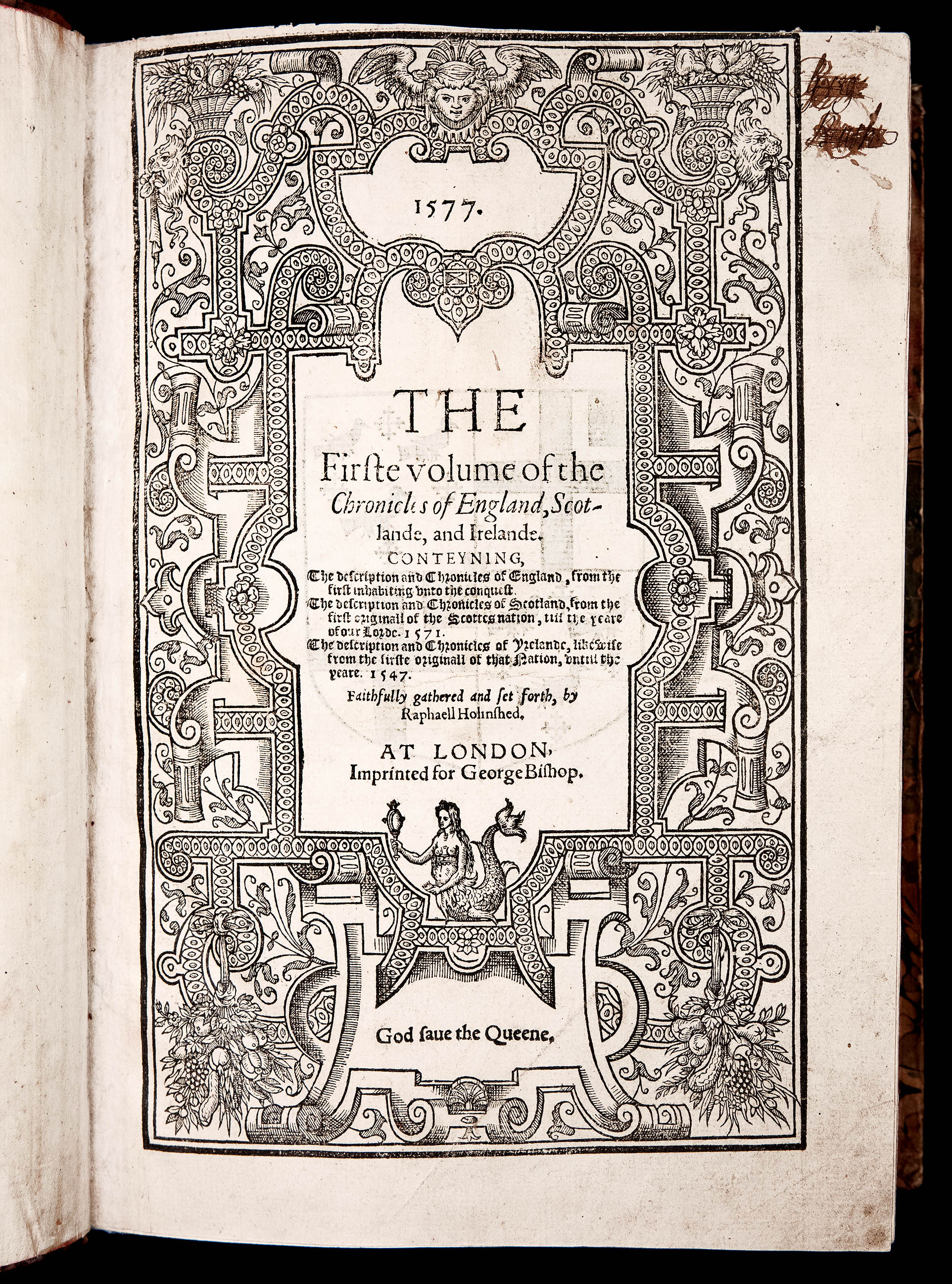
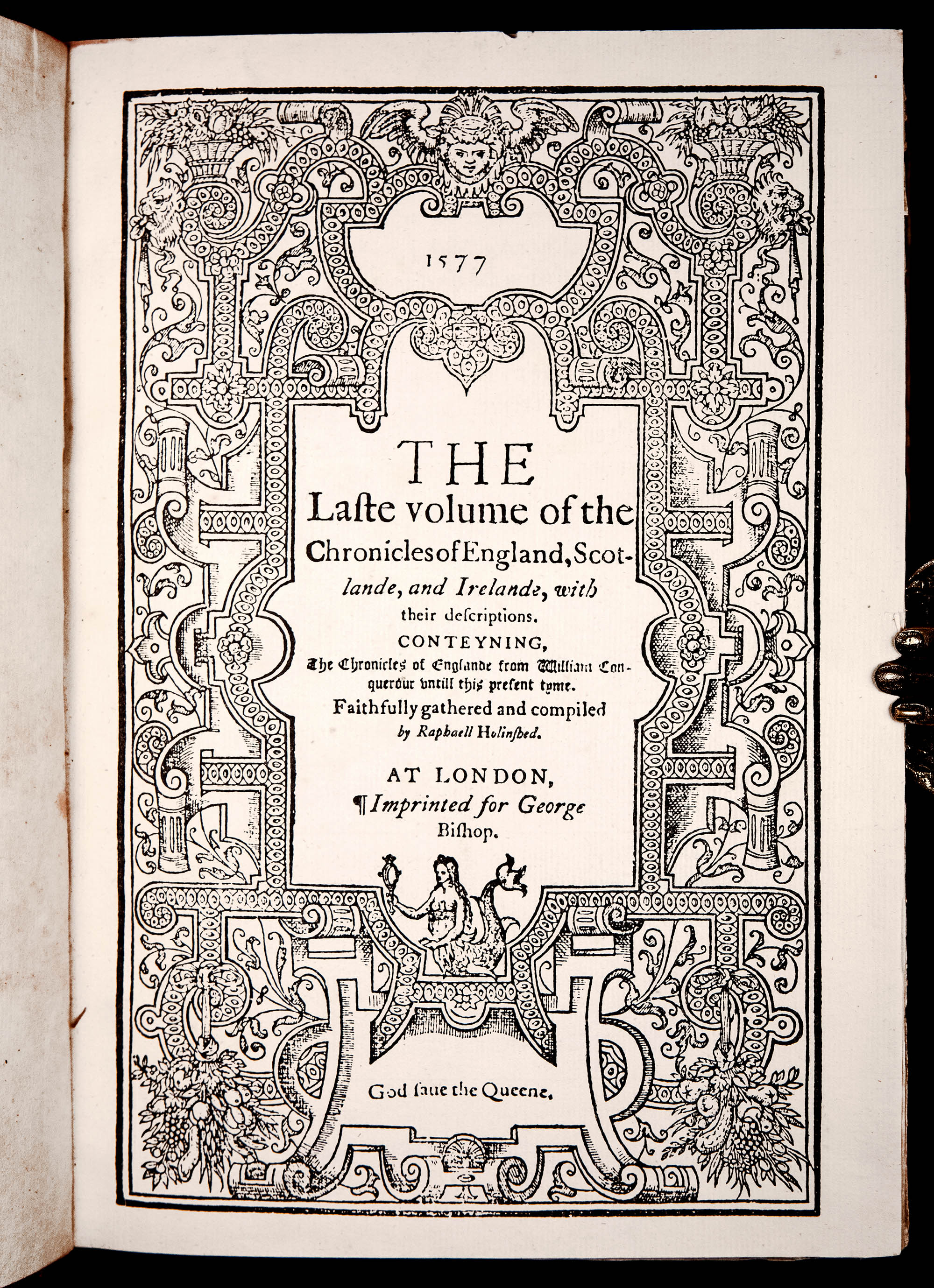
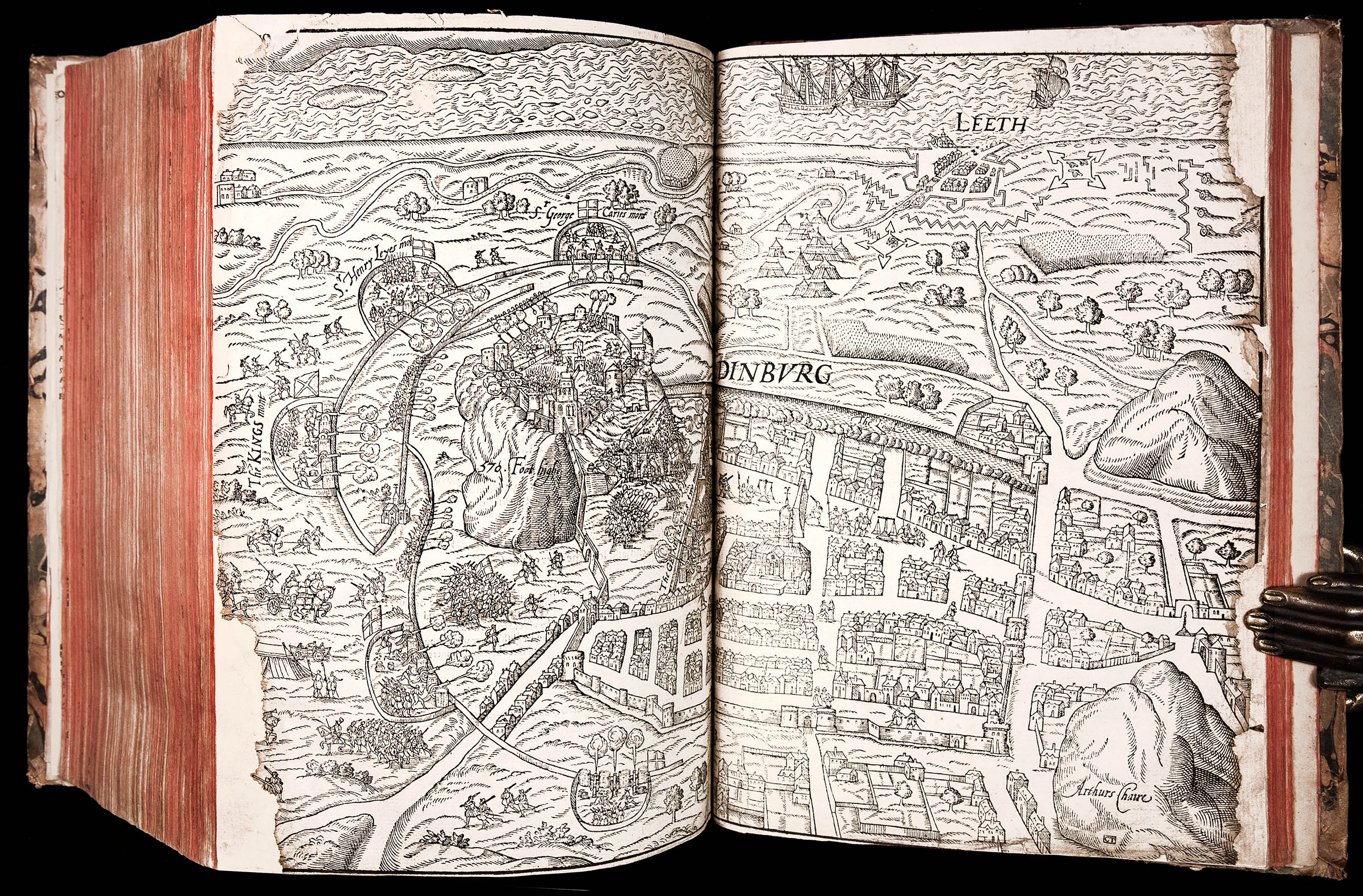
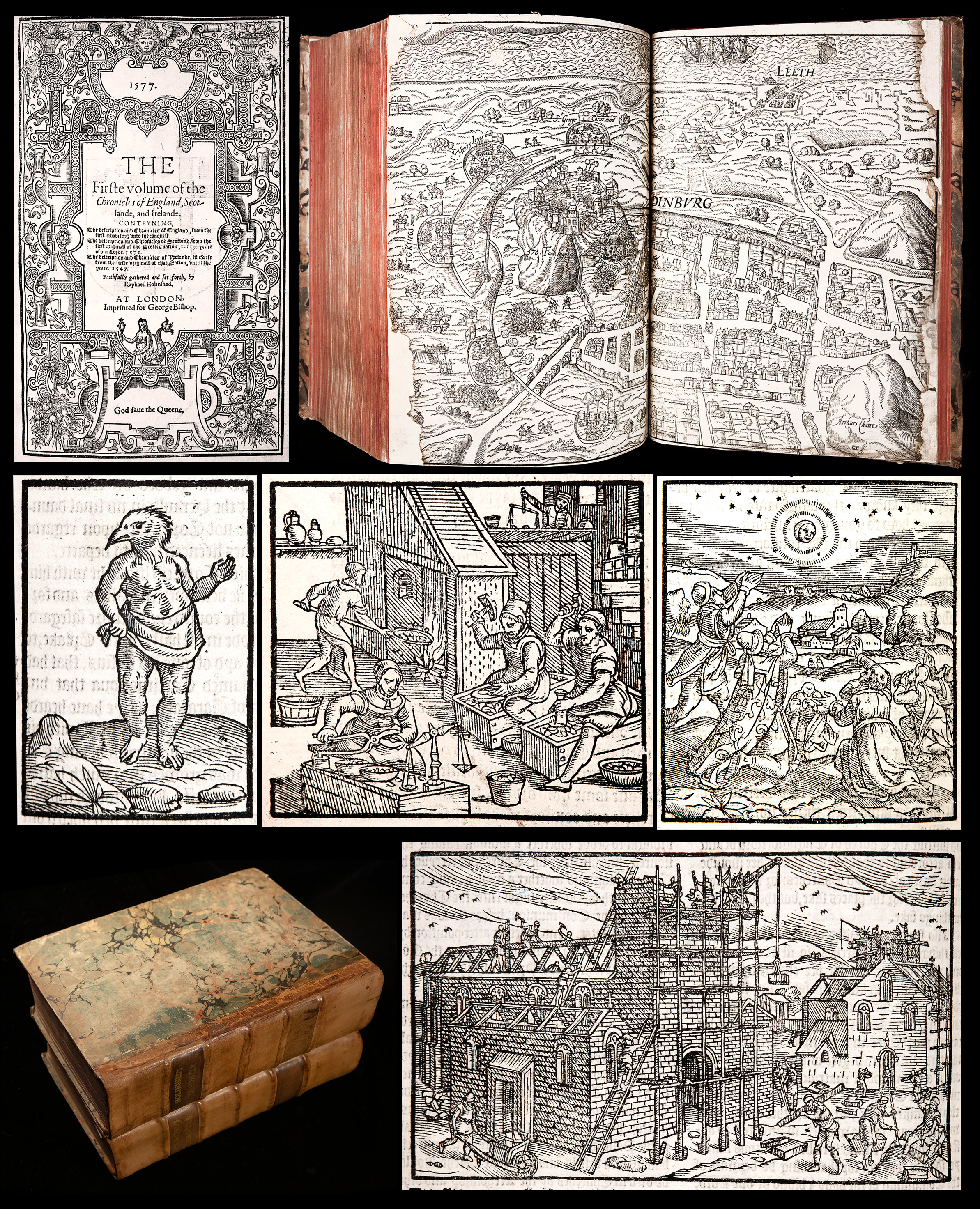
COMPLETE, except only for the blank b6 in Vol.I and the title page to Vol.II (The Laste volume), which is provided in excellent facsimile. THE OTHER THREE TITLE PAGES PRESENT, ALL TEXT AND ILLUSTRATIONS COMPLETE, INCLUDING THE VERY RARE DOUBLE-PAGE PLAN OF EDINBURGH, as well as all preliminaries, indexes and errata.
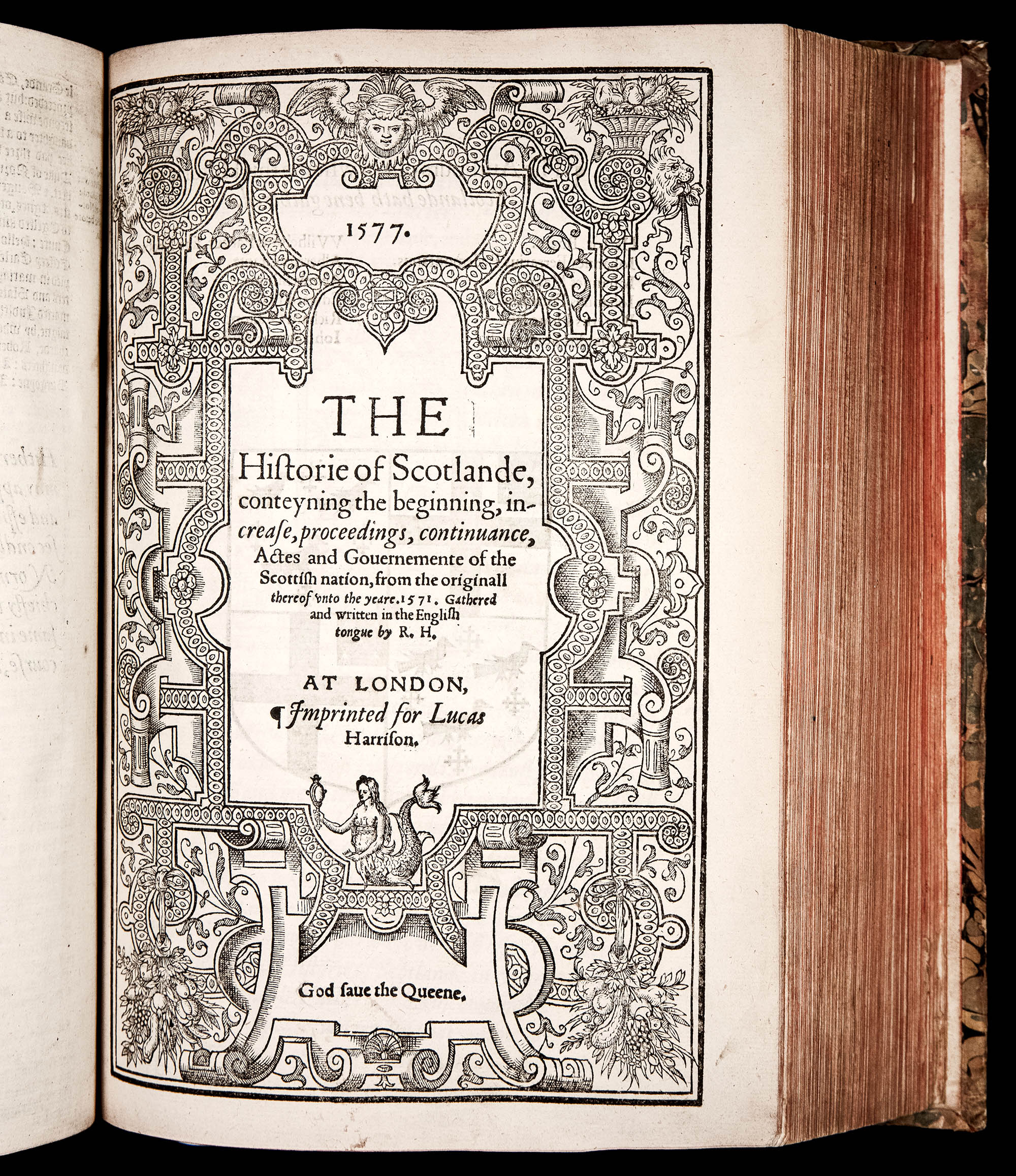
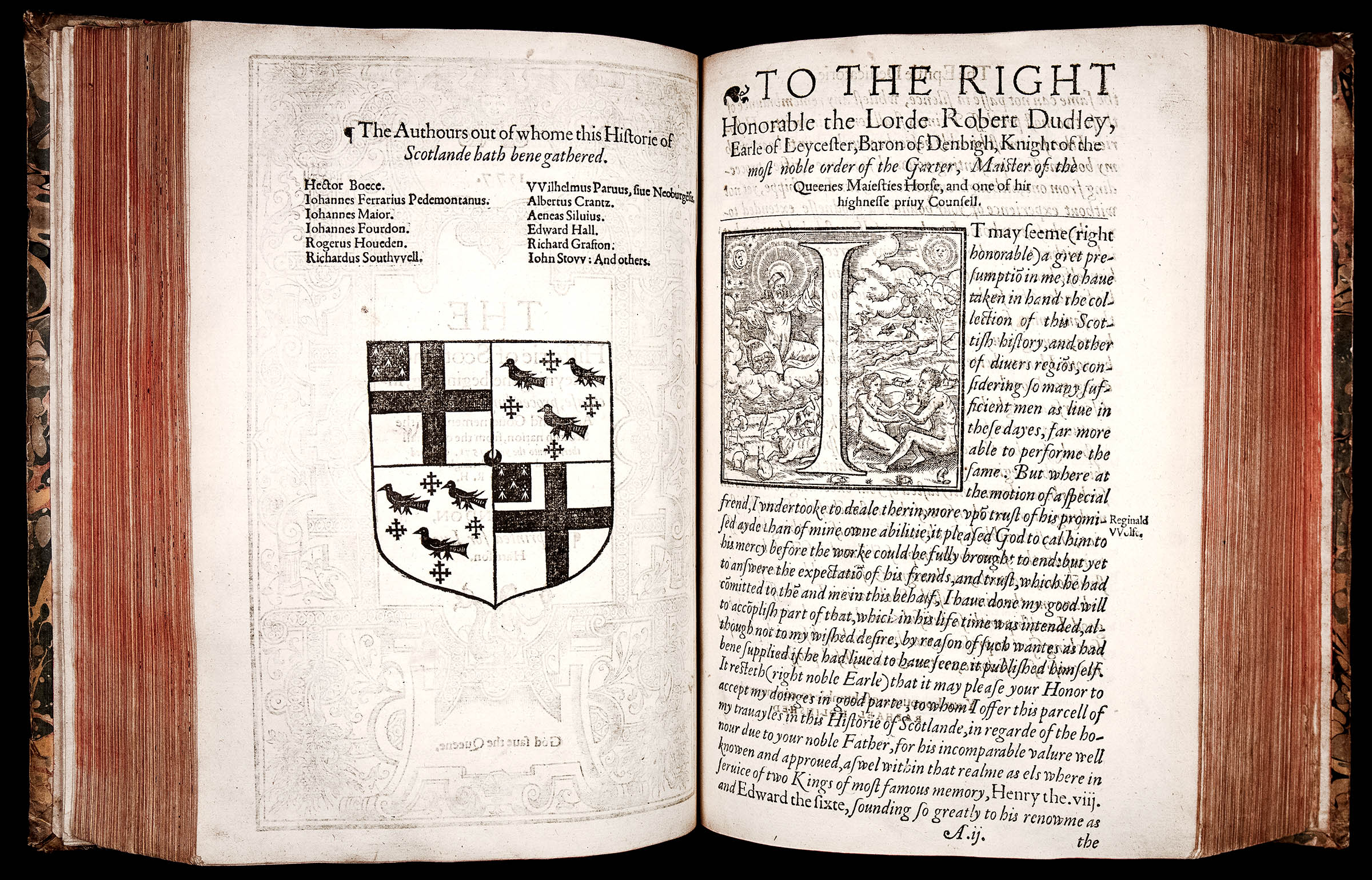
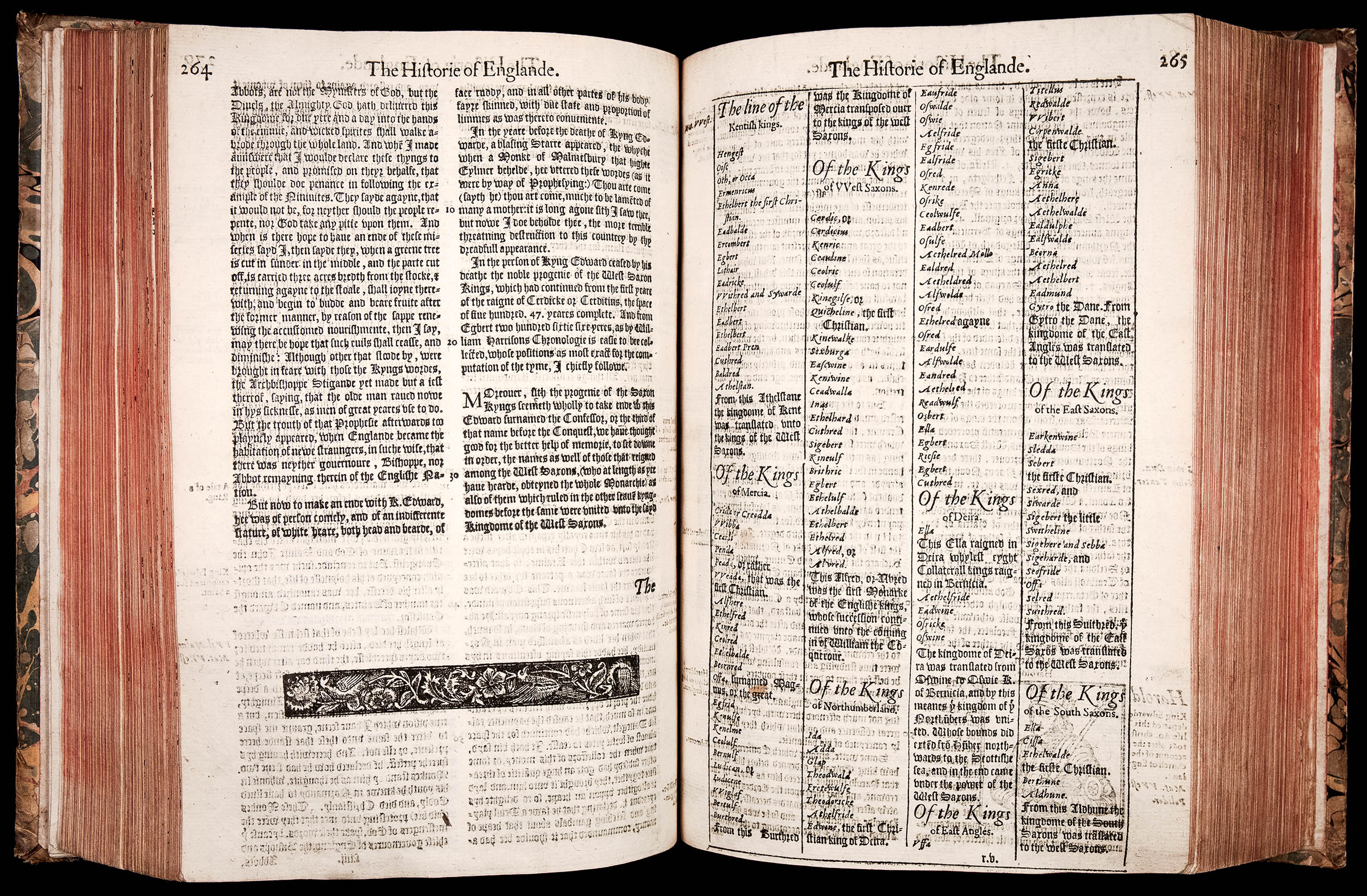
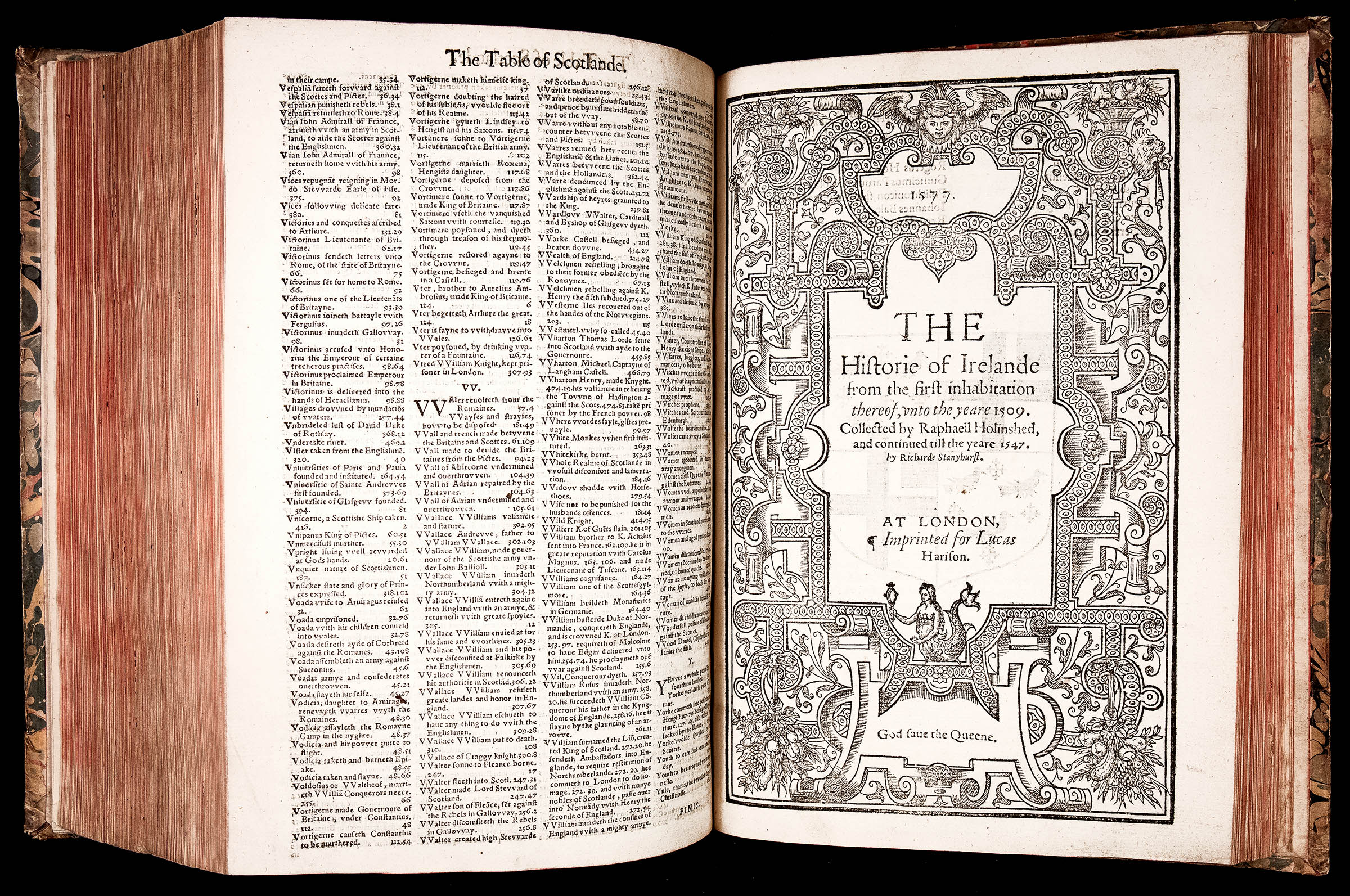
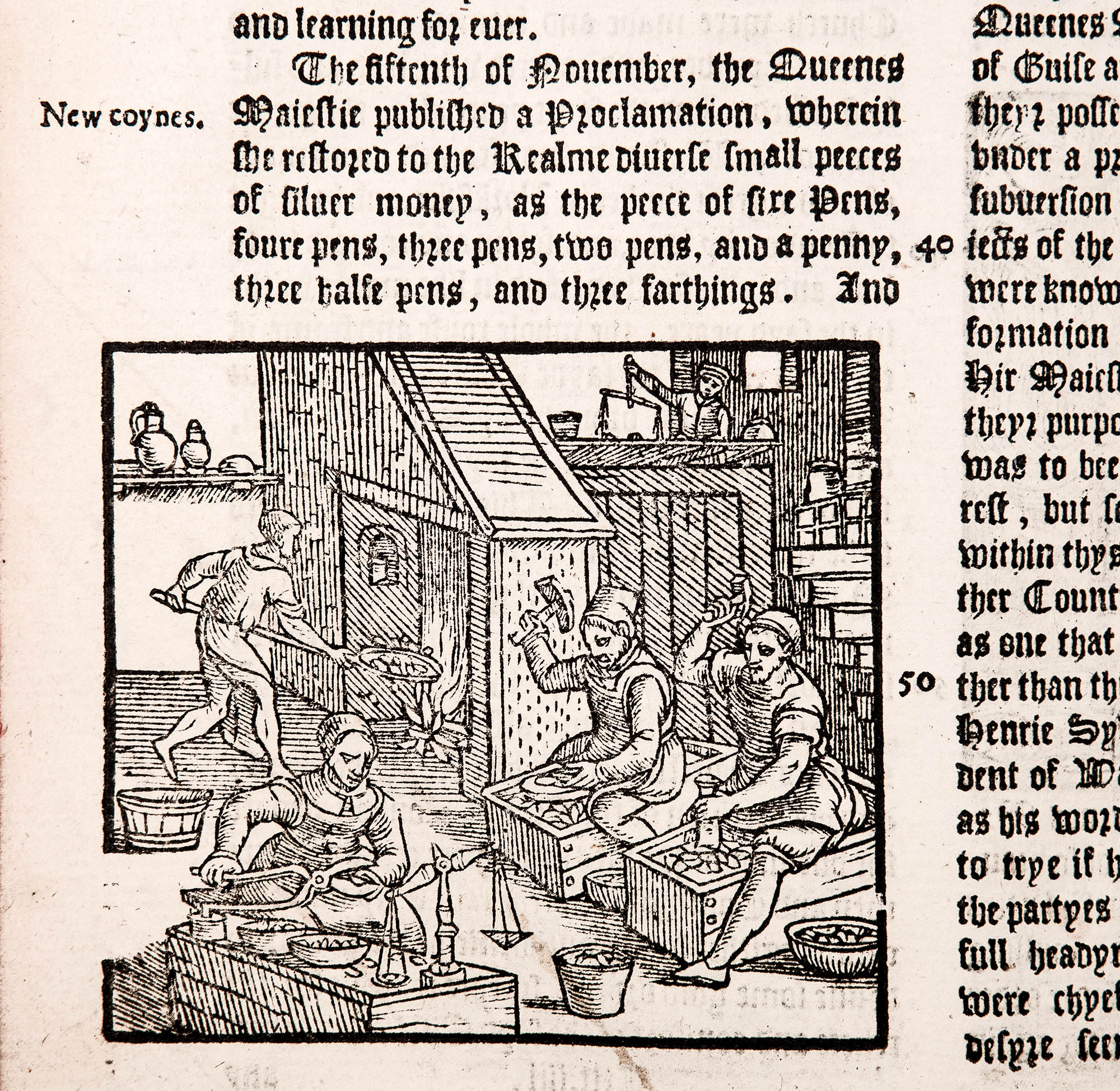
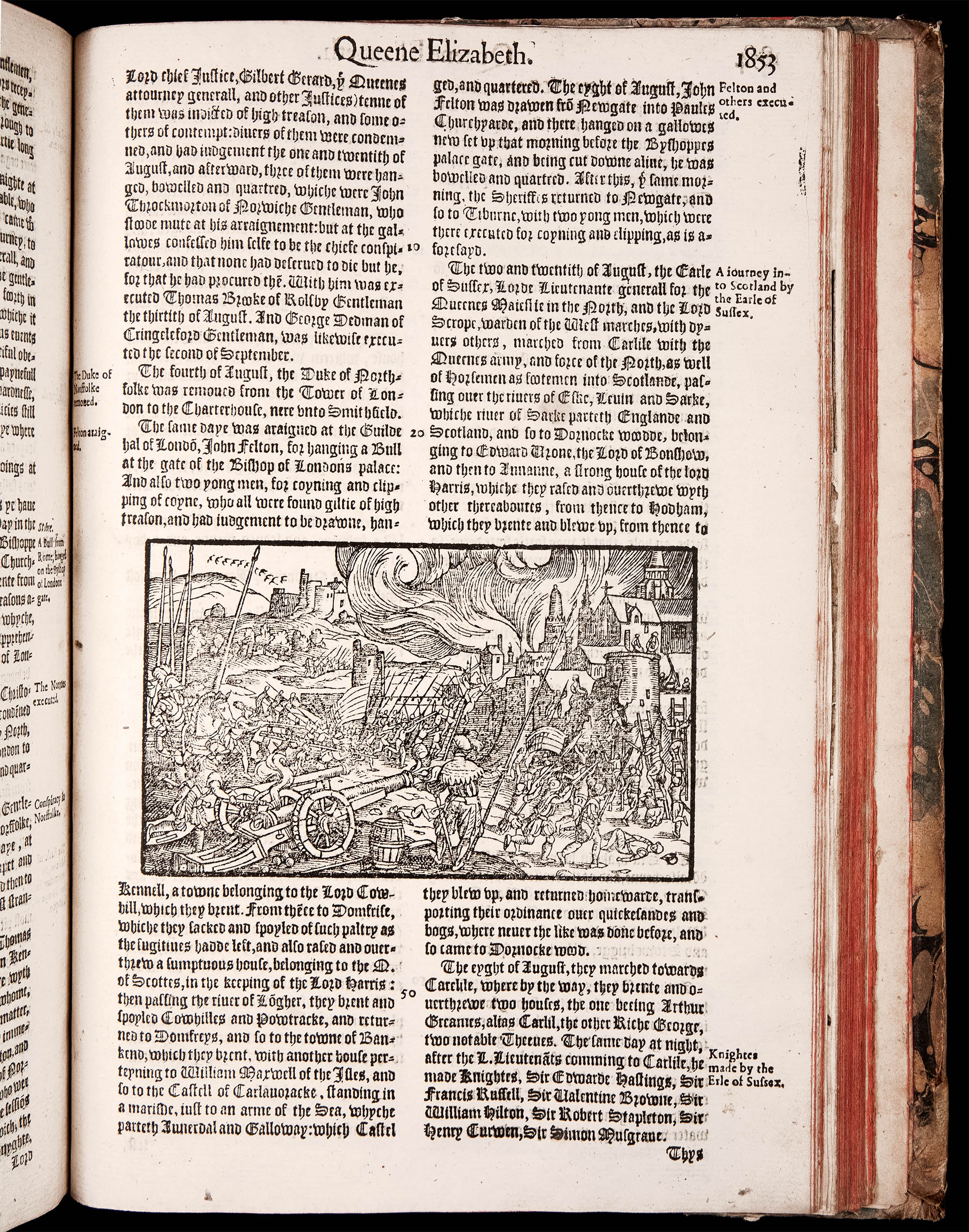
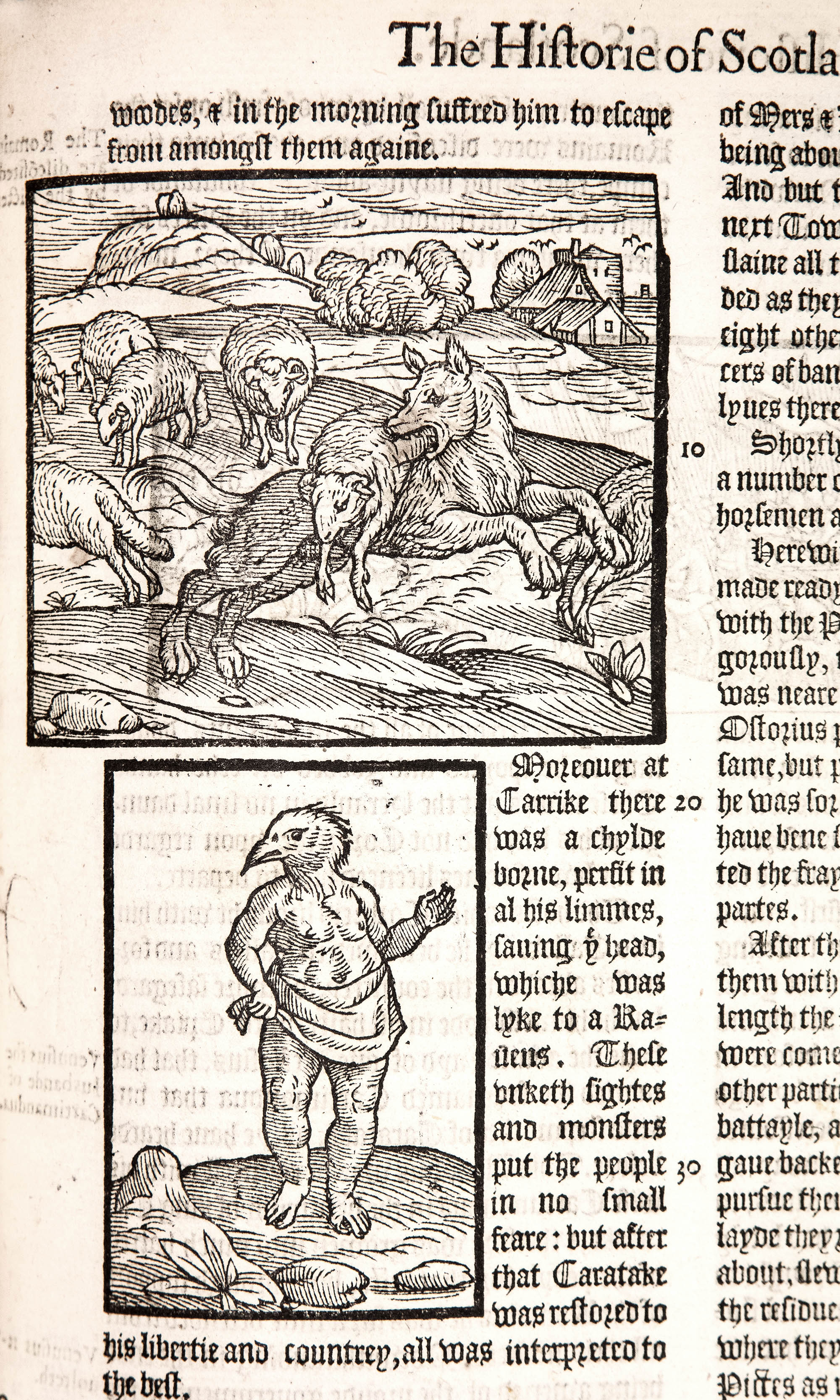
All title pages within woodcut borders (McKerrow and Ferguson, 147a); author's woodcut arms on versos of titles. Profusely illustrated with over a thousand woodcuts (including repetitions) in text depicting mostly historical scenes and portraits.
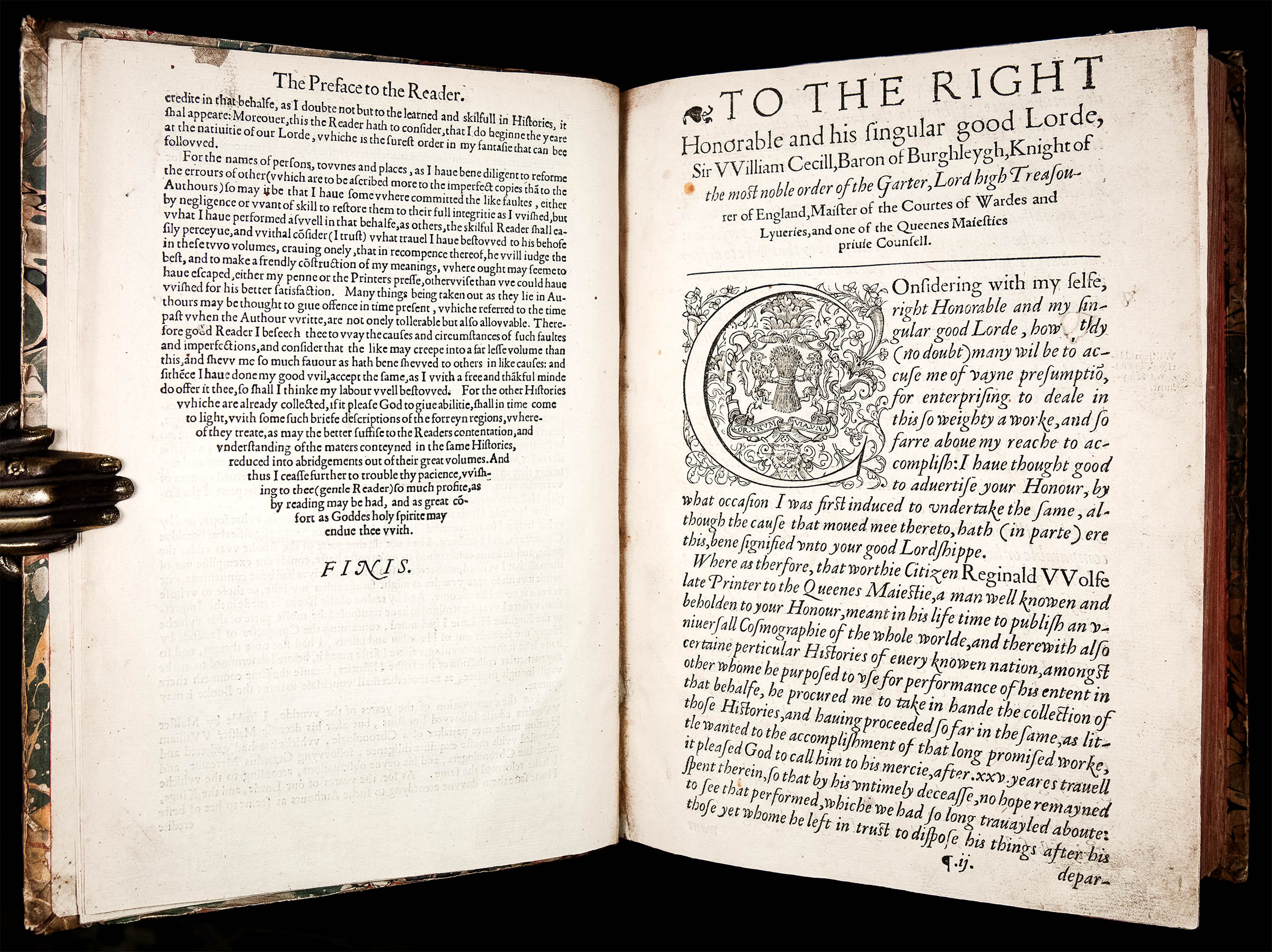
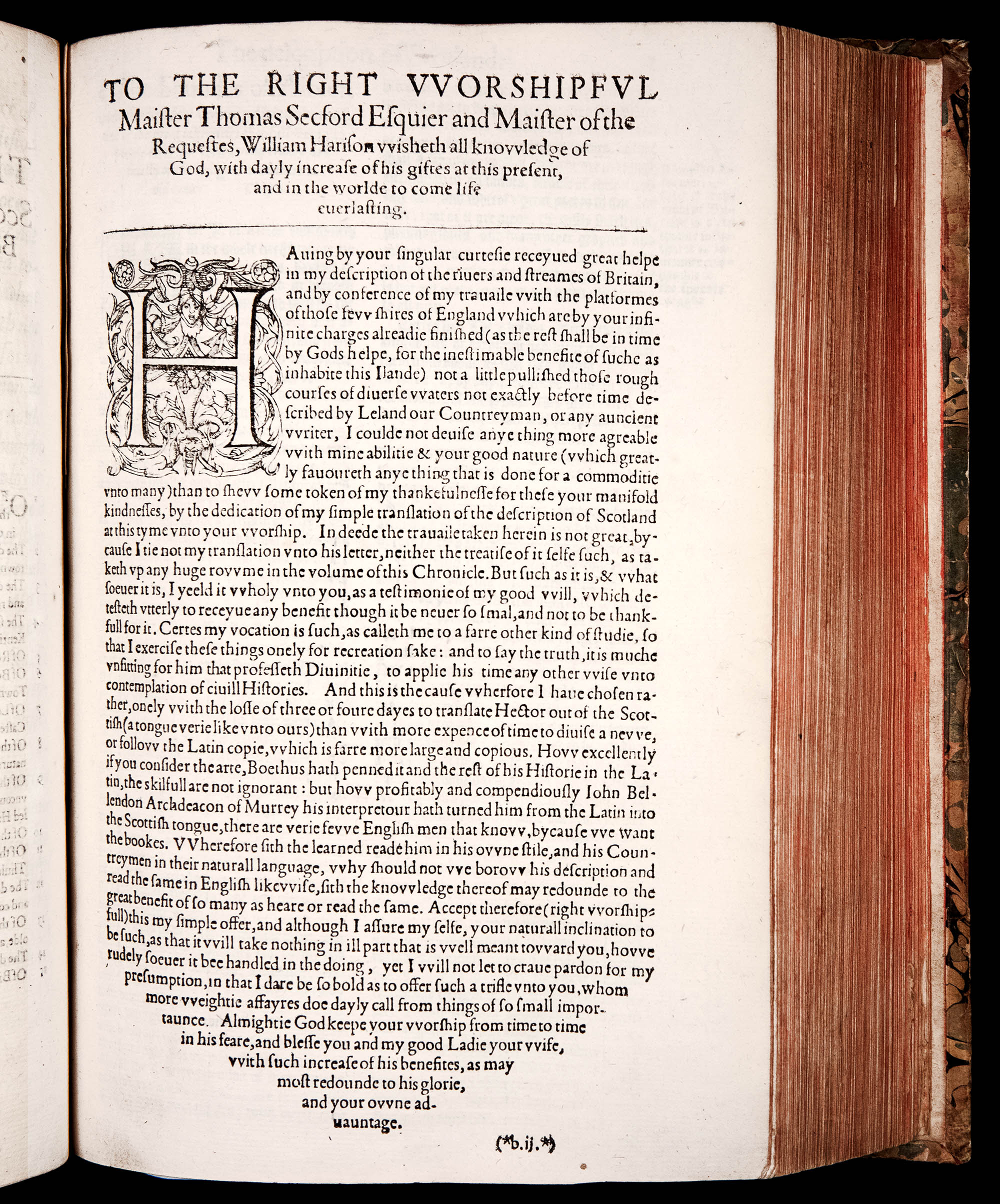
Numerous woodcut initials, including three gigantic historiated initials (one of which depicts God the creator and Adam & Eve in Garden of Eden) at opening of dedications to each part.
Double-page woodcut of the siege of Edinburgh Castle in Vol. II (following p. 1868).
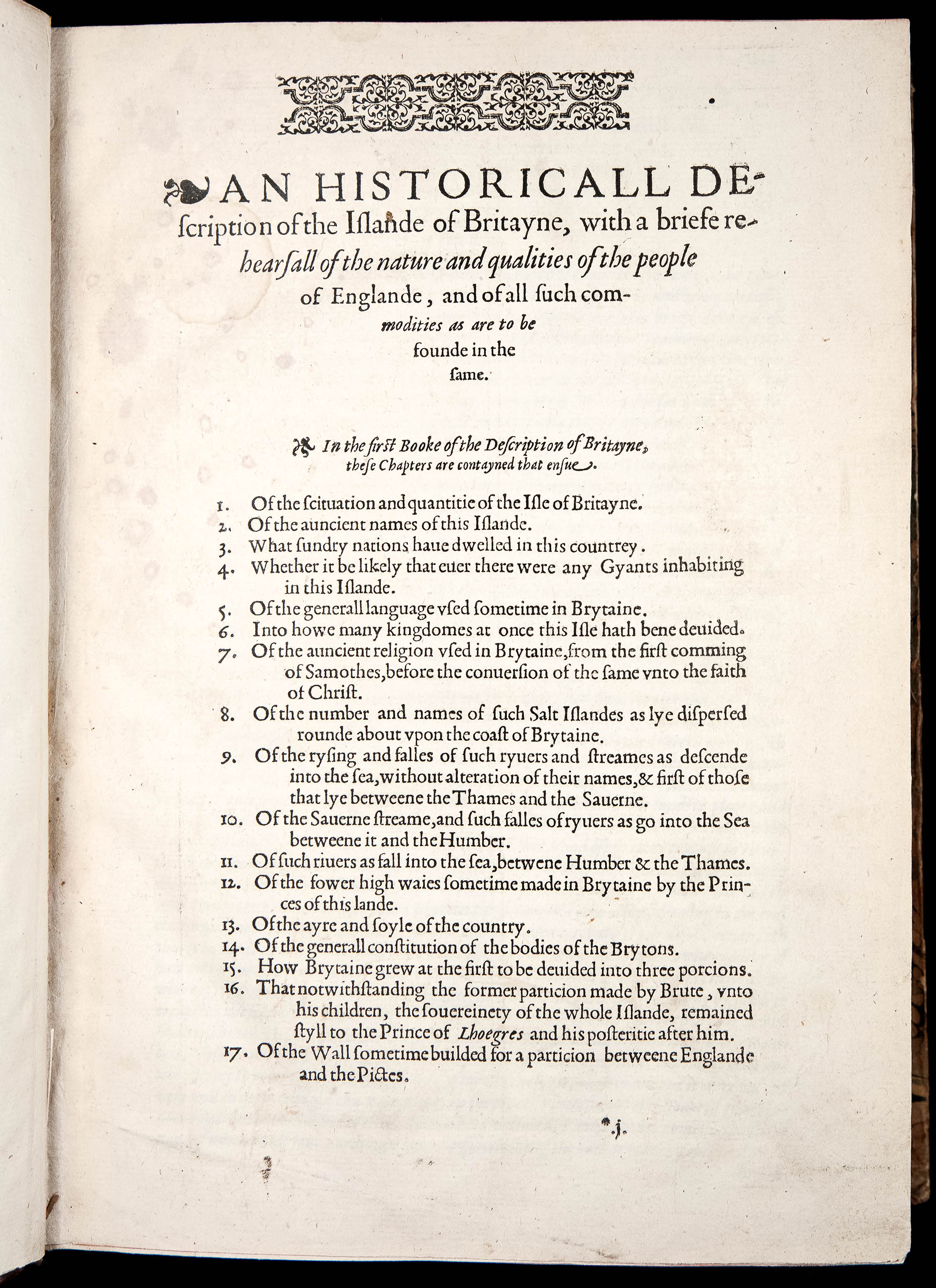
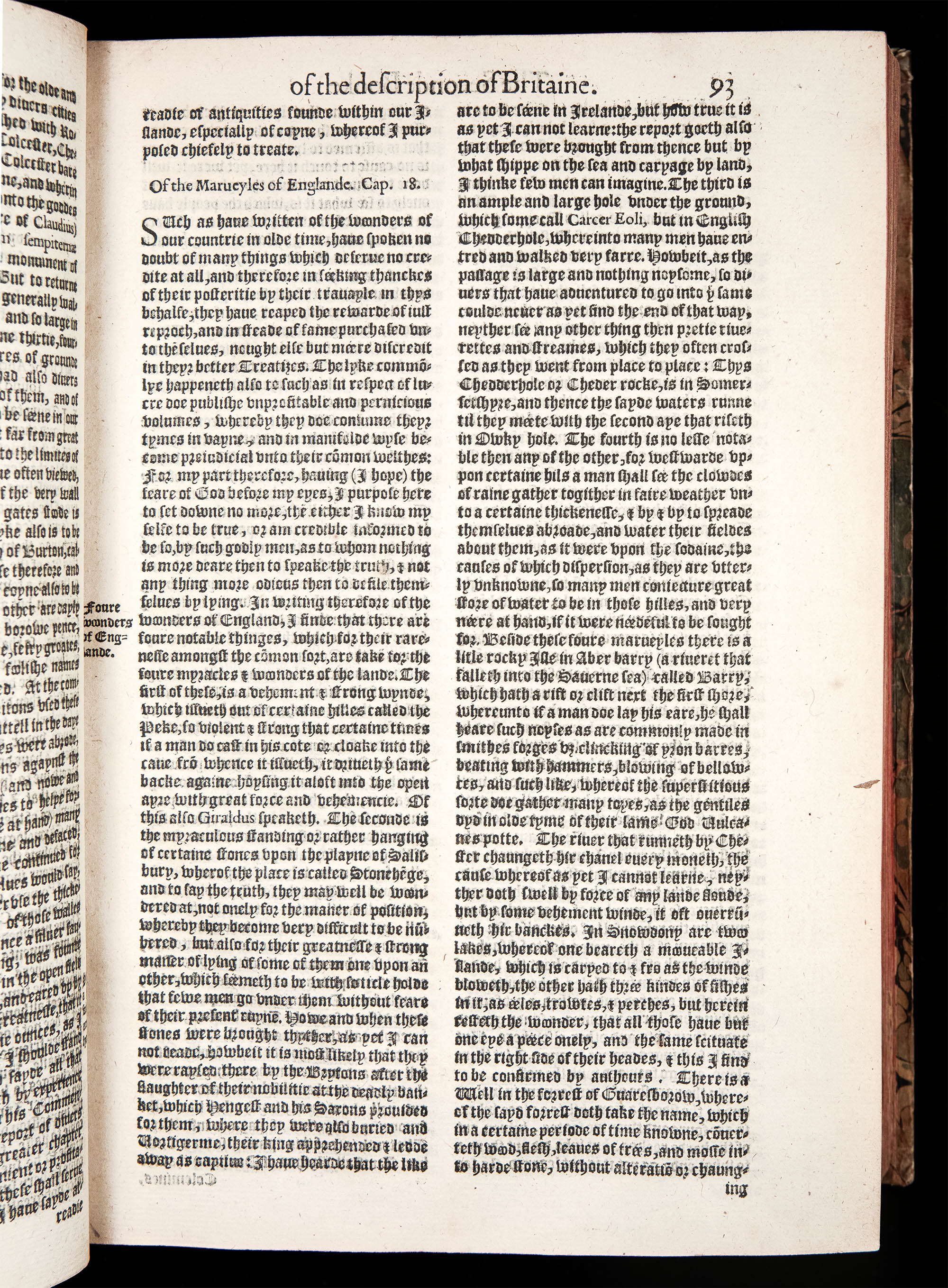
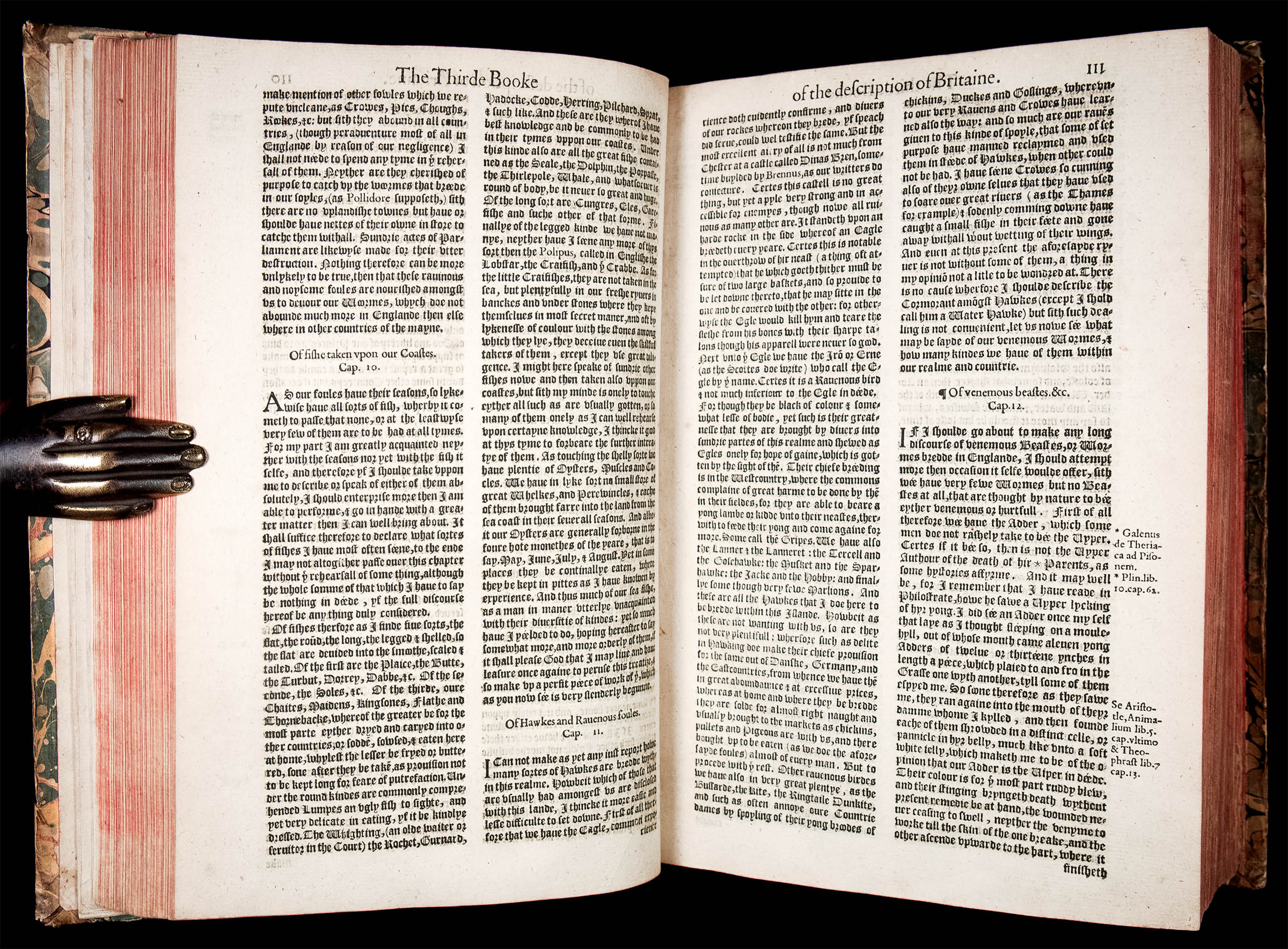
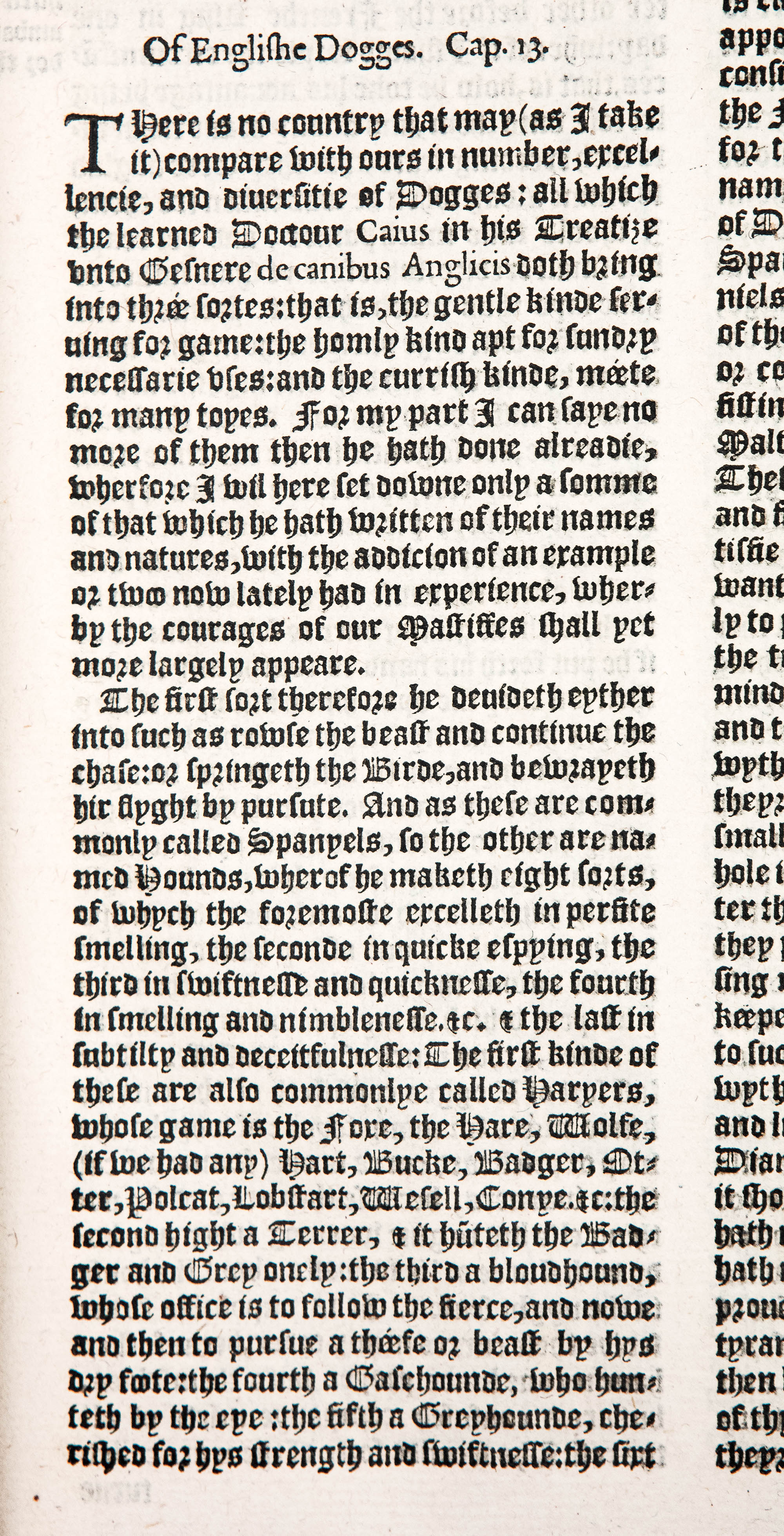
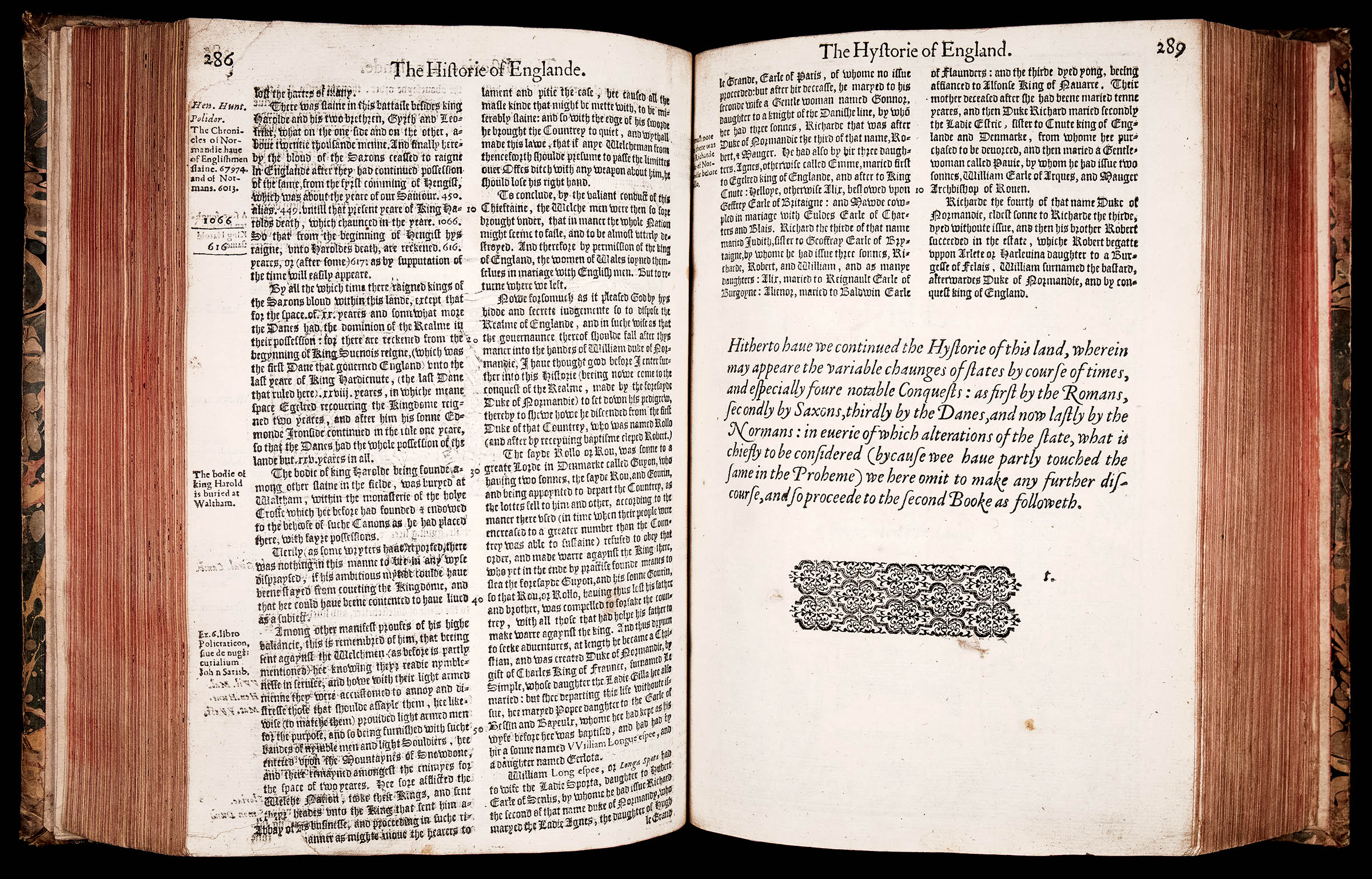
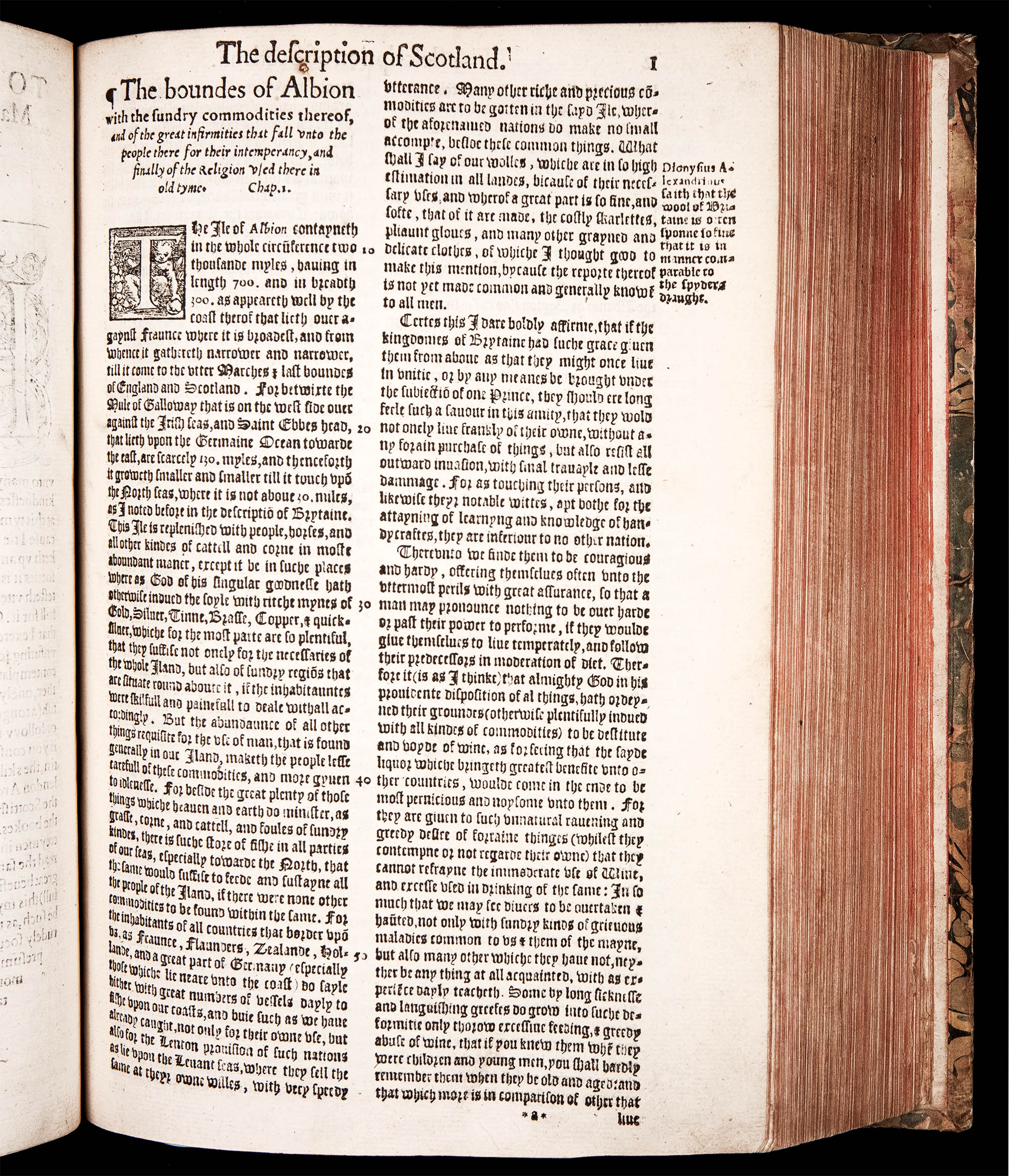
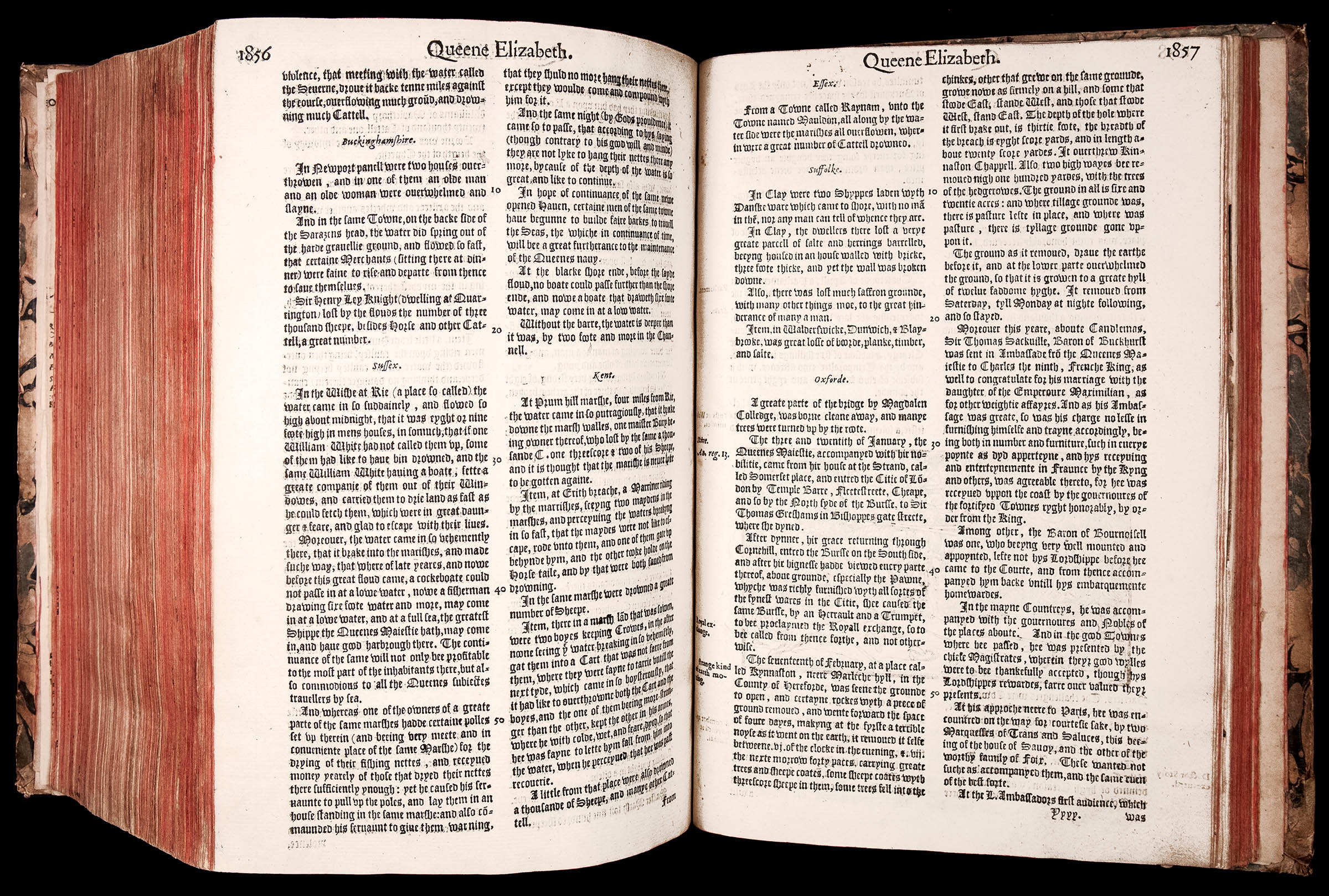
Text printed in double column in elegant upright English Gothic type (Black Letter), with marginal notes printed in small roman type; Latin quotes in text, as well as dedications printed in italic letter; Index in quadruple columns.
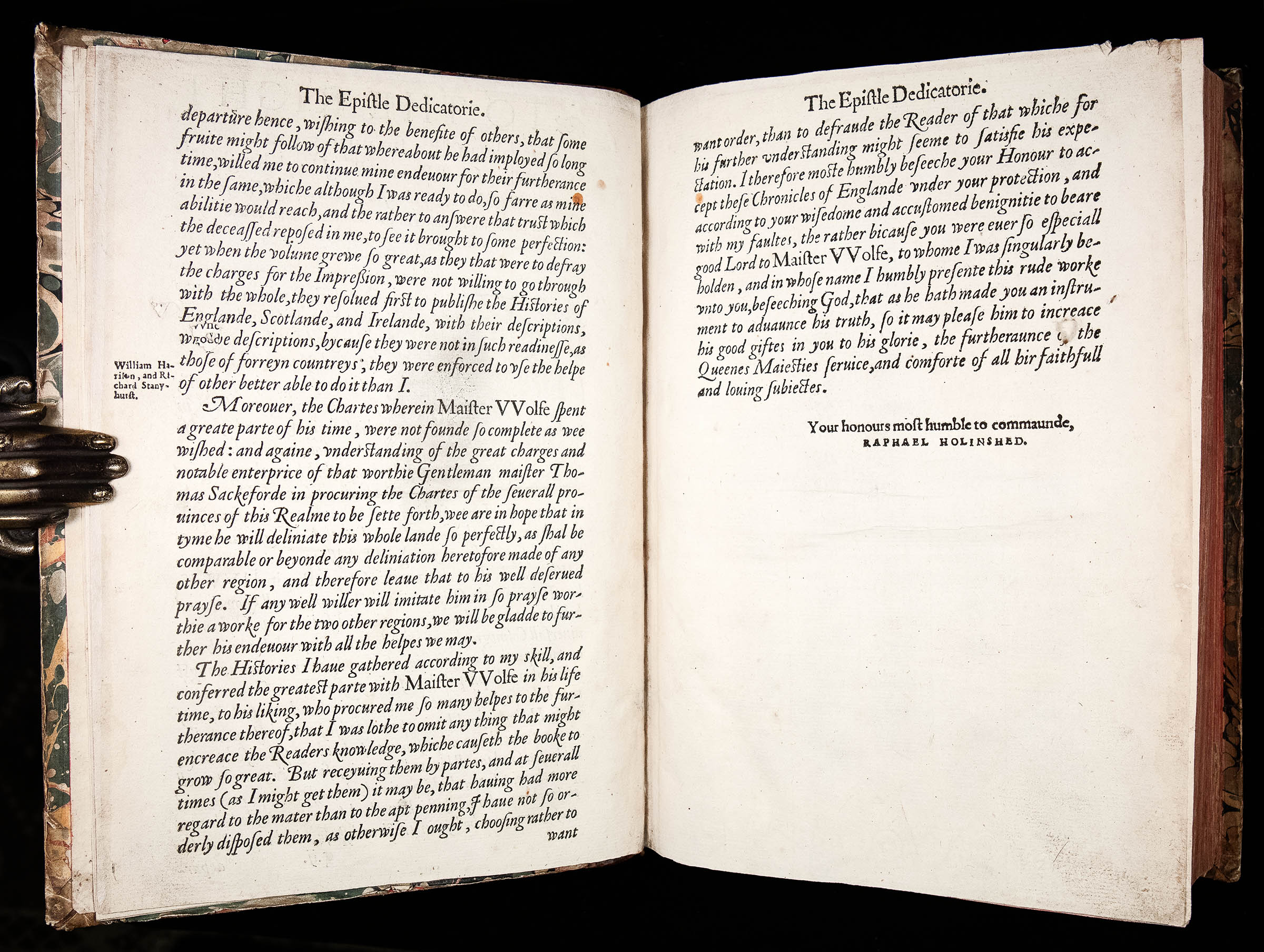
Preliminaries to ‘England’ include ‘The Preface to the Reader’, Holinshed’s general dedicatory epistle to William Cecil, 1st Baron Burghley, Lord High Treasurer and chief adviser of Queen Elizabeth I, followed by and a separate dedication (for the Description of England) by William Harrison to Sir William Brooke, 10th Baron Cobham, and the list of ‘The names of Authors from whome this Historie of England is collected’.
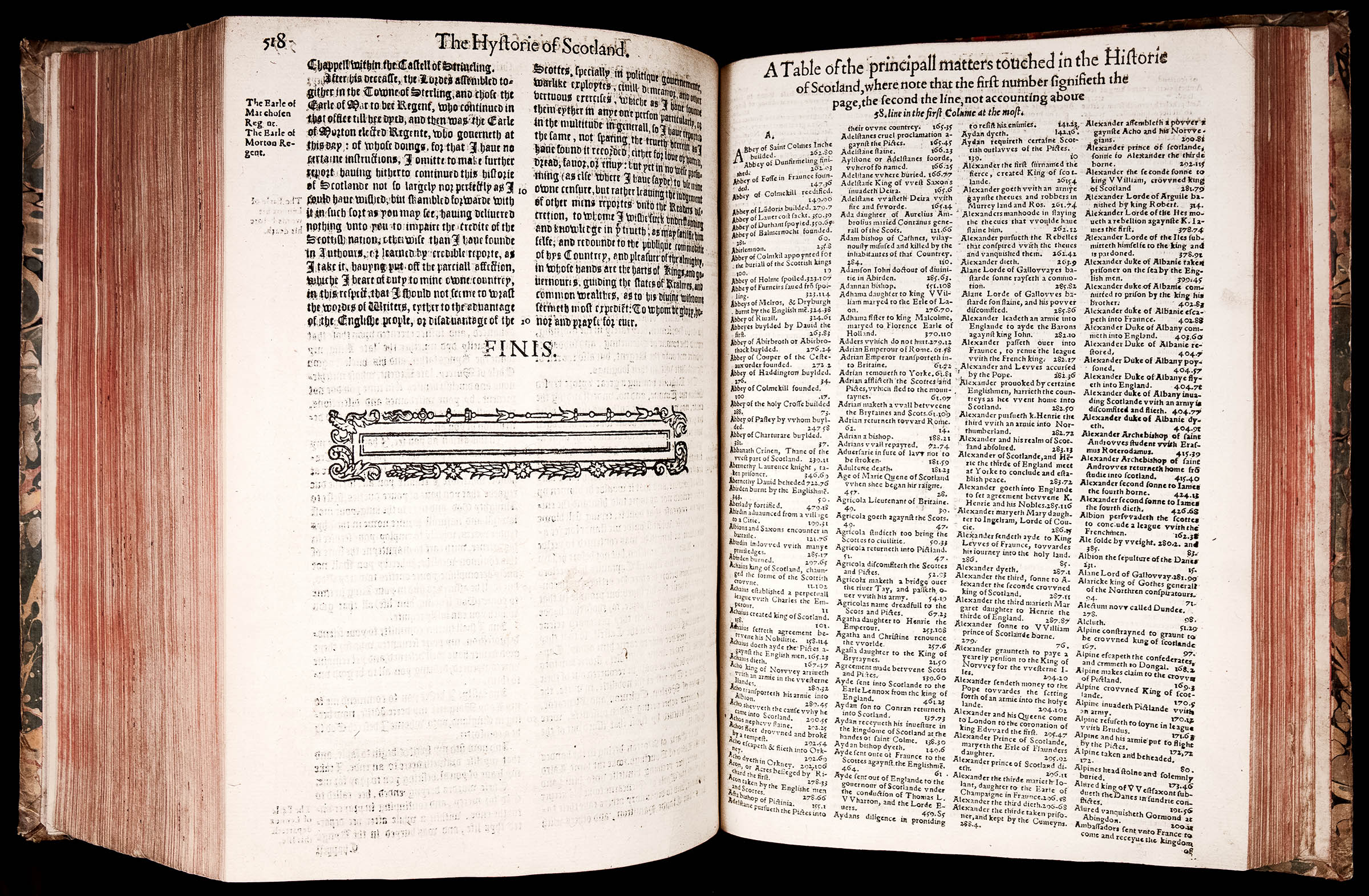
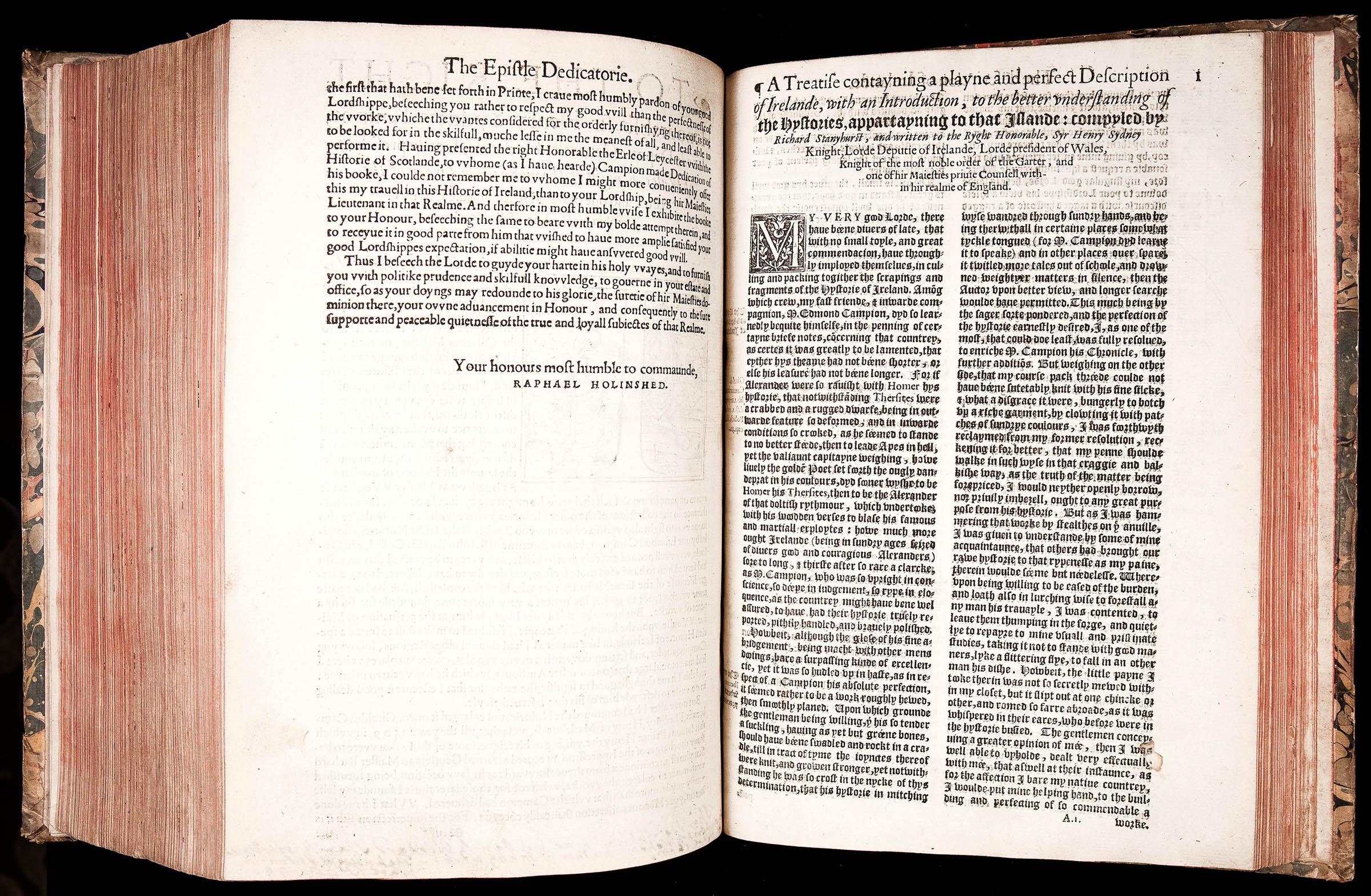
The History of Scotland with its own dedication by Holinshed to Robert Dudley, 1st Earl of Leicester, the favourite of Elizabeth I; the History is followed by an extensive index ‘A Table of the principall matters touched in the Historie of Scotland…’ The History of Ireland with its own dedication by Holinshed to Sir Henry Sidney, Lord Deputy of Ireland, and with its own index (‘Table’) at the end.
Volume II opens with its own short Preface to the Reader, and ends with a comprehensive index ‘A Table serving unto both parts of the Chronicles of England…’ followed by Errata (‘Faultes and oversightes escaped in printing’).
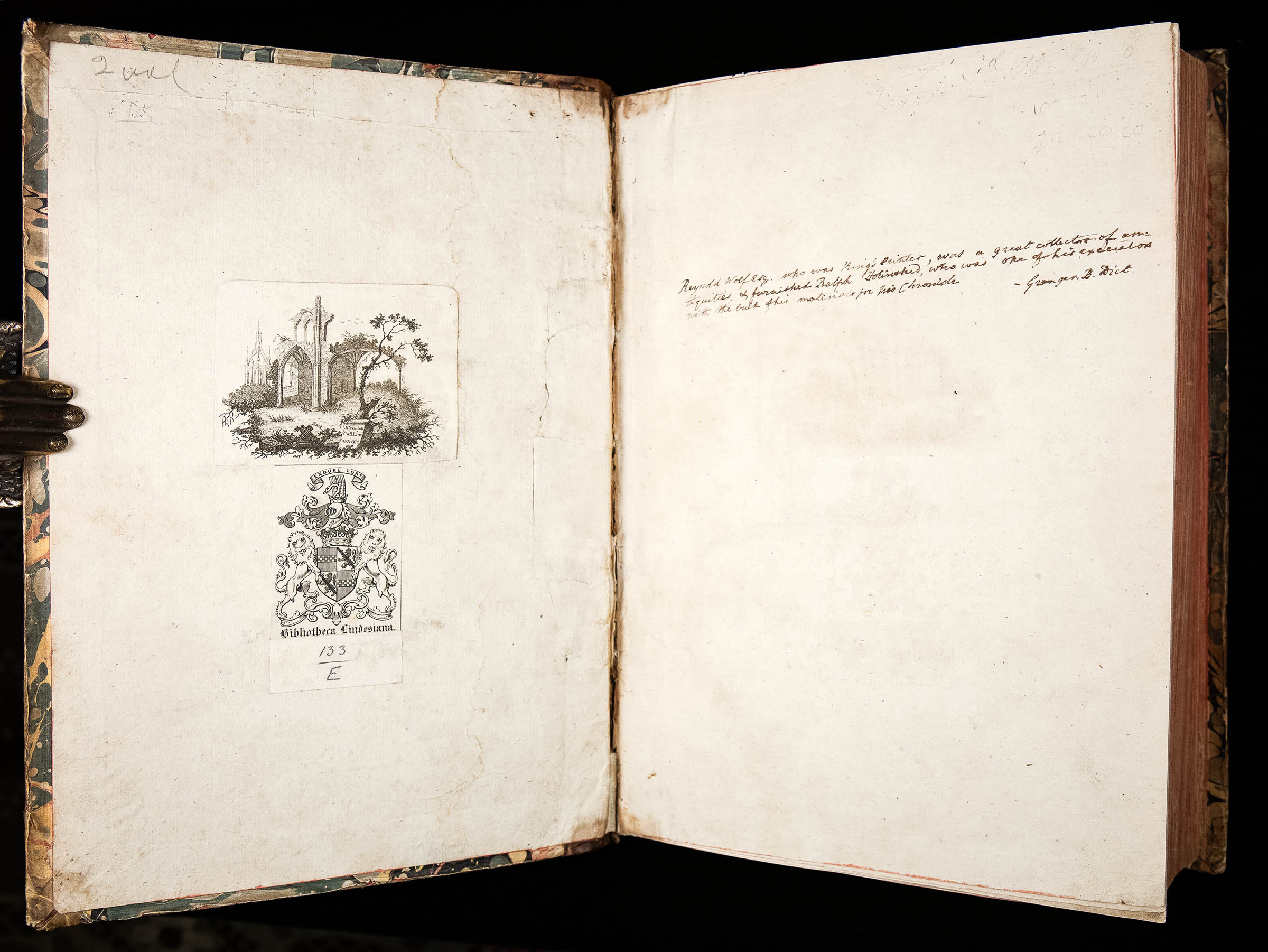
Both volumes with an etched bookplate (on front pastedown) of the antiquary John Brand (1744-1806), a notable English antiquarian and Church of England clergyman. He was author of Observations on Popular Antiquities (1777). Brand was appointed Secretary to the Society of Antiquaries of London in 1784 and was annually re-elected until his death.
Both volumes with an armorial bookplate (on front pastedown) of the Bibliotheca Lindesiana, i.e. from the magnificent personal library of Alexander William Crawford Lindsay, 25th Earl of Crawford, 8th Earl of Balcarres (1812 – 1880), styled Lord Lindsay, a Scottish peer, art historian and collector. Born at Muncaster Castle in Cumbria, he was educated at Eton and Trinity College, Cambridge. He travelled widely studying art. He published Progression by Antagonism in 1846 and Sketches of the History of Christian Art in 1847. He travelled to the Middle East in 1837-8, resulting in him writing Letters on Egypt, Edom and the Holy Land published in 1838. He became an avid art collector and many of his acquisitions are on display in galleries around the world. His other passion was genealogy. He was the author of the three-volume Lives of the Lindsays on the genealogy of his family, for which he doubtless used this set of Holinshed as one of his sources.
Over a period of 70 years, from the early 1830s to the turn of the century, Lord Lindsay and his son, James Ludovic Lindsay (1847‒1913), assembled one of the largest and most significant private libraries ever assembled in Britain - Bibliotheca Lindesiana. At its fullest extent, the library comprised over 100,000 printed books, tens of thousands of documents and printed ephemera, and six thousand manuscript codices, scrolls and fragments.
A short bibliographical note to front free endpaper of Vol.I, in either Brand’s or Lindsay’s hand.
Very Good antiquarian condition. Complete (except for the title page to the ‘Laste Volume’). Wear to binding with rubbing and occasional scuffing to boards. Vol.II with rear joint split, but boards securely attached (held in place by strong binding cords). Interiors with occasional light soiling, mostly marginal. In Vol. I: the preliminaries with neat minor marginal repairs; small hole in ¶2-3 (affecting a couple of words); 1st title-page may have been gently washed. Minor marginal worming in top inner corner of several leaves in quires f-h. Final three index leaves torn in outer margin affecting text, with last leaf laid down on blank verso. In Vol. II: a few initial leaves with light edge-fraying and some repaired tears at top (with minor loss); several other minor marginal chips or tears, mostly without loss, but occasionally affecting several words of text: in bottom outer corner of Mm2, Oo3, Aaa4, Iii1, and lower margin torn off leaf Hhhh5. The last index leaf with a tear causing loss of a few words. The double-page woodcut in Vol.II with a few minor repairs along outer edges (causing unimportant peripheral loss only). Margins somewhat trimmed, touching a few running heads and causing, occasionally, light partial cropping to some marginal notes. Front pastedown of each volume with two early bookplates of former (18th- and 19th-century) owners; 1st title-page with an early ownership signature inked out; an 18th-century (?) manuscript note to bottom margin of the History of Ireland (Vol.I).
In all, a very desirable, essentially complete set of this magnificent 1st Edition with superb provenance; still quite solid, perfectly readable, and rather well-preserved.