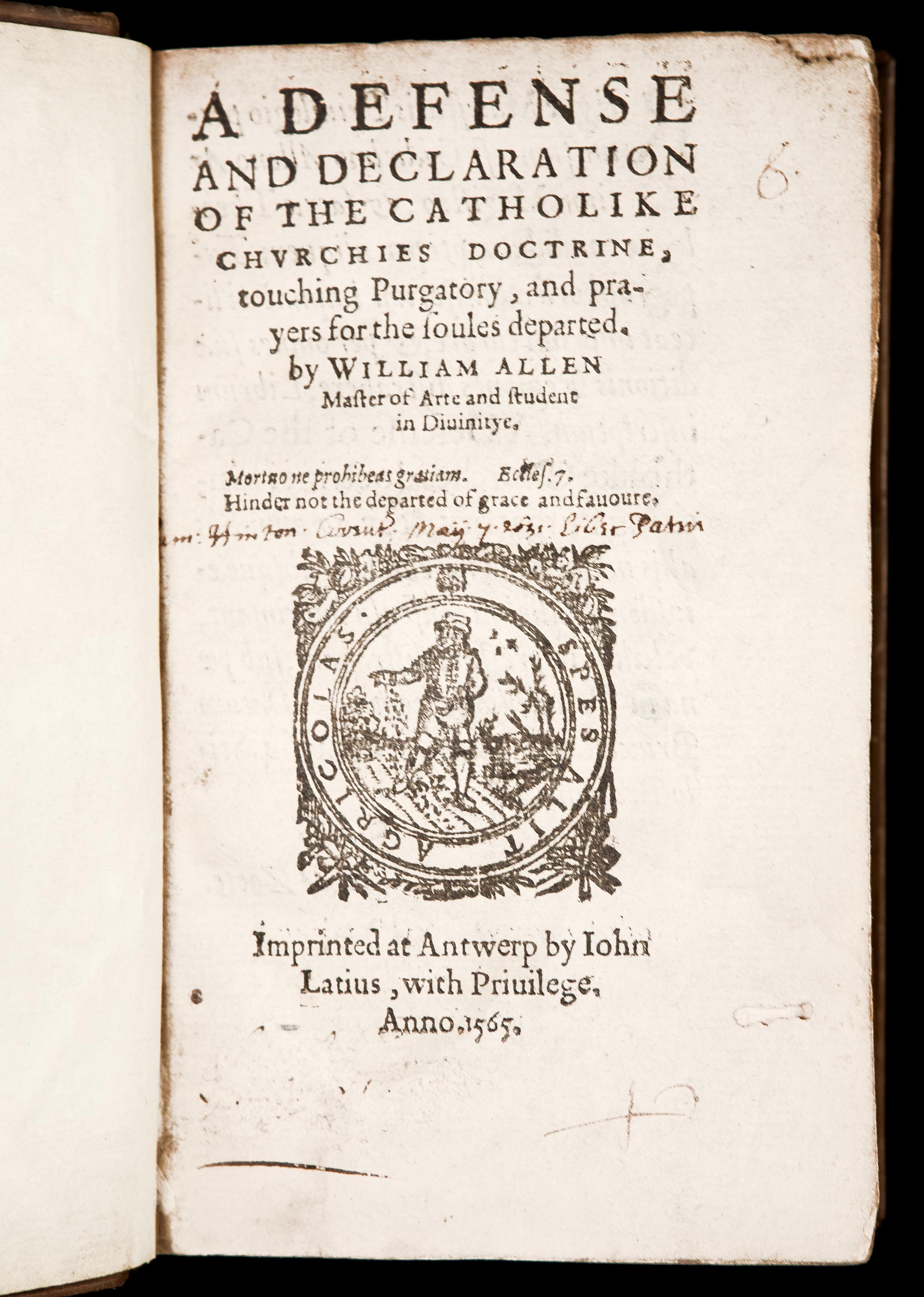
Printed in Antwerp by Hans de Laet, 1565.
Text in English.
RARE FIRST EDITION of this important defense of the Catholic doctrine of purgatory and the practice of praying for the dead, a belief system that was being actively suppressed in Protestant England at the time. Allen supports his arguments by extensive quotations from various scriptural and patristic sources.
Allen's influential apologetic work was "perhaps the most exhaustive, clear and learned exposition of the doctrine [of purgatory] that has ever been written" (M. Haile). It was an important contribution to the ongoing religious debates of the era, helping to sustain Catholic resistance in England.
William Allen (1532 – 1594) was Catholic cardinal and scholar who supervised the preparation of the famous Douai-Reims translation of the Bible into English and engaged in intrigues against the Protestant regime of Queen Elizabeth I. Born in Lancashire, England, and educated at Oxford, Allen became principal of St. Mary's Hall there in 1556. After the accession of Queen Elizabeth, he fell under suspicion for refusing to take an oath acknowledging the queen as head of the Church of England. Further government pressure caused him to leave England in 1565 for Mechelen (then in the Spanish Netherlands, now in Belgium), where he was ordained a priest. In 1568 Allen founded at Douai a seminary for training Englishmen as missionary priests. He was the president of and a lecturer at this seminary until 1585. The school gave its name to the influential Douai-Reims version of the Bible, translated into English under Allen's direction. In 1579 Allen helped found the English College in Rome, and the following year organized the first Jesuit missions to England, where Roman Catholic worship was prohibited. However, he soon despaired of restoring Catholicism to his native country by peaceful means, and called upon King Philip II of Spain to conquer England and assume the English throne. As a consequence, he was made a cardinal at Philip's request in 1587. But England's defeat of the Spanish Armada (1588) ended Allen's political intrigues. In 1584 he wrote a tract defending English Catholics from charges of treason by William Cecil, Lord Burghley. From 1585 until his death, Cardinal Allen lived in Rome at the English College.
This treatise on Purgatory was the first work Cardinal William Allen wrote and printed in exile in the Spanish Netherlands, after he left England in 1565.
"Allen was 29 years of age at the time of writing the book, and modestly refers to his 'lack of years', and judgment and knowledge. He adds that he had revised and enlarged the work 'during these last months'. Nothing in the great Elizabethan spoliation of the Church had been swept away with a more ruthless hand than the grants for obits and Masses for the dead established in well-nigh all the churches and monasteries in the land: the existence of Purgatory being denounced as a 'vain superstition'. [...] Allen justly contends that of all causes in the world 'this was wont to touch the very sore of heresy', and to procure him 'the hatred of such, whose love otherwise I could be content either to keep or win'. [...]
"The work itself is perhaps the most exhaustive, clear and learned exposition of the doctrine defended, that has ever been written, and as such it was republished towards the end of the 19th century [in 1886]. [...] The work is in two books, the first, divided into 13 short chapters, is devoted to the exposition of the doctrine of Purgatory; the second, in 17 chapters, treats 'of the Prayers and the ordinary relief, that the Church of Christ procureth for the Souls Departed.' Across the eloquent pages move, in stately procession, Allen's witnesses - the patriarchs and prophets of old, Isaiah Malachy, David, St. John in the Apocalypse; all the passages of holy writ in the Old Testament as in the New, which testify to the existence of that intermediate state wherein the souls of the departed are cleansed, 'yet so as by fire', of the last vestige of temporal punishment due to their sins. And round them throng the crowd of commentators - Augustine, Jerome, Cyprian, Athanasius, Gregory the Great, Chrysostom and Bede, with their testimony to the truth of the doctrine. [...] Allen arms himself with their shafts against the old heretical opinions revived by Luther, Calvin, and the others lately dead, or still living, like John Jewel, Bishop of Salisbury, whom he takes to task for the 'shallow and false reasoning' in his famous sermon at Paul's Cross in the Lent of 1561." (Martin Haile, An Elizabethan Cardinal: William Allen, p. 59-60)
"The most substantial contribution [to the debate on Purgatory] on the Catholic side was a 1565 work by the exile William Allen, A Defence and Declaration of the Catholike Churches Doctrine touching Purgatory.... Allen [who] later [...] attempt[ed] to orchestrate armed foreign intervention in England, but in the early years of Elizabeth's reign he seems to have been best known as the champion of purgatory. 'Alen, who wrote the late booke of Purgatory' heads the list of apostates due for arrest in a royal writ delivered to the High Sheriff of Lancashire in 1567, and a few years later William Fulke derisively termed him 'Master Allen of Purgatory'. His defence of purgatory and intercession was traditional in many ways [...] echoing More and Fisher with its evocation of poor souls crying out for assistance. But Allen [...] was noticeably cautious about advancing ghosts and visions as proofs for the doctrine..." (Peter Marshall, Beliefs and the Dead in Reformation England, p. 125)
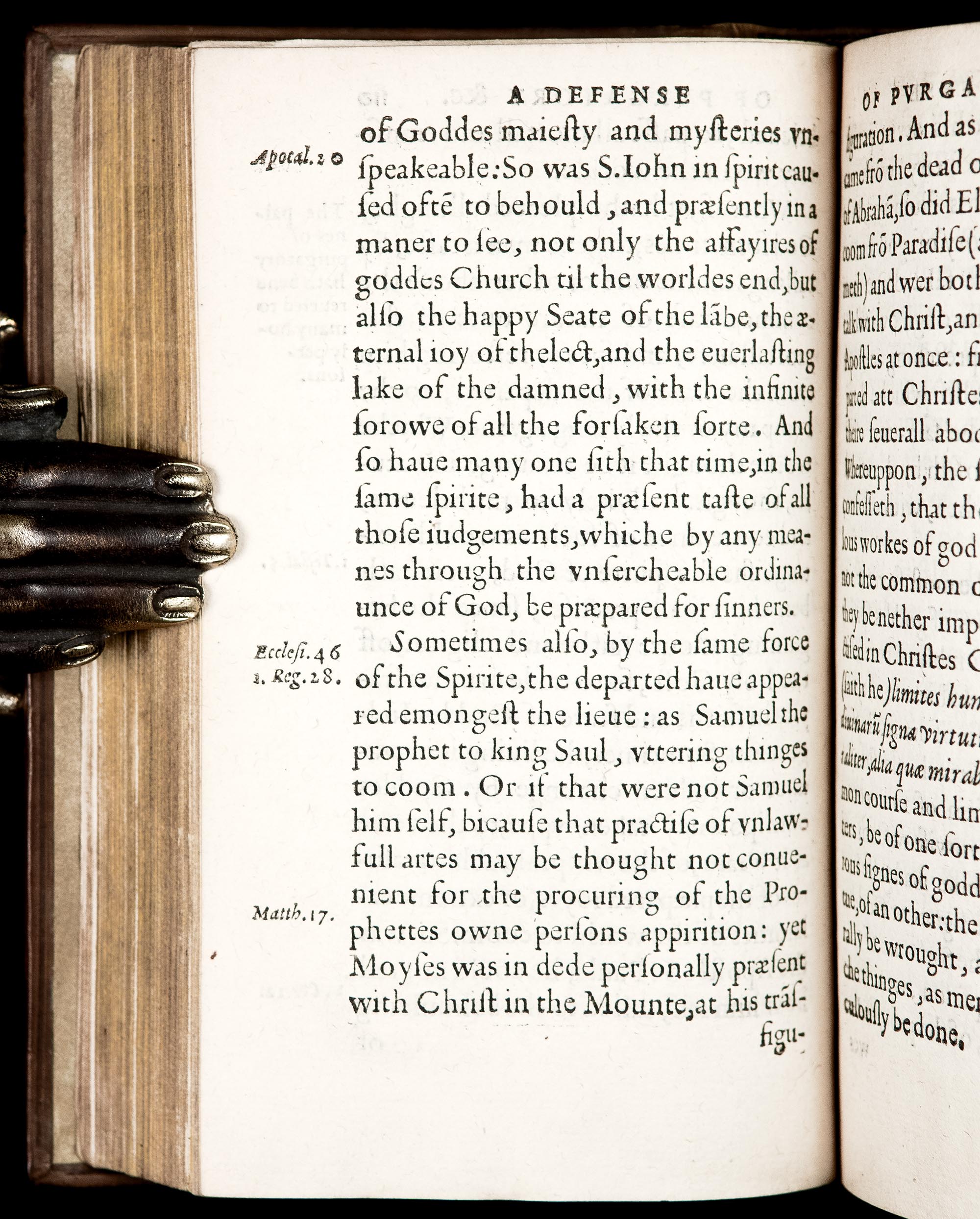
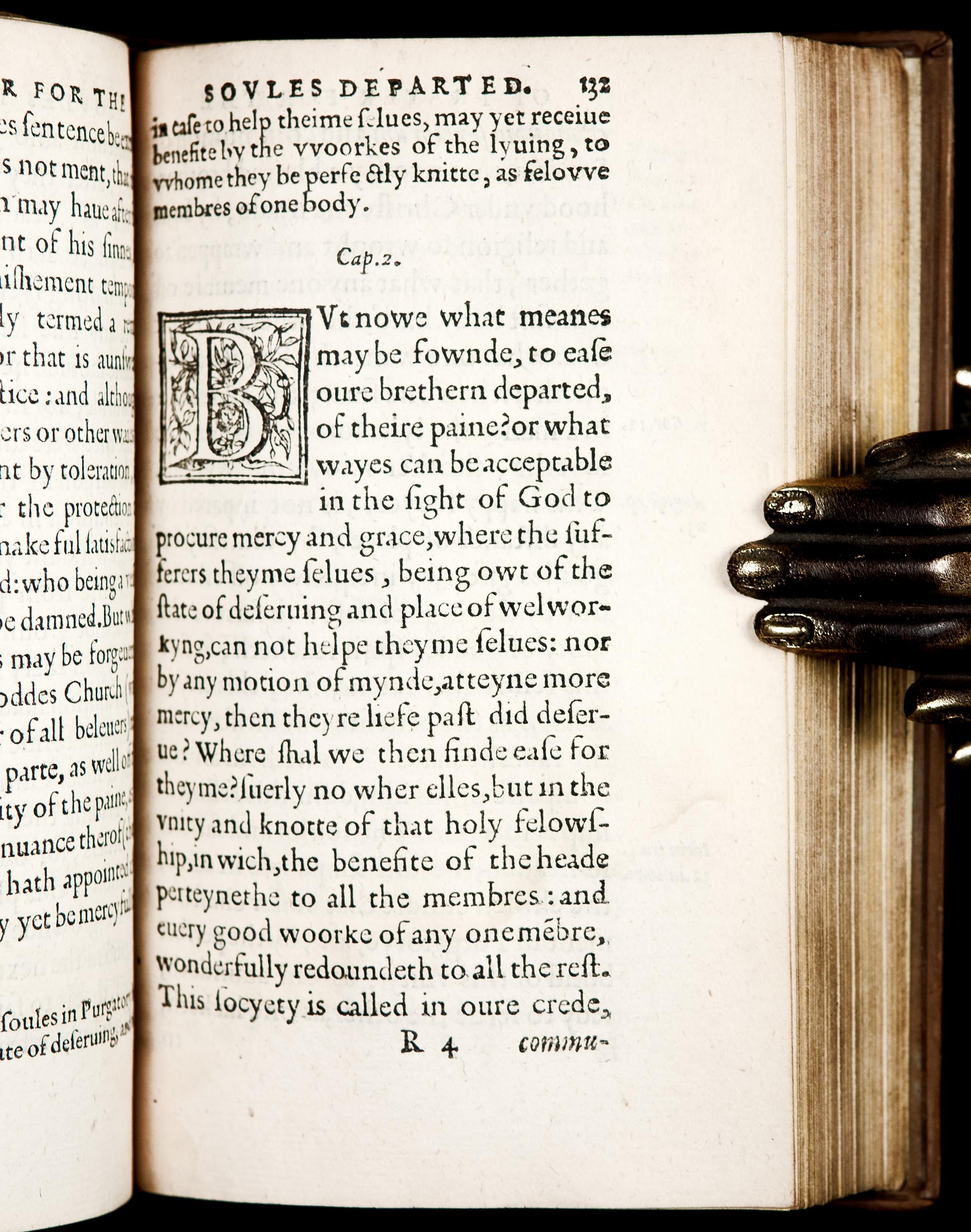
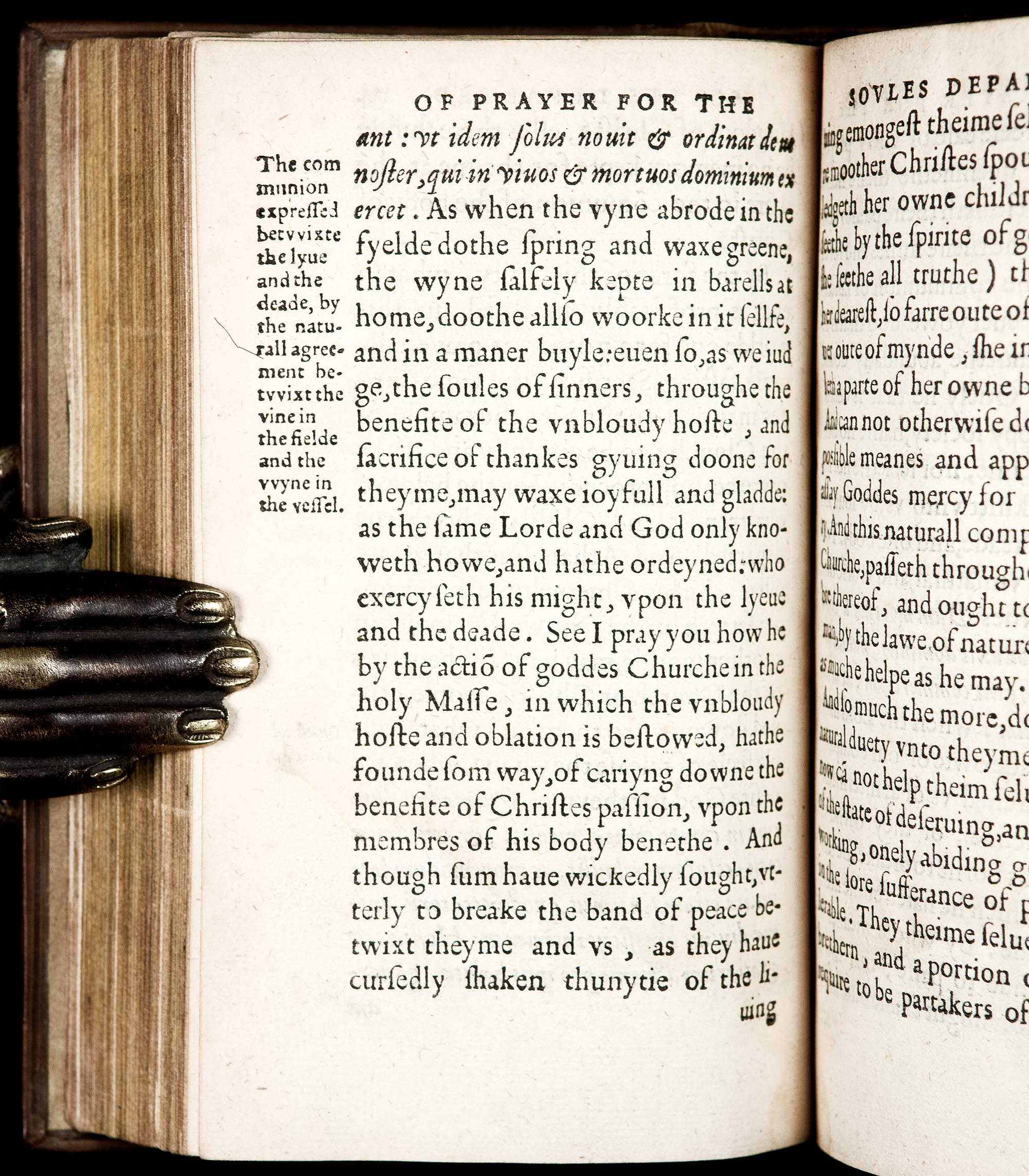
Allen's book on Purgatory includes a passionate discussion on unity between the living in the dead (see ff.132r-137r), as well as a discussion on the possibility of return from the dead with biblical examples of such events (see ff. 110v-111r).
Notably, unlike most of contemporary writings on the subject Allen brings up - albeit cautiously - the subject of ghosts.
"In 1565 the future cardinal William Allen referred somewhat cautiously to ghosts in his 'Defense and Declaration ... Touching Purgatory'. Allen observed that the spirits of the dead could sometimes return to earth [...]. While asserting the reality of such manifestations, however, he noted that they were 'rare and marvellous works of God', and was keen to distinguish them from the 'fantasies' of superstitious men and women. For Allen's Protestant contemporaries, of course, even these qualifications were unacceptable..." (Darren Oldridge, The Supernatural in Tudor and Stuart England, p. 109)
"William (later Cardinal) Allen made a few cautious and circumspect remarks on the subject of the returning dead in his Defense and Declaration of the Catholike Churches Doctrine touching Purgatory (1565). This was by no means the only Catholic work on the subject of purgatory, but the others left the issue of ghosts untouched. One reason for this was the warning in the [...] Council of Trent's decree concerning purgatory (1563) that 'those things that are not certain' should not be preached to the laity. [...]
"Allen declared that: 'Sometimes also, by the same force of the Spirite, the departed have appeared amongest the lieve', and went on to give the ghost of Samuel as an example, remarking in parenthesis that some may find it 'not convenient' that 'unlawfull artes' [i.e. necromancy] could raise a man's spirit. Moses, however, was certainly present at the transfiguration. Allen concluded:
'These rare and mervelous workes of god though they folow not the common order of nature, yet they be nether impossible, nor unpractised in Christes Churche [...] the common course and limites of manes matters, be of one sorte: and the woonderfull signes of goddes powre and vertue, of an other: the woorkes that naturally be wrought, are nothing like suche thinges, as mervailously and miraculously be done.' In other words, if God wanted to make ghosts appear, he could; although Allen's insistence on the reality of Moses' appearance on Mount Tabor made him rather more than an agnostic on ghosts. Allen's writings had a lasting influence on the Catholic community." (Francis Young, English Catholics and the Supernatural, 1553-1829, p.83)
ESTC S100096; Pollard & Redgrave, STC 371; Pettegree & Walsby, Netherlandish Books, 708.
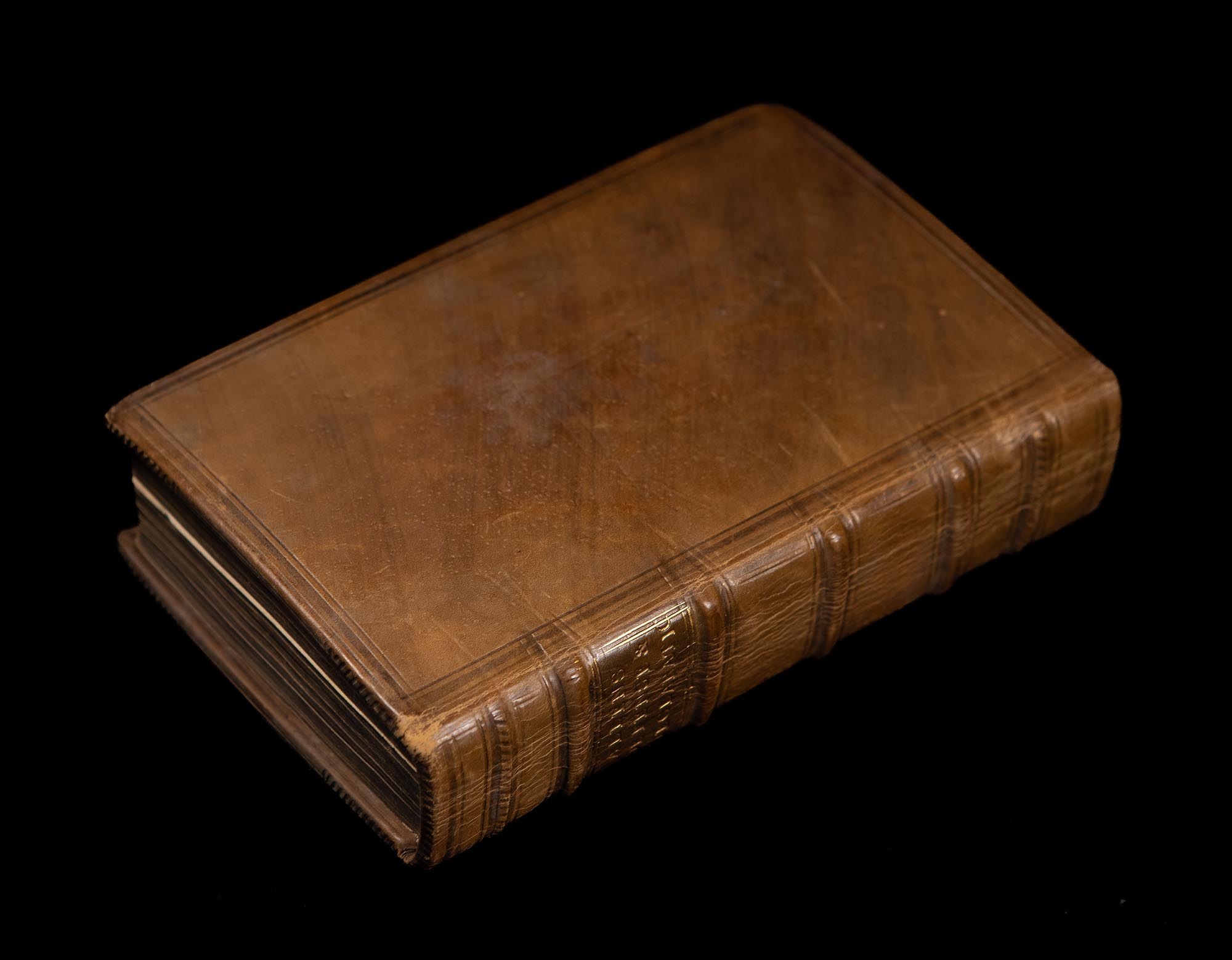
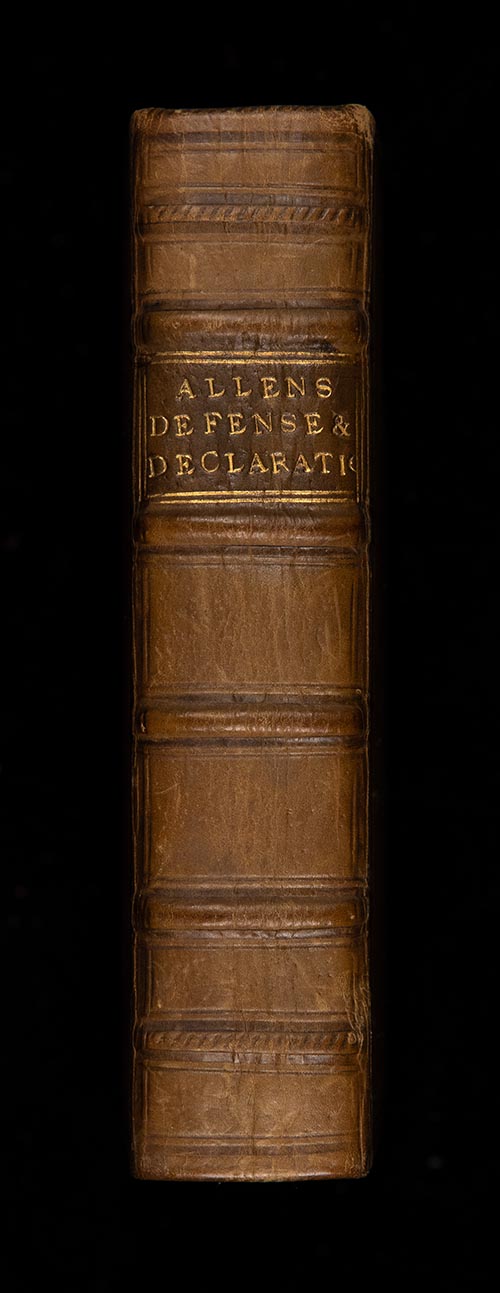
Octavo; textblock measures 15.5 cm x 9.5 cm; rebound in mid 20th-century full brown calf; ruled in blind; spine with raised bands; titled in gilt.
Foliation: 289, [6] leaves (forming 590 pages).
Signatures: A-Z8 Aa-Oo8 [-Oo8 blank].
COMPLETE.
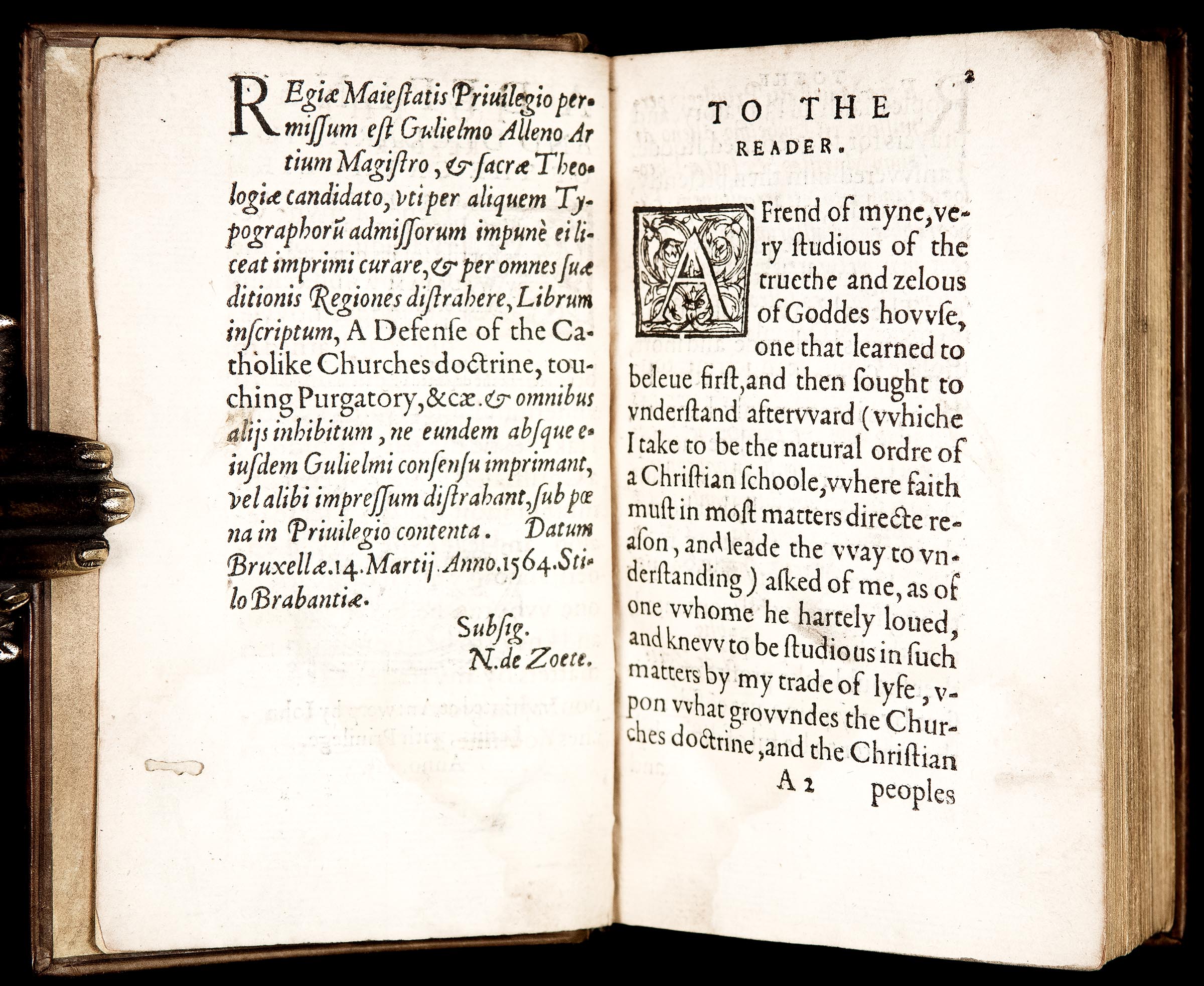
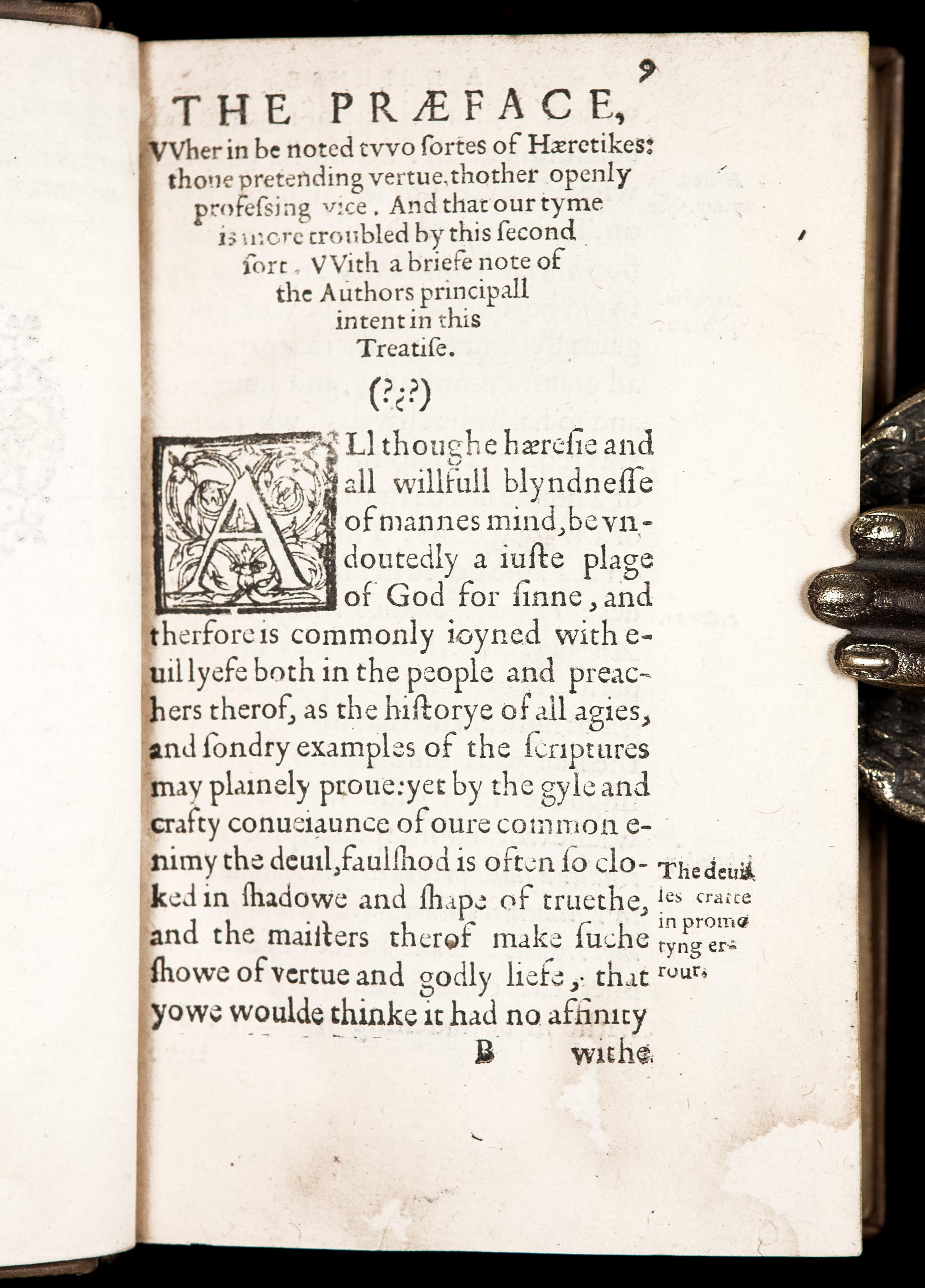
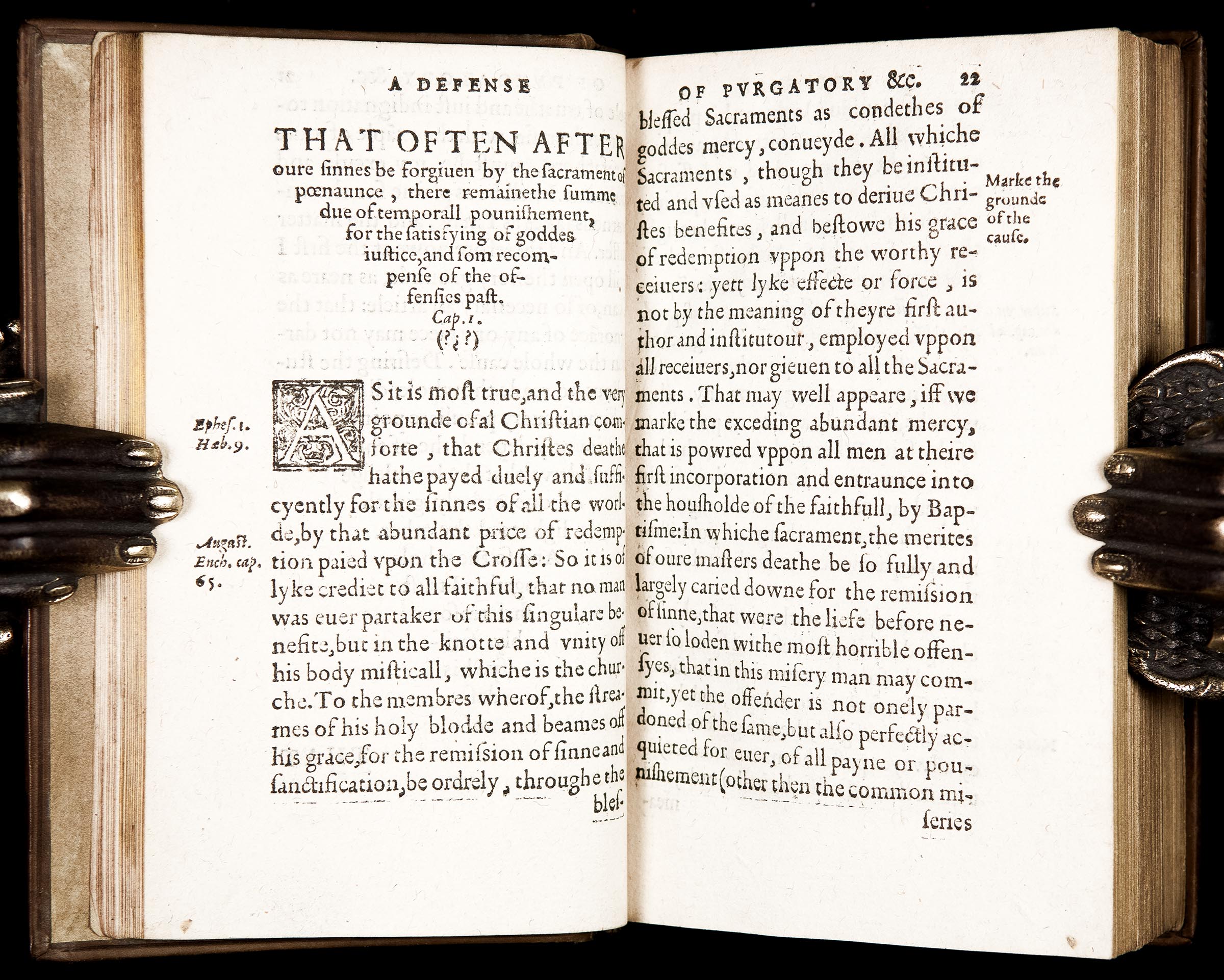
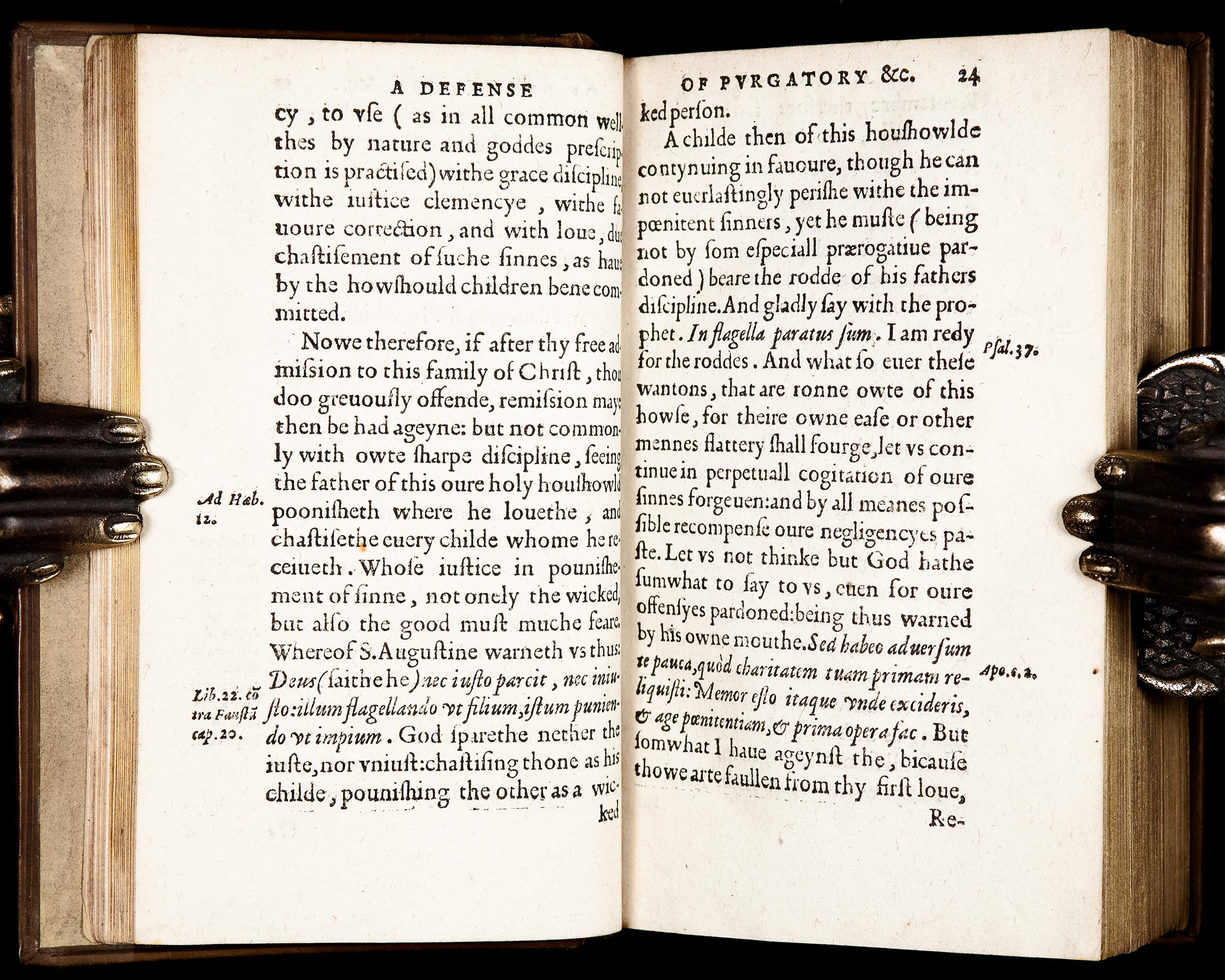
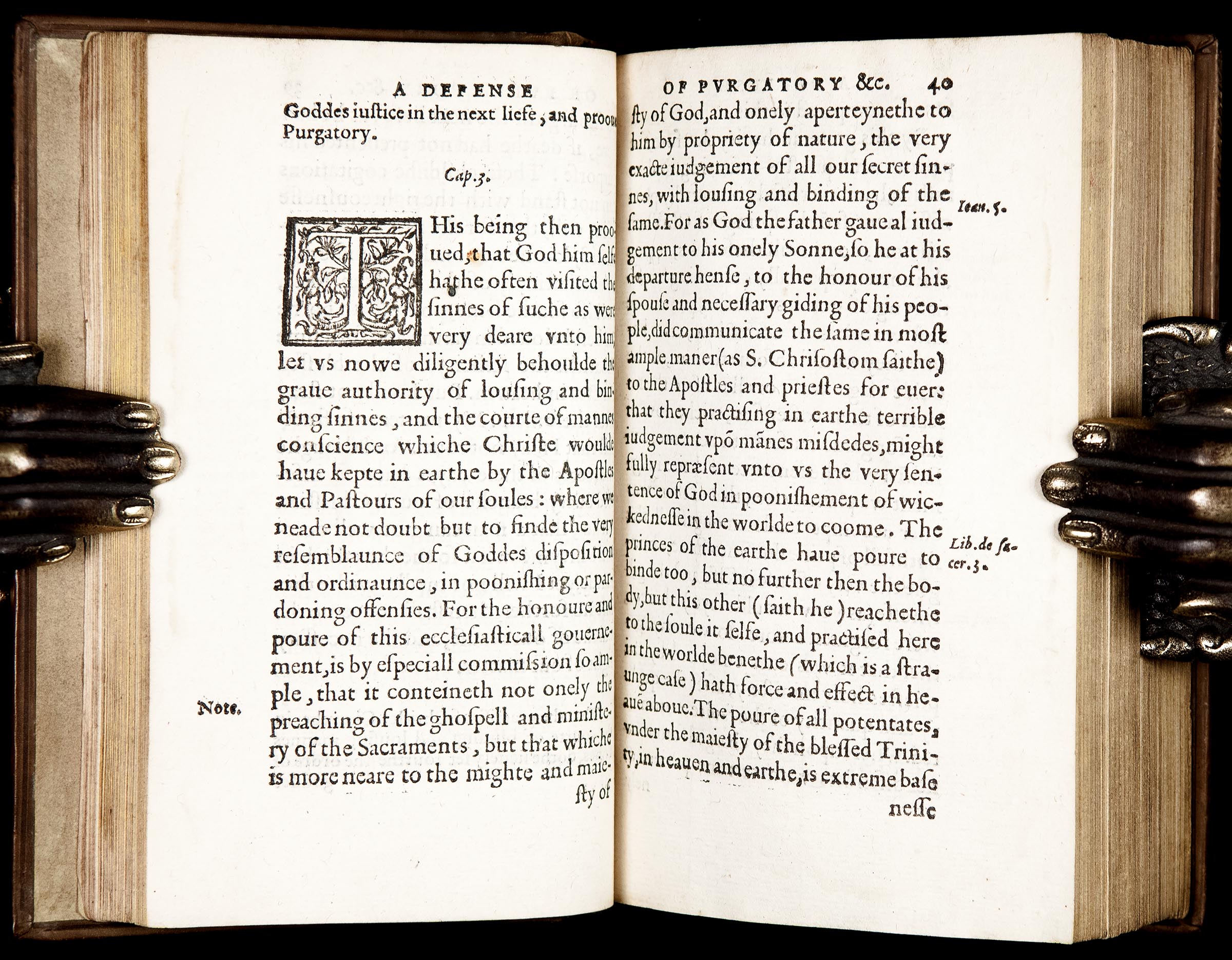
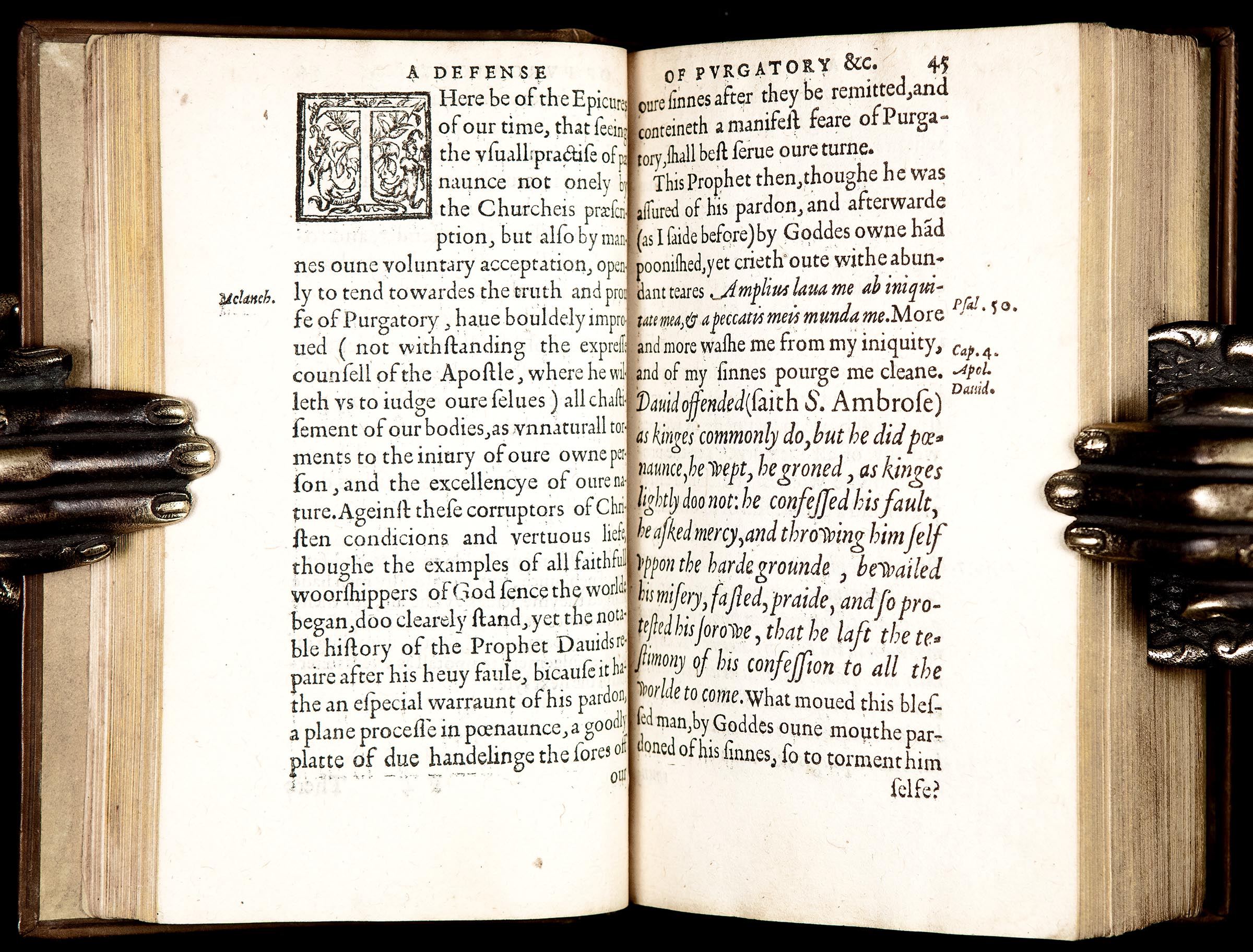
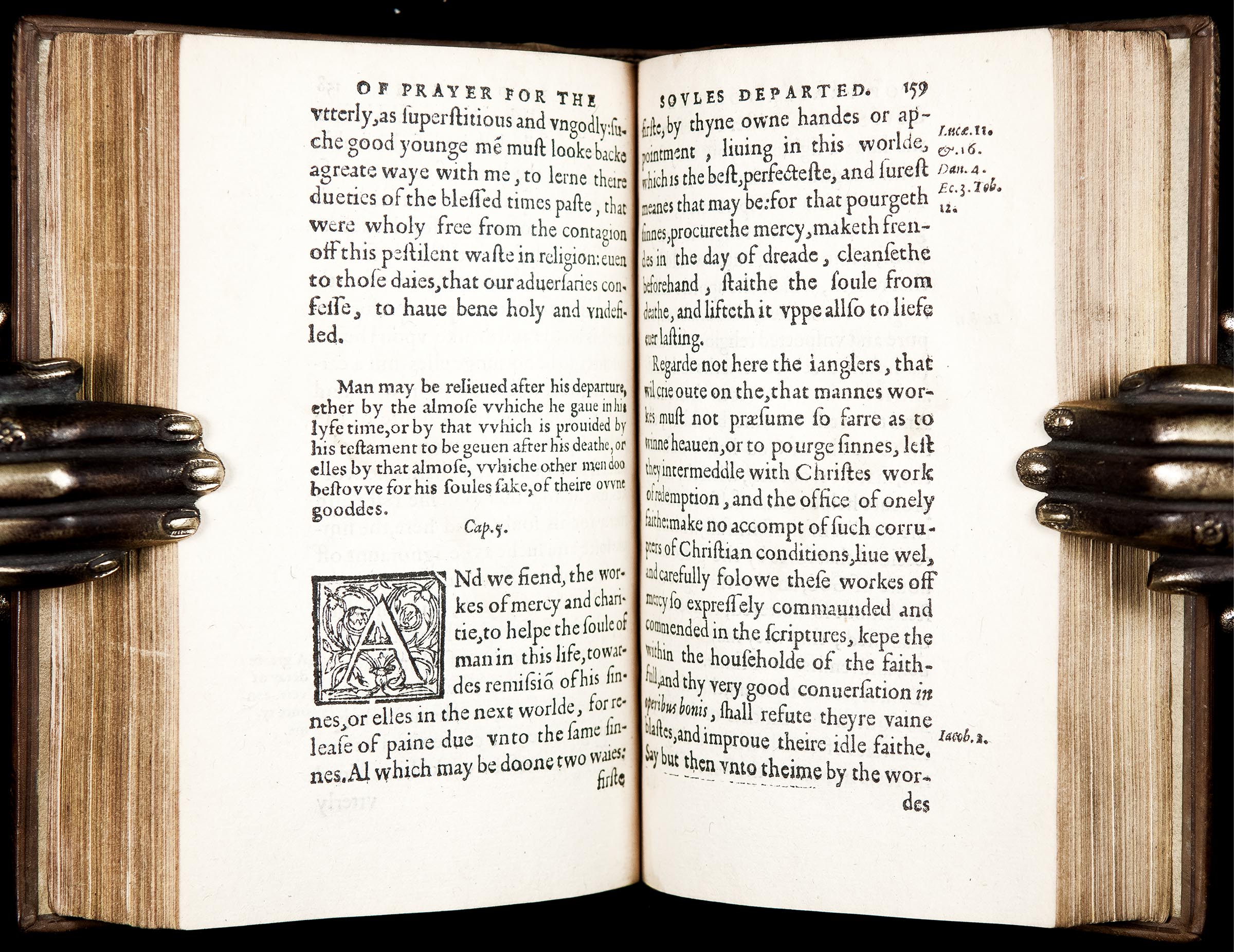
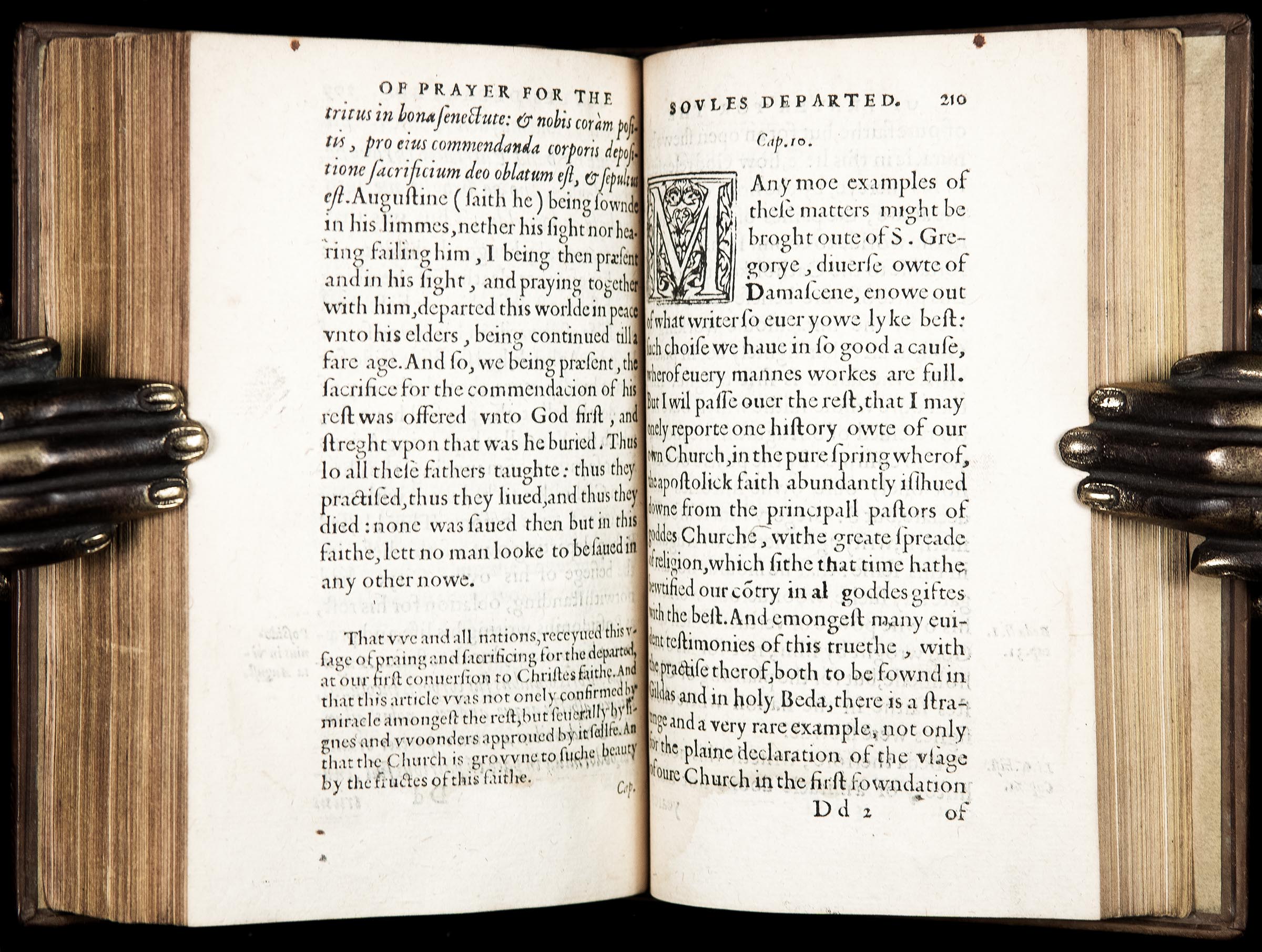
Text printed in roman letter, with marginal notes in small italic type.
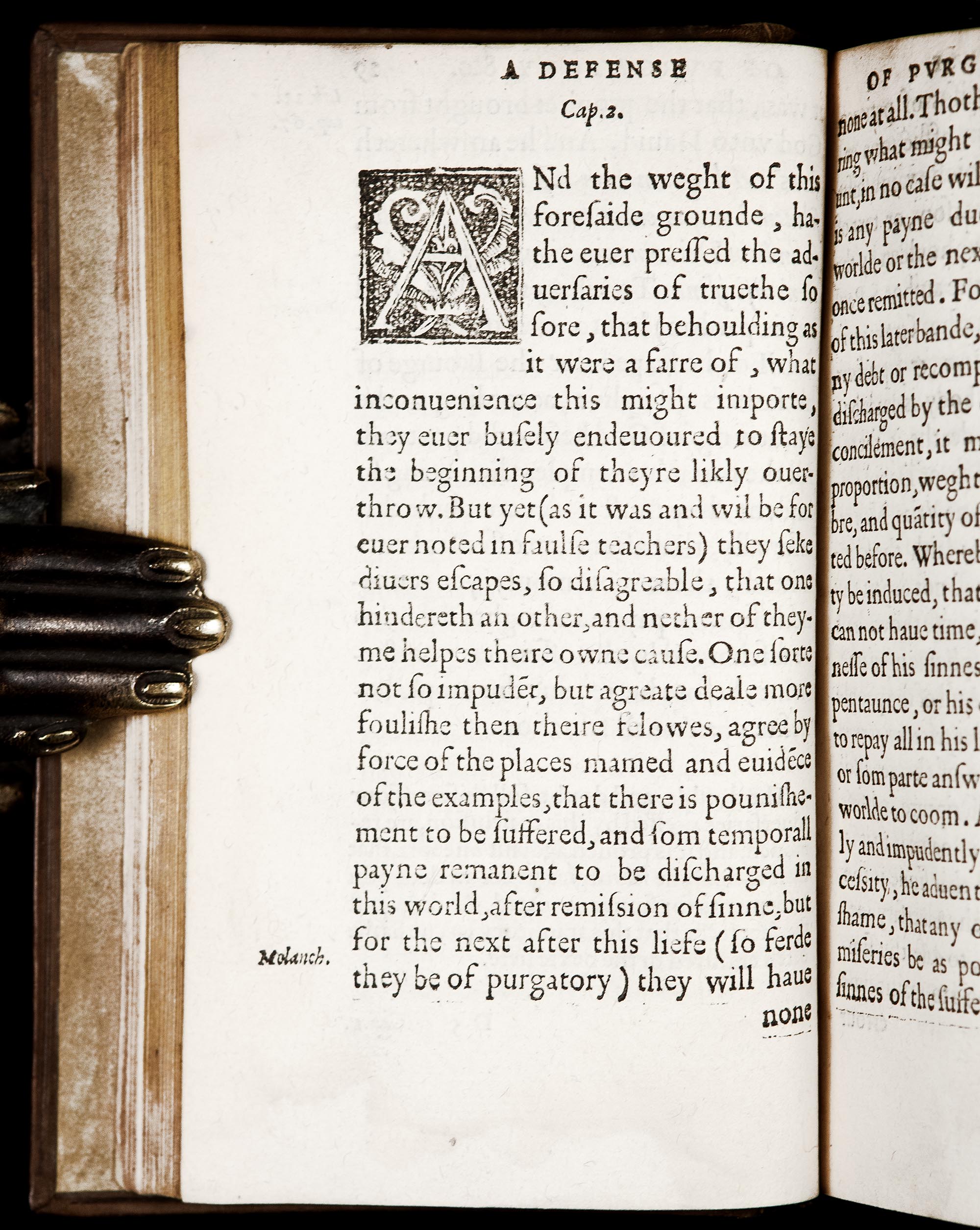
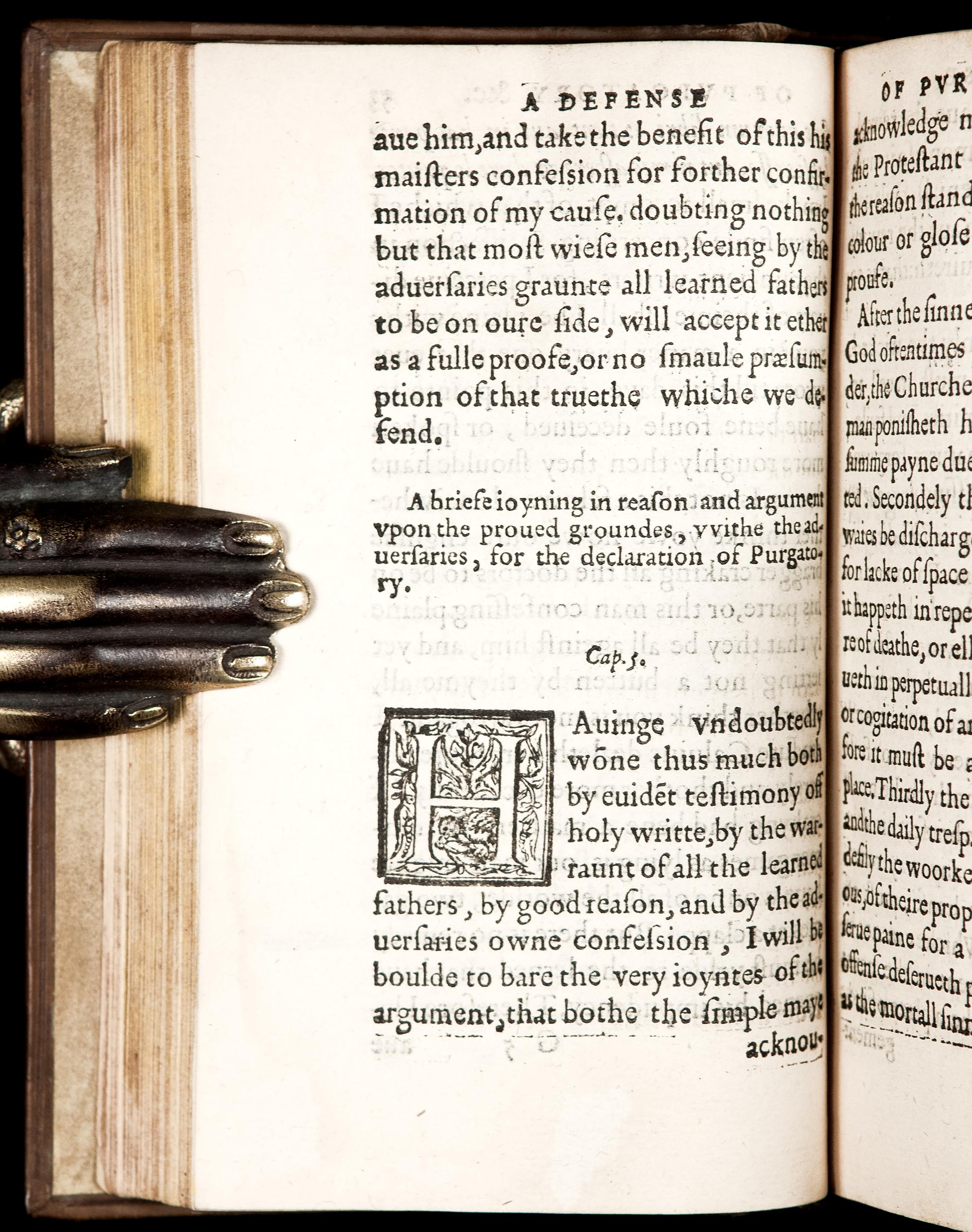
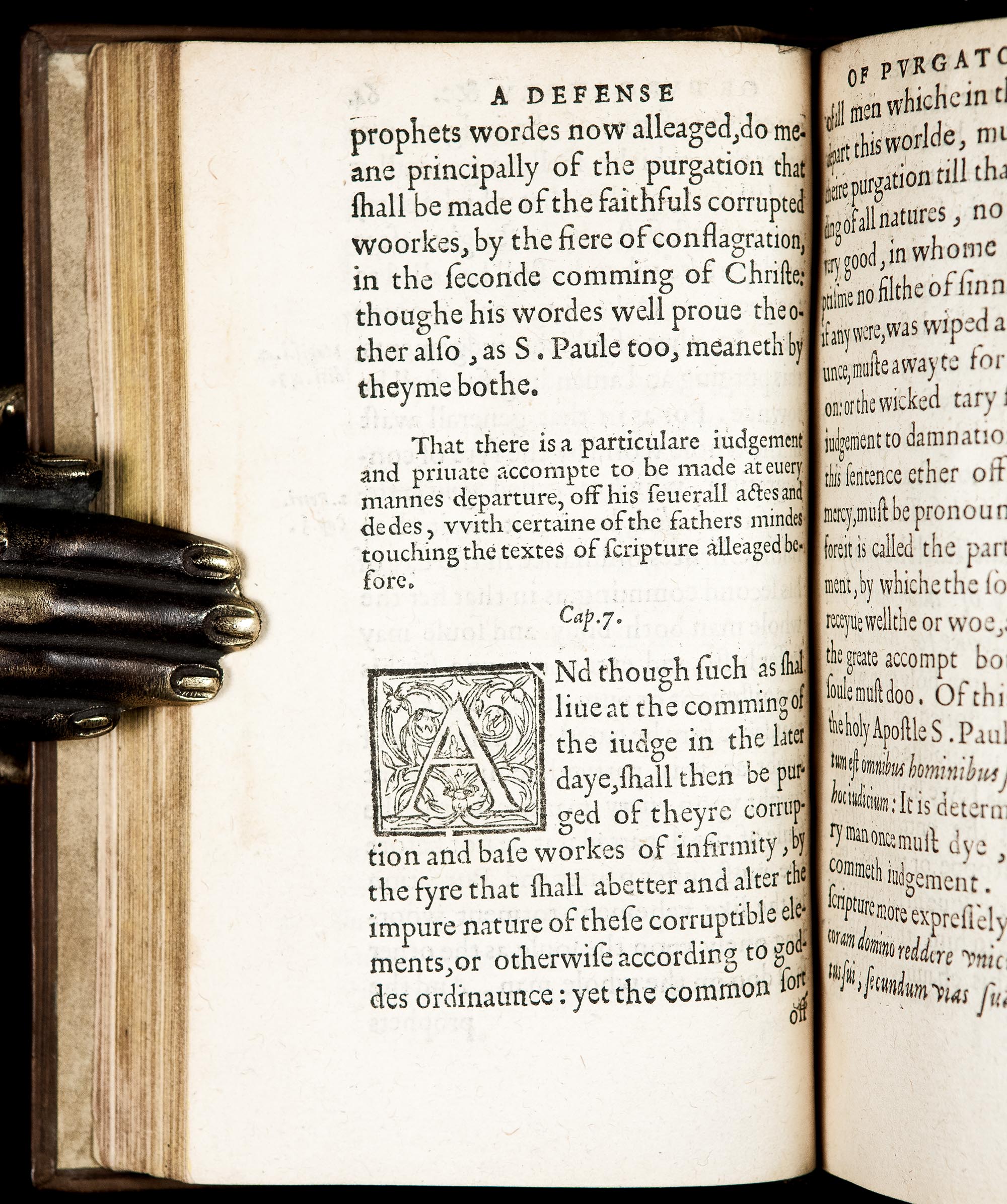
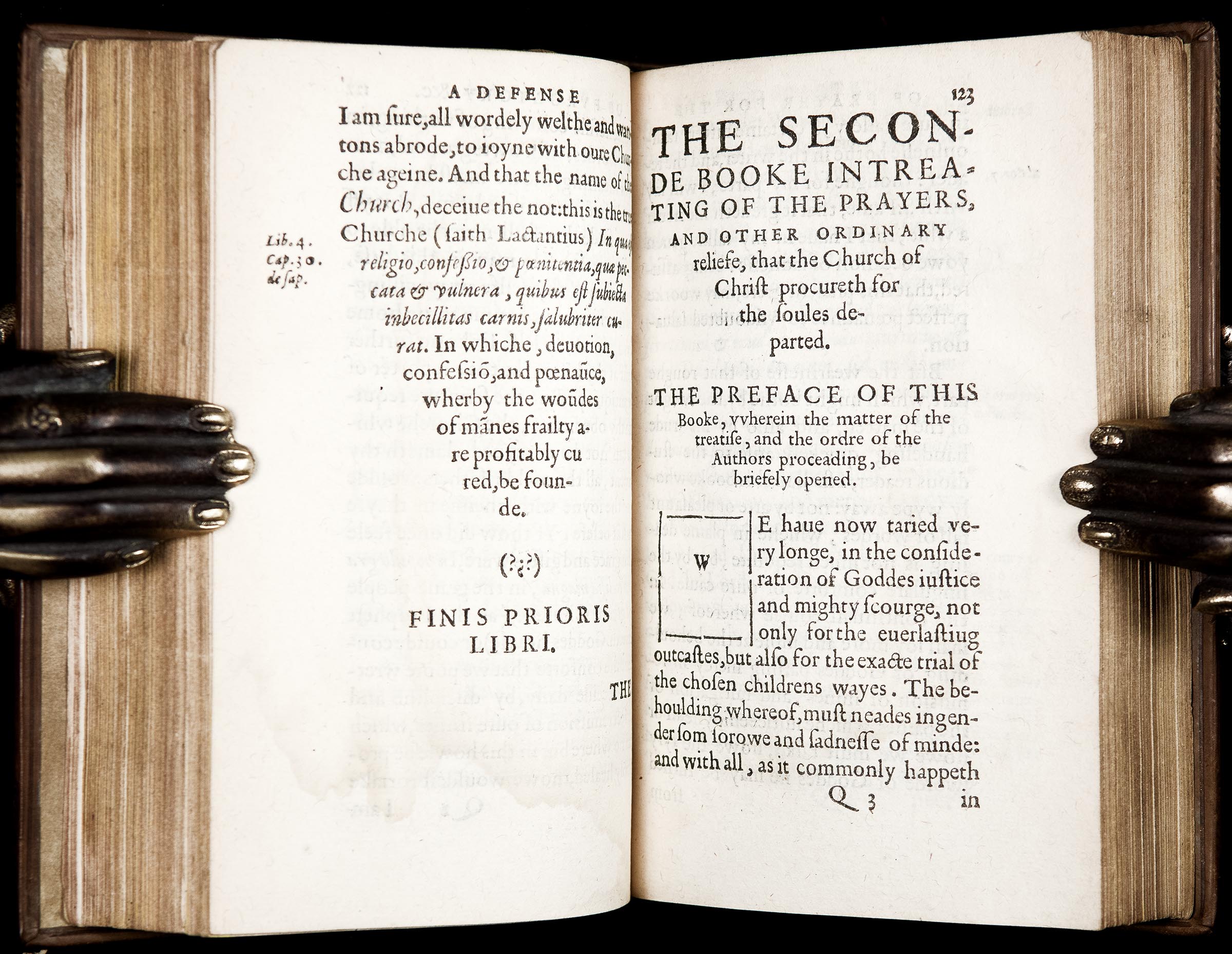
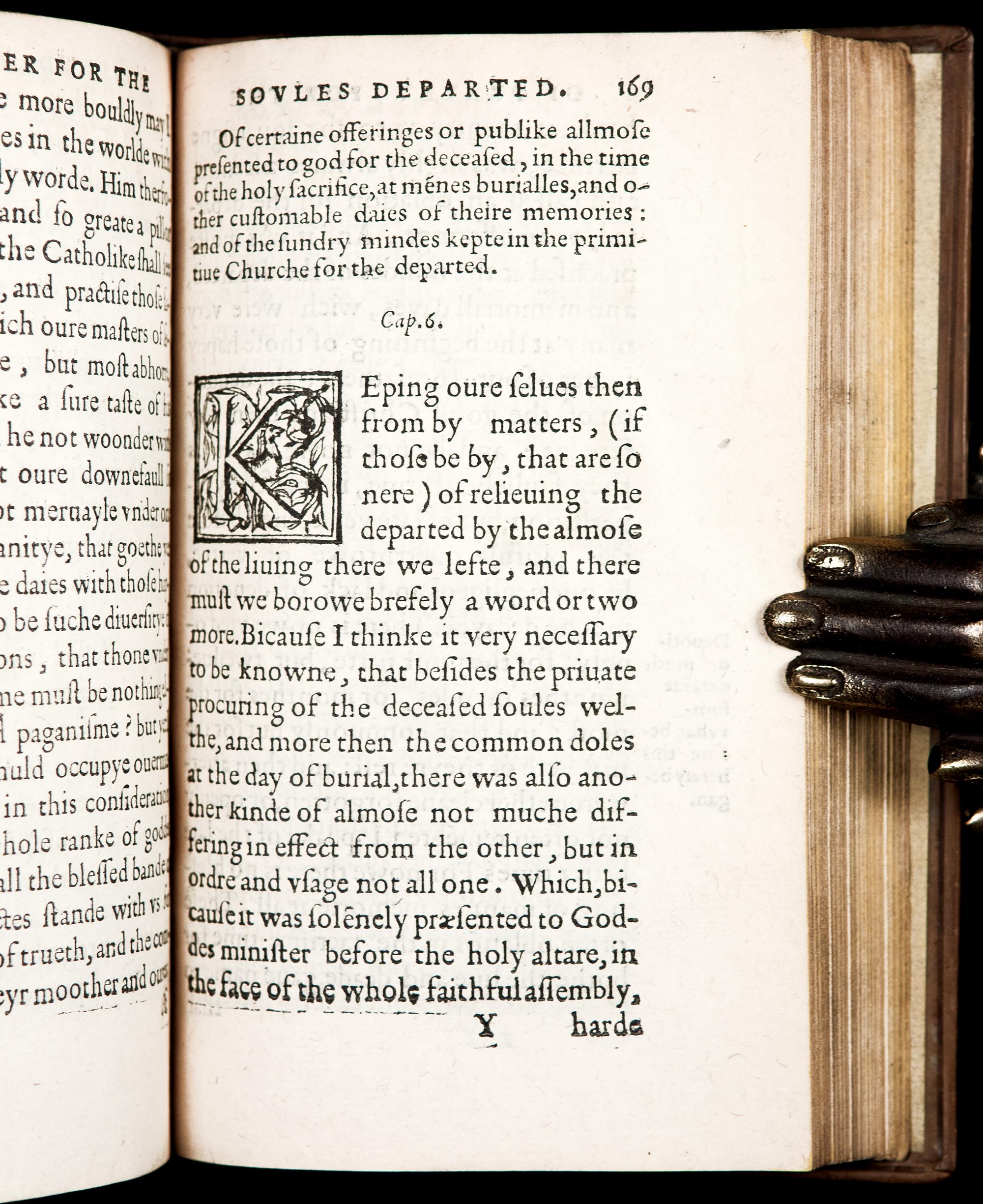
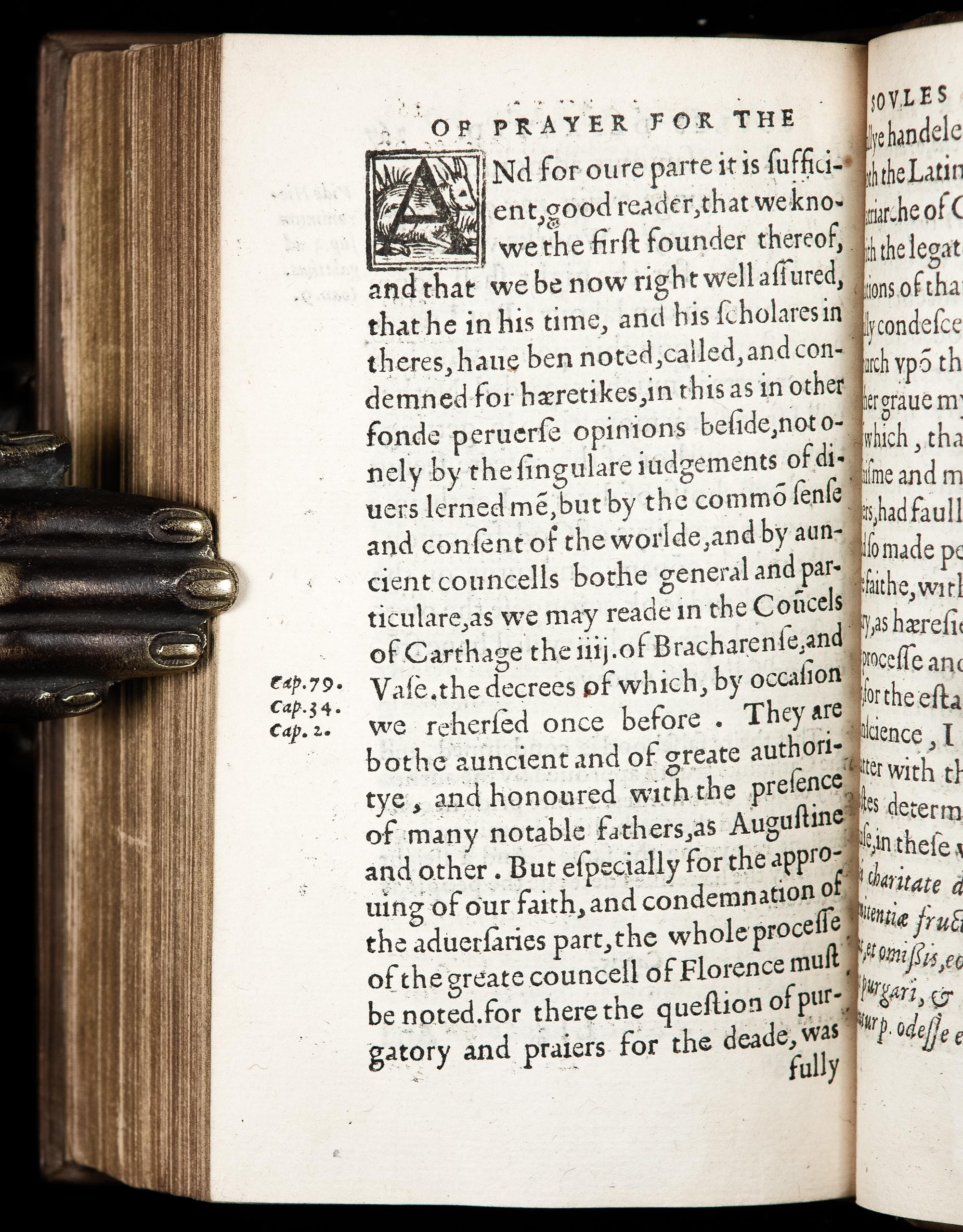
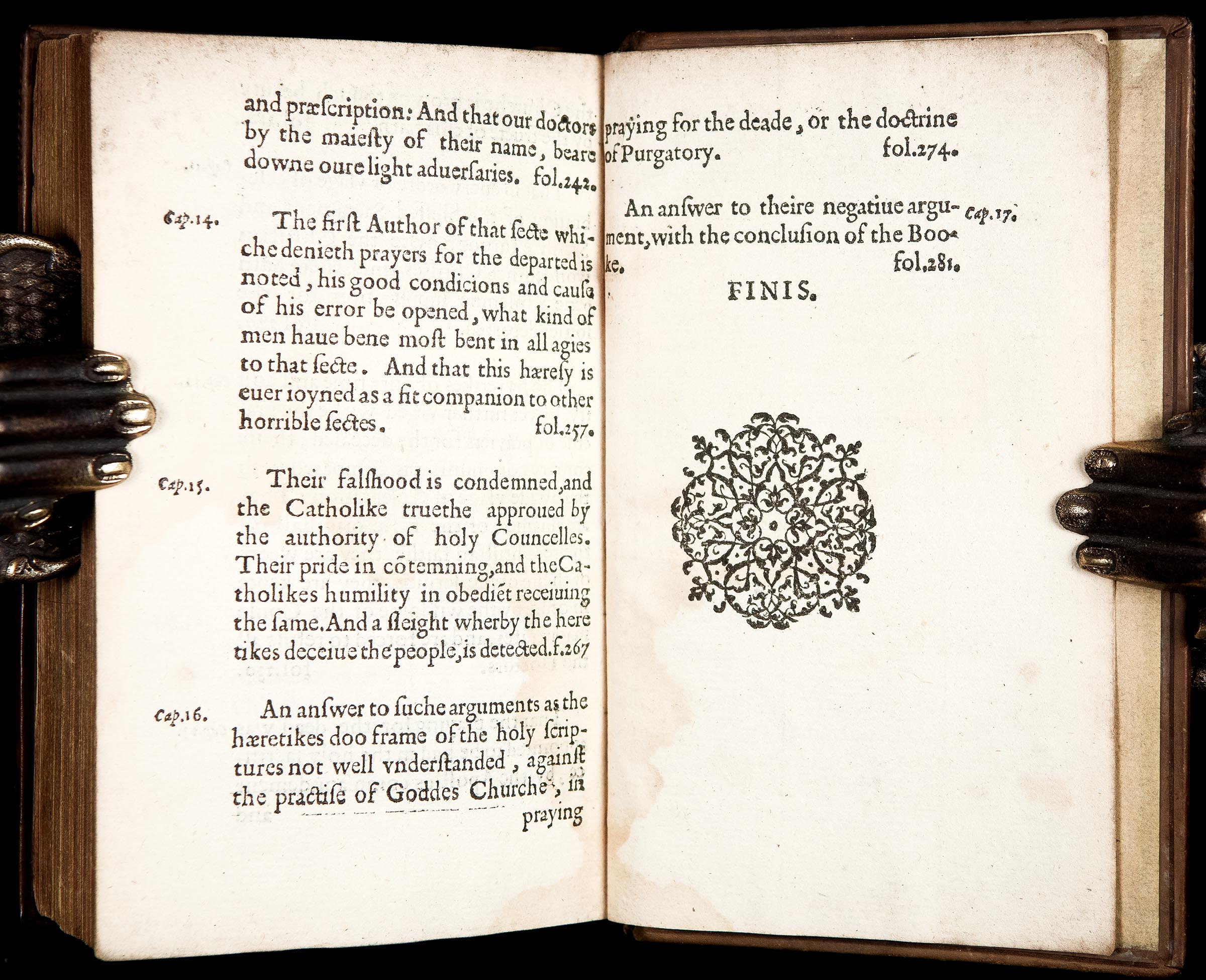
Title page with woodcut printer's device; a few large ornamental arabesque woodcut tail-pieces; many woodcut decorative initials. [On leaf Q3r a space for woodcut initial 'W' is left blank (except for printed guide letter), either through printer's error or perhaps intentionally (?), to be filled by hand in incunable style; all text printed properly.]
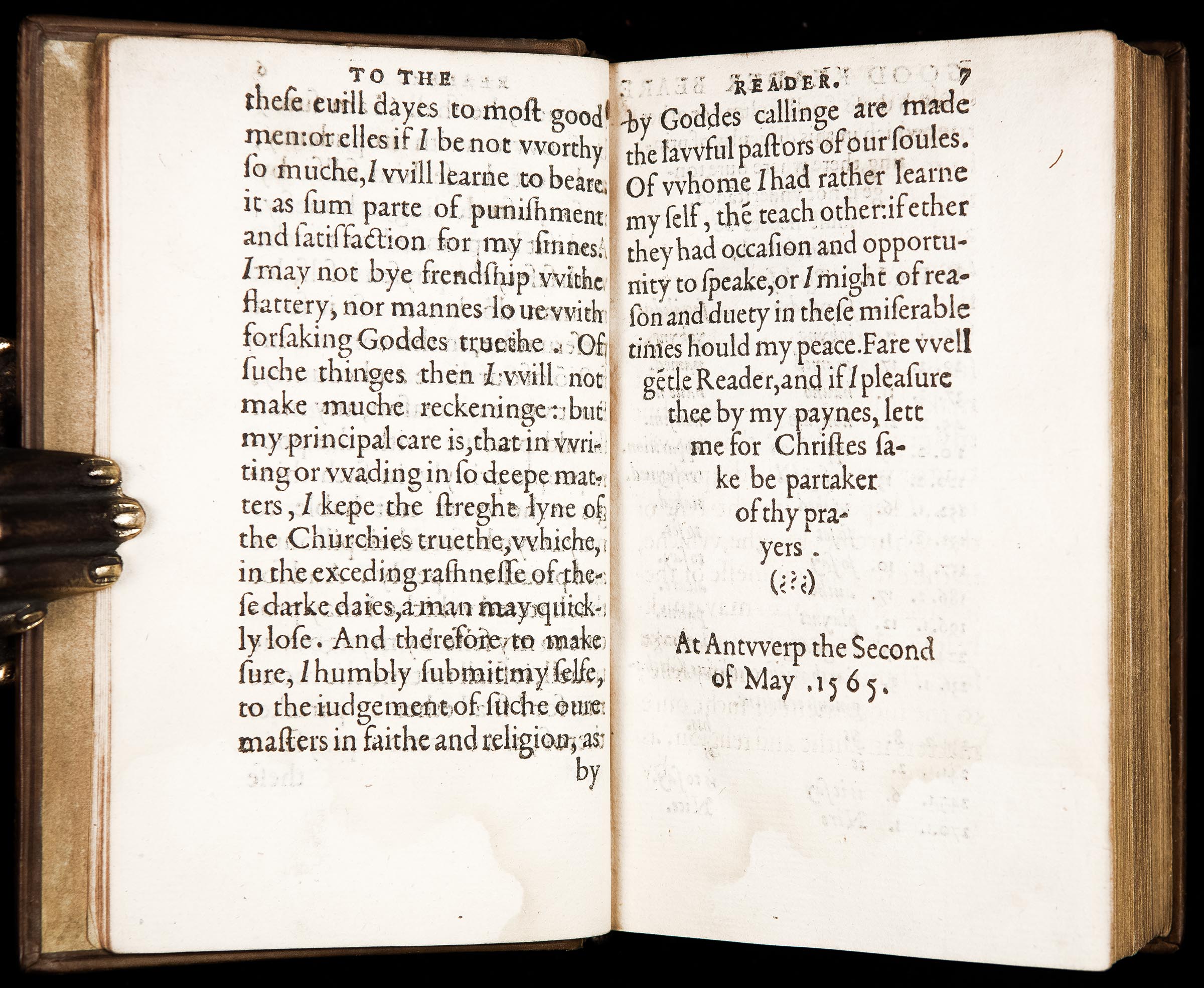
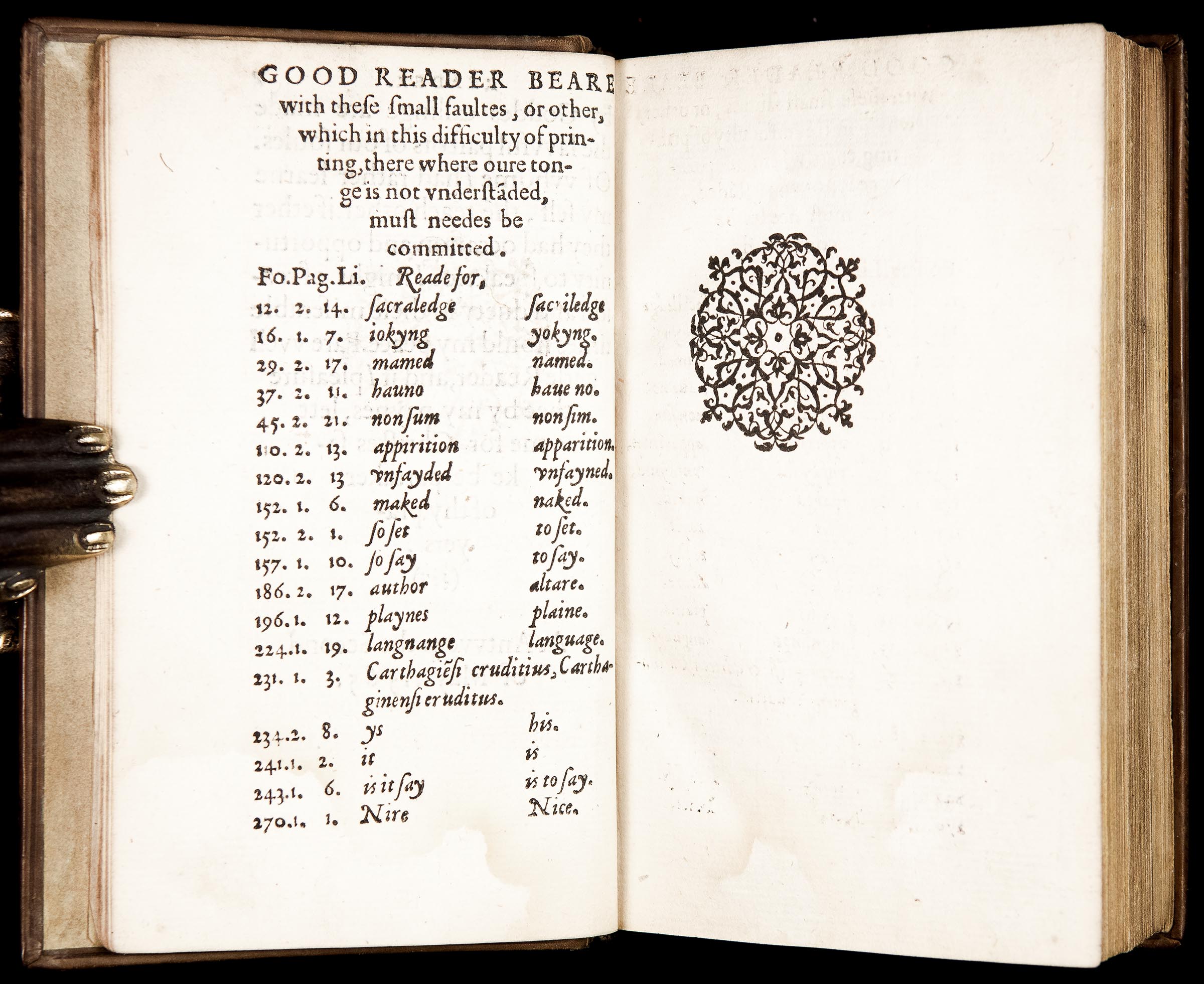
Preliminaries (quire A) comprise statement of royal printing privilege in Latin (dated Brussels, 14 March 1564) on verso of title page; author's address "To the Reader" dated Antwerp, May 2 1564 (on leaves A2r-7r); Errata (A7v); leaf A8 is blank except for a large woodcut tail-piece on verso.
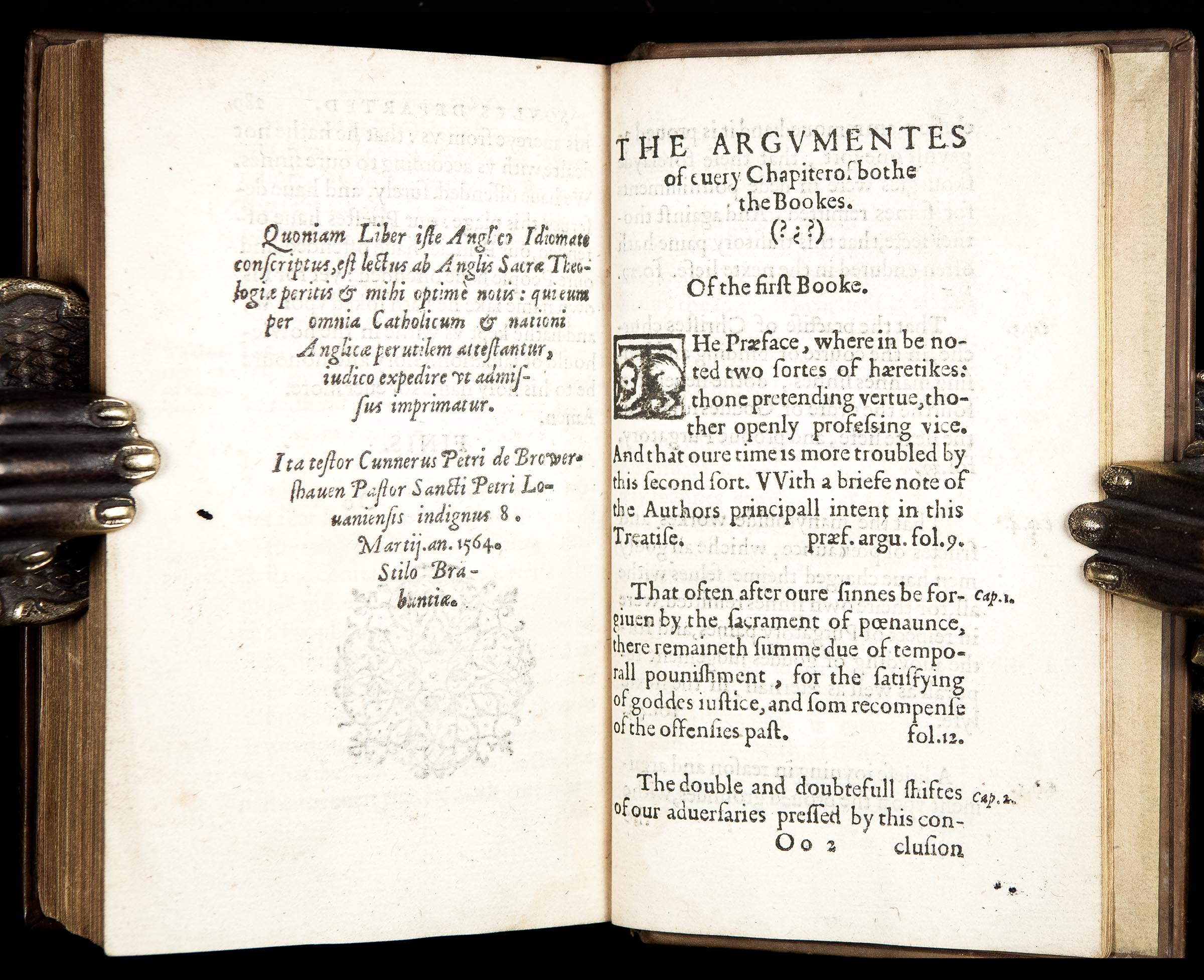
Included at the end of the volume are: an Imprimatur in Latin (permission to print) dated Louven, 8 March 1564 (on Oo1v), and short summaries of all the chapters "The Argumentes of every Chapiter of bothe the Bookes (on leaves Oo2r-7r, Oo7v blank).
An early 17th-century ownership inscription on title page: “sum Hinton (…?), Maij 7, 1631. Liber Patris”.
Very Good antiquarian condition. Complete. Binding slightly rubbed (with very minor discoloration to rear cover). Internally with occasional light marginal soiling; a few leaves with moderate water-staining (mostly to the preliminary quire A). Title page lightly browned, with a small marginal wormhole (in bottom fore-corner), and an early manuscript possession note. In all, a nice, solid, genuine, well-margined example of this rare first edition.